Hello fellow beekeepers and honeybee enthusiasts!
Have you been in your apiary lately? If so, you may have noticed that your sweet Spring honey bees have turned into feisty, defensive, Summer honey bees. Also, the dearth is here and with less pollen and nectar sources available, bees may very well begin robbing. At this point in the season, you are likely noticing an uptick in hive pests. Now is the time to test and treat for Varroa mites. Also, watch for small hive beetles and wax moths.
RPBBA Calendar of Events for August
📅 Monday, Aug 14th – RPBBA Meeting @ 7pm at the Rockwood Park Nature Center
📅 Monday, Aug 21th – Study Group @ 7pm at the Rockwood Park Nature Center
🐝 Saturday, Aug 19th – National Honey Bee Day
August Meeting
Our meeting this month will focus on Varroa mites. RPBBA member John Davis will lead the presentation, which is sure to provide new and engaging information! Doors open at 6:30pm for socializing, sharing about your hives and asking general questions. The meeting starts at 7pm. Add to Google Calendar
National Honey Bee Day
Saturday, August 19th is National Honey Bee Day 2022 in the United States. National Honey Bee Day (formerly National Honey Bee Awareness Day) is an opportunity to recognize the contribution of honeybees to our collective lives and to draw attention to the need to protect this critical species. National Honey Bee Day also pays homage to beekeepers, whose labors ensure there are well-managed, healthy bees to pollinate crops.
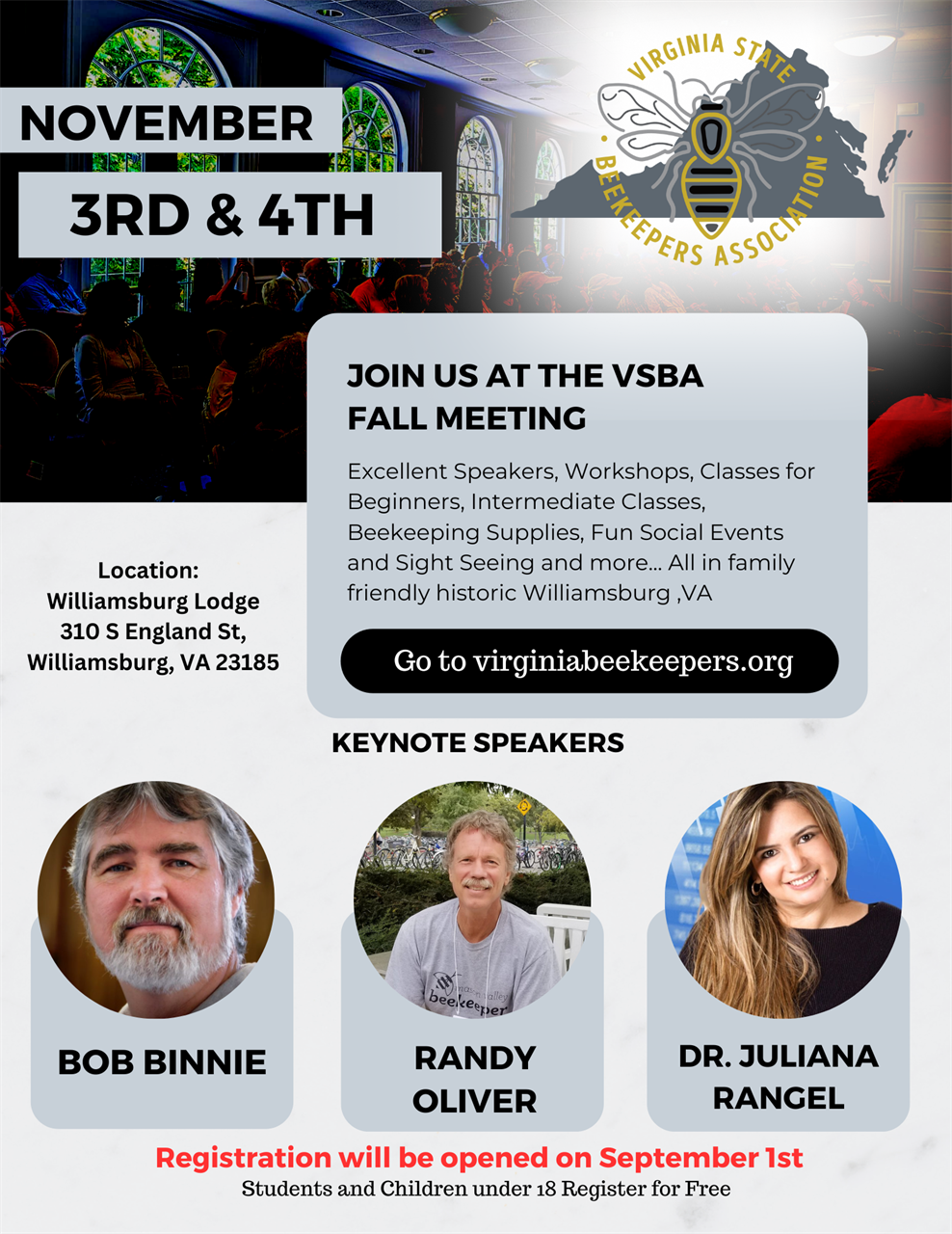
Virginia State Beekeepers Association (VSBA)
Beekeepers in the News
Our member, Hollee Freeman was featured on CBS6 this month for her efforts to expand the world of beekeeping, particularly for BIPOC folks through her organization, City Bees RVA. She has increased the number of BIPOC beekeepers (and those interested in beekeeping) in the Metro Richmond region from 4 to 17 in one year!
Feel free to watch the story here.
Meet Your Friendly Neighborhood Beekeeper: Jimmy Rheinhart

Q: How long have you been a beekeeper and how many hives do you manage?
A: I have been a beekeeper since 2020, starting with 2 hives and currently managing 4 hives. I am building 2 Long Langstroth Hives to keep and manage in West Virginia next spring.
Q: What inspired you to become a beekeeper?
A: During Covid, my wife and I saw a documentary about honeybees and pollinators. That started my research into becoming a backyard beekeeper.
Q: What is the best thing about beekeeping for you?
A: I enjoy so many aspects of beekeeping, it’s hard to narrow it down to just one. I would say, sharing the importance of honeybees and other pollinators with the younger generation. For some reason, I get a lot of questions when people find out I am a beekeeper.
Q: What’s challenging about beekeeping for you?
A: For me, the challenge is keeping the hives from swarming, while trying to keep only four hives. Another challenge, like many beekeepers, it’s keeping the bees alive and thriving throughout the dearth and winter.
Q: What fun, surprising story would you like to share?
A: Catching my “first swarm ever” this year was a very memorable experience. I was working on a car in my driveway when I heard a massive amount of bees flying. I watched them fly to my swarm trap right in my backyard and stood in the middle of the swarm without a bee jacket or veil. I was amazed at what was happening all around me. I sat in my apiary chair and took it all in. Nature is amazing.
Q: In what ways do you feel like you are making an impact on the environment and/or the community?
A: My neighbors have said their backyard gardens have produced more in the past couple of years, than they ever have before. A few of them have also quit using chemical pesticides and put out more habitat for local pollinators. As for the environment, If we all do a little, a lot can get done.
Bee Vocabulary – bearding
We experienced a really hot & humid July and chances are- your bees were bearding. Bearding is when bees congregate on the front of the hive, hang from the bottom board or cluster around the entrance. They do this to provide increased ventilation and regulate the temperature for the bees on the inside. For healthy brood development, the temperature inside the hive needs to be kept between 90-97 degrees F. If there are too many bees inside the hive, fanning may not be enough–so they scoot on outside to decrease the heat load.
When we have high temperatures and high humidity, bearding is likely to occur. Overcrowding, poor ventilation in the hive can also cause the hive to overheat. Also, in a dearth, there are few nectar-producing flowers available so the bees hang outside on the porch-just like people!
Bearding is normal bee behavior and the bees should be left alone when they are cooling down their home. The bees know what they are doing.
Info adapted from https://bestbees.com/ Talk to your Rockwood mentor/friend for more detailed information 🙂
This month in the Hive (August)
The colony’s brood growth rate is slowing down. Drones are still around, but the workers will soon lose interest in feeding them. Outside activity slows down as the nectar flow decreases and eventually stops. Much of the flight activity is water-gathering, pollen collection, and orientation of new bees. On hot evenings and nights, the bees may beard, making them especially vulnerable to skunks.
Cucumbers, melons, carrots, and pumpkins need honeybees for pollination this month. Net honey production is unlikely in August due to heat and drought. The hive may consume 10 pounds of stored honey or syrup during a dry August.
Watch for a failing queen, especially a queen that is more than 1 year of age. Egg laying should continue at the rate of 400-500 eggs per day, and the brood nest should be at least 14 inches across. Watch for wasps and hornets attacking the hives to steal away live bees for the purpose of feeding their brood. If you have harvested honey, this is the time to examine the hive to make sure there is at least 10 pounds of capped honey-the bees will need this to overwinter.
Watch out for robbing. If you tend to re-queen- this is a good month (or in early September) to do it. Watch for wax moths and small hive beetles; ruthlessly combine hives that are too weak to defend against them now. Take losses now, rather than in the winter.
Many chemical mite treatments should be applied in early August, if they are going to be used. Carefully read the instructions and consider the temperature forecast before any treatment is applied, however. Honeybees may not be able to tolerate harsh chemical treatments combined with high temperatures. However, it is also not wise to allow Varroa mites to parasitize the bees that you hope will carry the hive into early winter.
The bees that are born in August will have to carry the hive through the early winter. Make certain that the hive has enough pollen and honey to generously feed the new brood. Skinny August bees will not make it to February.
[Adapted From https://buzzwordhoney.com/wp-content/uploads/2012/12/Northern-Virginia-Honeybee-Annual-Cycle.pdf]
What’s in Bloom (according to https://www.plantnovanatives.org/bloom-time-table)
Coral honeysuckle, Purple passion flower, Butterfly weed, Wild bergamot, Ox-eye sunflower, Swamp Milkweed, Culver’s root, Orange cornflower, New York ironweed, Buttonbush, Boneset, Blue lobelia, Joe-pye-weed, Early goldenrod, Wingstem, Obedient Plant, New England Aster
Final Word
If you are not a member of RPBBA, we encourage you to join and be active. Our club operates 100% on volunteers. There is a constant flow of activities within the club and a lot of work to be done to share the importance of honeybees. You can be as active as your schedule allows. Check out our website for more information.
We are always looking for ways to improve communications in the club. If you have any ideas or suggestions, please let me know. If you do a cool thing, email me at the RPBBA email address so I can put it in the newsletter.
I hope to see you at the meeting 7pm, Monday, August 14th at the Rockwood Park Nature Center. Our club meetings are open to members and non-members with no pressure to join. Come on out if you can make it. It’s sure to be a fun, learning experience.
-Hollee (please excuse any typos)
 Rockwood Park Backyard Beekeepers