Hello beekeepers and honeybee enthusiasts!
We are experiencing the hottest summer on record since 1940 when records first collected (UN World Meteorological Organization and European Climate Service)! Even though it’s hot hot hot, it’s time to think about preparations for overwintering. Lots to think about: maybe a final honey harvest, feeding, treating for mites, combining weak hives with strong ones, etc. We will be covering all that and more at our meeting this month. Come on out and get some valuable information.
September Meeting & Study Group
Our meeting this month will be 7pm, Monday, September 11th at the Rockwood Park Nature Center. We will discuss Fall actions needed to prepare hives for winter. Whether this will be your 1st winter or you’re a seasoned beekeeper, this is good information to have and share. We hope to see you all there. Doors open at 6:30pm. Add to Google Calendar
Study group meets on September 18th at 7pm at the Rockwood Park Nature Center.
RPBBA Club Picnic
The club picnic will be held on September 23rd from 4-8pm at Gregory’s Pond Fishing Club (3501 Gregory Pond Rd). If you have not already marked your calendar and RSVP’d on SignUp Genius, now’s the time. Add to Google Calendar We hope all members and their families can join us. A flier and RSVP link was emailed to RPBBA members. The association will provide fried chicken, soft drinks/water & tableware. Please sign up to bring:
- A Side to Share
- Lawn Chairs
- A Picnic Blanket for your family
Grills will be set up in case anyone needs them. Alcohol is permitted, BYOB, but please keep in mind this is a family-style event. Fishing is allowed from the pond, BYOP&B, bring your own pole & bait. If you’ve got other fun outdoor games like cornhole or horse shoes, bring ’em!
Virginia State Beekeepers Association (VSBA)
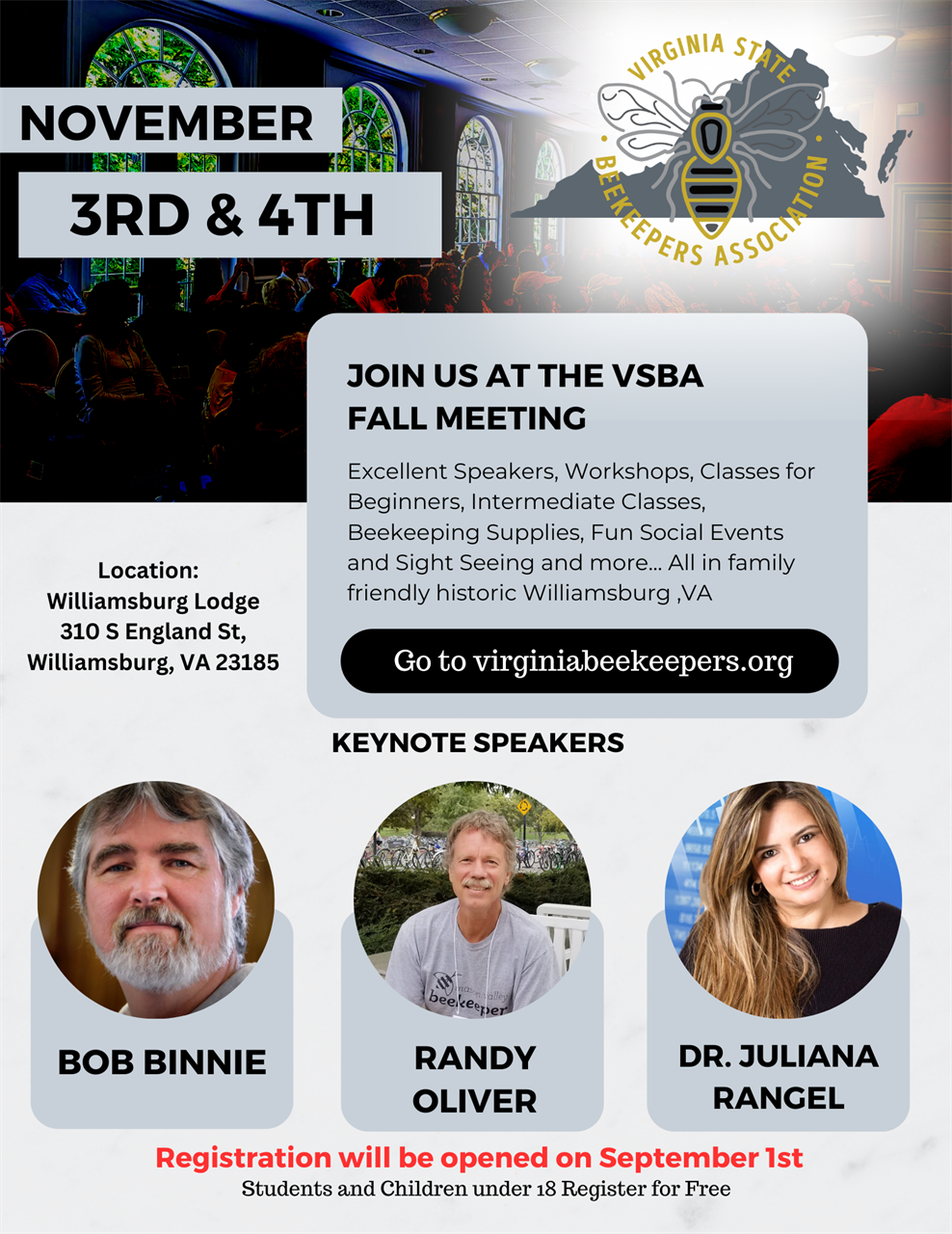
Join us at the VSBA fall meeting. There will be engaging speakers, workshops for beginner and intermediate beekeepers, supplies, fun social events, sightseeing and more!
Come meet beekeepers from far and wide, learn some important information and talk about bees all weekend! What could be better? Nothing!
See the VSBA website for details and to register https://www.virginiabeekeepers.org/
State Fair of Virginia
The always fun State Fair of Virginia will take place at Meadow Farm in Doswell, VA (just past Kings Dominion) from Friday, September 22nd- Sunday, October 1st. https://www.statefairva.org/.
VDACS Beehive Distribution Program
Applications for the program are currently being accepted through September 12th
https://www.vdacs.virginia.gov/plant-industry-services-beehive-distribution-program.shtml
Beekeepers in the News
The Virginia Climate Action folks visited Hollee’s apiary for a workshop on National Honeybee Day. Together they completed a hive inspection and honey extraction. It was a great event for a great cause. Huge thanks to Mr. C for the assist.



Meet Your Friendly Neighborhood Beekeeper: Christine Moran
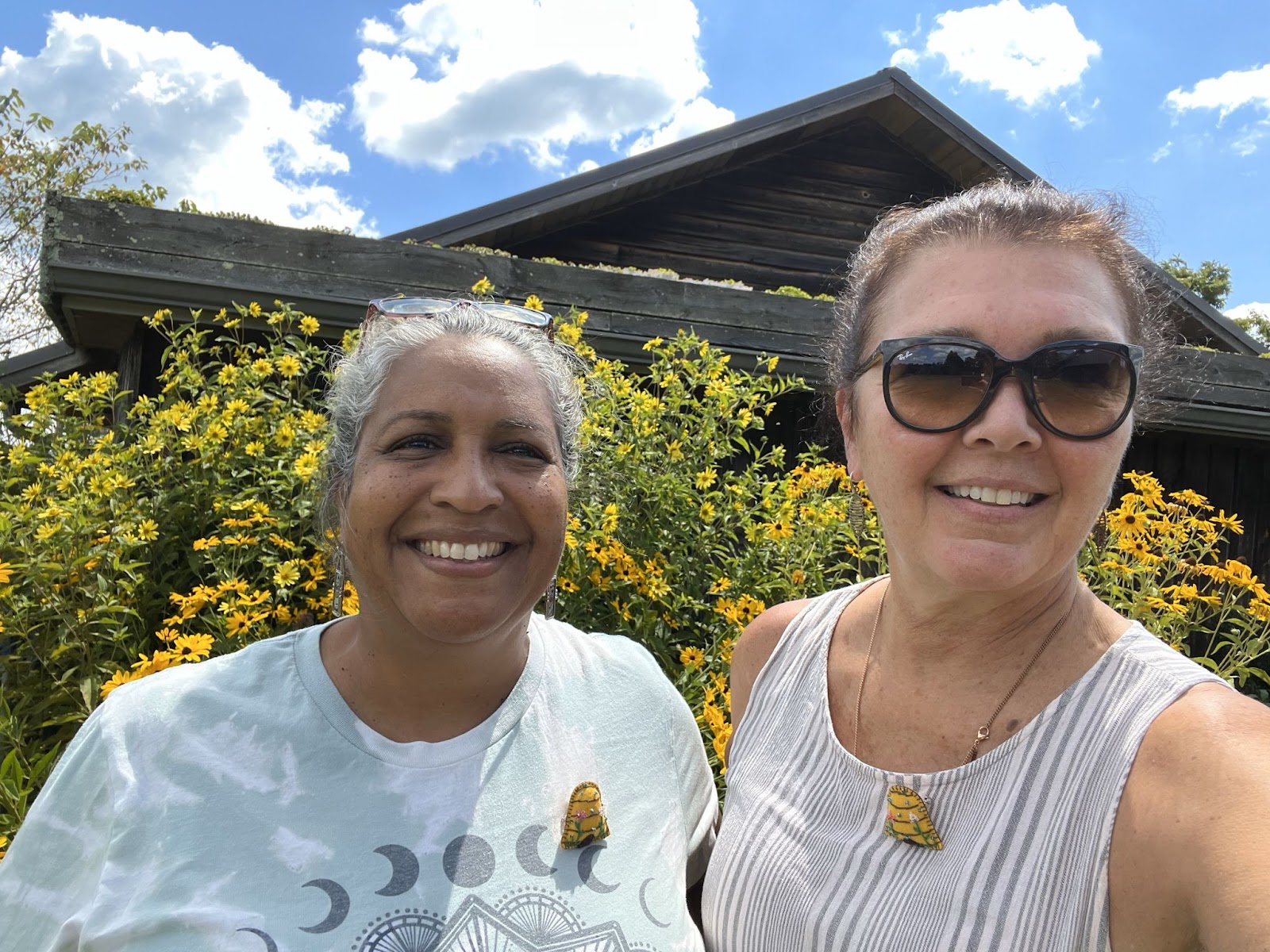
[Hollee (L) & Christy (R) at Spikenard Farm Honeybee Sanctuary learning about biodynamic beekeeping.]
Q: How long have you been a beekeeper and how many hives do you manage?
A: I began beekeeping in 2016 under the mentorship of Rick McCormick. In a good year, I have 6 hives and in a low year 2.
Q: What inspired you to become a beekeeper?
A: I was certified as a Master Gardener a few years previously. I became interested in how native bees, bumblebees and honey bees contribute to my flowers and vegetables.
Q: What is the best thing about beekeeping for you?
A: During the pandemic, I was home 24/7. We have one acre with no grass!! So, I began to watch ALL the bees on our property. When one is moving too fast, the tiny native bees are missed. I love watching the bumblebees play as they gather. I have also learned to respect the contribution of wasps. I maintain all sorts of habitats on the property for all the pollinators. I worry about butterflies. Their population is low, but I keep their resources active.
Q: What’s challenging about beekeeping for you?
A: My greatest challenge is SHB!! I’m constantly reading and recently visited Spikenard Sanctuary to learn their methods.
Q: What fun, surprising story would you like to share?
A: Rick was helping me inspect a large hive. I cover each box with a towel to keep the girls calm. It was standing at least 5 high when the whole stack fell over. We both were shocked and laughing at the same time! Because of the towels, the girls were relatively calm. Inspection proceeded!
Q: In what ways do you feel like you are making an impact on the environment and/or the community?
A: I believe in leading by example. If I can show or tell one person about bees and sustainable living, then I have succeeded!

This Month in the Hive
As John Davis mentioned during our August club meeting, this is the perfect time to think about your goals for fall/winter, what steps you will take to get there, and what resources you need.
The hive population is decreasing due to reduced egg-laying by the queen. Also, drones may begin to get kicked out of the colony toward the end of this month. Typically, we have a frost in mid-October and the bees will begin to cluster when the temperature inside the hive drops below 57 degrees.
In a year with adequate rainfall (4-6 inches, spread across the month), asters, daisies, ragweed, clovers, tickseed, and goldenrod may provide substantial sources of nectar. In these conditions, strong hives may make up to 20 pounds of honey during September.
In years with drought conditions, however, September can be disastrous for the hive, with the bees consuming the honey and pollen that should be saved for winter.Feeding of syrup and pollen substitutes may be essential since September is proving to be a month with very little rainfall.
Consider removing the queen excluder if you left it on the hives after the harvest. Check on the queen. If you are going to use it, feed and medicate with Fumagillin in syrup to fight nosema towards the end of the month. (Only the first 2 gallons of syrup per hive are medicated if you are using it.) Add chemical mite treatments if you did not do so in August and if you are using those treatments. Now is the time to use menthol crystals for tracheal mite control, if you are going to do so. If it is dry, or you made up splits in July, feeding continues until the bees will take no more syrup.
[adapted from https://buzzwordhoney.com/wp-content/uploads/2012/12/Northern-Virginia-Honeybee-Annual-Cycle.pdf]
Bee Vocabulary – “candy board”
A candy board is a way to feed your bees through winter. During colder temperatures, the honeybees will form a cluster to keep warm. As they eat through their food stores, they’ll move upward in the hive. A beekeeper can make a candy board and place it at the top of the hive to supplement feeding to avoid starvation. There are various mixtures for candy boards. Think of it like a large sugar block or sugar brownie.
Final Word
If you are not a member of RPBBA, we encourage you to join and be active. There is a constant flow of activities within the club to be as active as you want to be. You can join on our website.
If you have an event that you’d like to share or if you would like to be featured in our Beekeeper for the Month, please email
We are always looking for ways to improve communications in the club. If you have any ideas or suggestions, please send an email to rockwood.beekepers@gmail.com
We hope to see you at the meeting 7pm, Monday, September 11th at the Rockwood Park Nature Center. Our club meetings are open to members and non-members with no pressure to join. I hope you can bee there!
Attend bee meetings and state and local fairs and festivals. Give honey to your neighbors, and make sure they understand how good the bees are for gardens, flowers, and the growing environment in general.
-Hollee
 Rockwood Park Backyard Beekeepers
One response to “RPBBA newsletter Sept 2023”
You are sooooooo talented! Great newsletter! Thx for all you do for RPBBA.
G
LikeLike