Hello beekeepers and honey bee enthusiasts,
Hopefully your bees are finally settling down as we ease into cooler weather. Be attentive- hive pests such as the small hive beetle and wax moths may be on the rise. For those who attended any of the workshops held recently on winter prep, we hope that you now have additional information to help you get your colonies as strong and healthy as possible going into the winter months.
If anyone out there is still looking for guidance, the club is here with many smiling faces and tons of experience to help. The RPBBA Practical Beekeeping Group (Rockwood Park Backyard Beekeepers Group) is a great first start for those who use Facebook. Also, you can also come out to a meeting or email us! There is still time for some last minute preparations.
RPBBA Calendar of Events
📅 We have rescheduled the Club Potluck/Picnic to Monday, Oct 9th @6:30 pm at the Nature Center- This potluck is in lieu of a formal meeting (note: limit of 2 people per member). Come on out to chat with club members and enjoy great food.
A flier and RSVP link was emailed to RPBBA members. The club will provide fried chicken, water, and tableware. Please bring
1. A side to share
2. Lawn chairs
3. Any soft drinks you might like
Alcohol is NOT permitted on the property.
If you have not already RSVP’d on SignUpGenius, now is the time. When you sign up, please leave a comment to let everyone know what you plan to bring. Thanks in advance. Add to Google Calendar We hope members and their families can join us.
📅 Monday, Oct 16th @7pm – VSBA Master Beekeeping Study Group
This study group meets monthly on the 3rd Monday of each month. The study group is a great way for RPBBA members to deepen their beekeeping knowledge. We are making our way through the VSBA Apprentice Study Guide. In addition to going through the study group content, we discuss and problem-solve for what folks are experiencing in their hives. The study group is open to all members who want to learn and there is no requirement for attendees to pursue certification.
The Annual Holiday Party will be held on Dec 11th. Stay tuned for more details.
Beginning Beekeepers Classes will start on Saturday Feb 2nd at the Nature Center and will continue every 2 weeks for 4 sessions. Watch for details since this class falls up quickly.
Club News – Board of Directors Nominations
It’s that time of year again – time to begin our change of leadership. The Board of Directors consists of a maximum of 9 members per by our By-Laws and Articles of Incorporation. We have 5 Directors (elected in late 2020, for 2021-23). These 2 years terms are coming to an end for the following people:
-
Stan Houk
-
Dennis Marshall
-
Rick McCormick
-
Steve Syrett
-
Kyree Tanner
As a club, we can choose to renew the Board of Directors for another 2 year term or replace them with newly nominated and elected members.
The role of the Board of Directors (BOD) is to select Officers (President, Vice President, Secretary, Treasurer, Communications) for next year, vote on club business, and oversee the functions of the club (e.g. the club picnic, holiday party, selecting a Honey Bee Festival chair, etc). The BOD meets a few times a year, as needed, for discussion. If you wish to nominate someone for the Board of Directors or even volunteer yourself, please send an email to rockwood.beekeepers November 1st. Each person nominated to serve on the Board of Directors will be contacted by a member of the Nominating Committee to confirm their interest & willingness to serve.
Speaking of the Nominating Committee, the club is in need of volunteers to join the Nominating Committee. Any RPBBA member can make nominations. However the purpose of the Nominating Committee is to receive the nominations, verify willingness to serve with those nominated, and put forth a slate of candidates for election. This committee should have at least 3 members. If you are interested and willing to volunteer as a member of the nominating committee, please email rockwood.beekeepers November 1st. The club needs you.
Please consider volunteering or, if you are nominated, please consider serving. We need new ideas, new perspectives and can always use more energy from new people helping. Your involvement in the club helps make RPBBA the best it can be. Thank you.
Members of the club will visit the site of the Chesterfield County Fairgrounds soon to begin to plan for the Honey Bee Festival. Send us an email if you are interested in helping out with this walk-through.
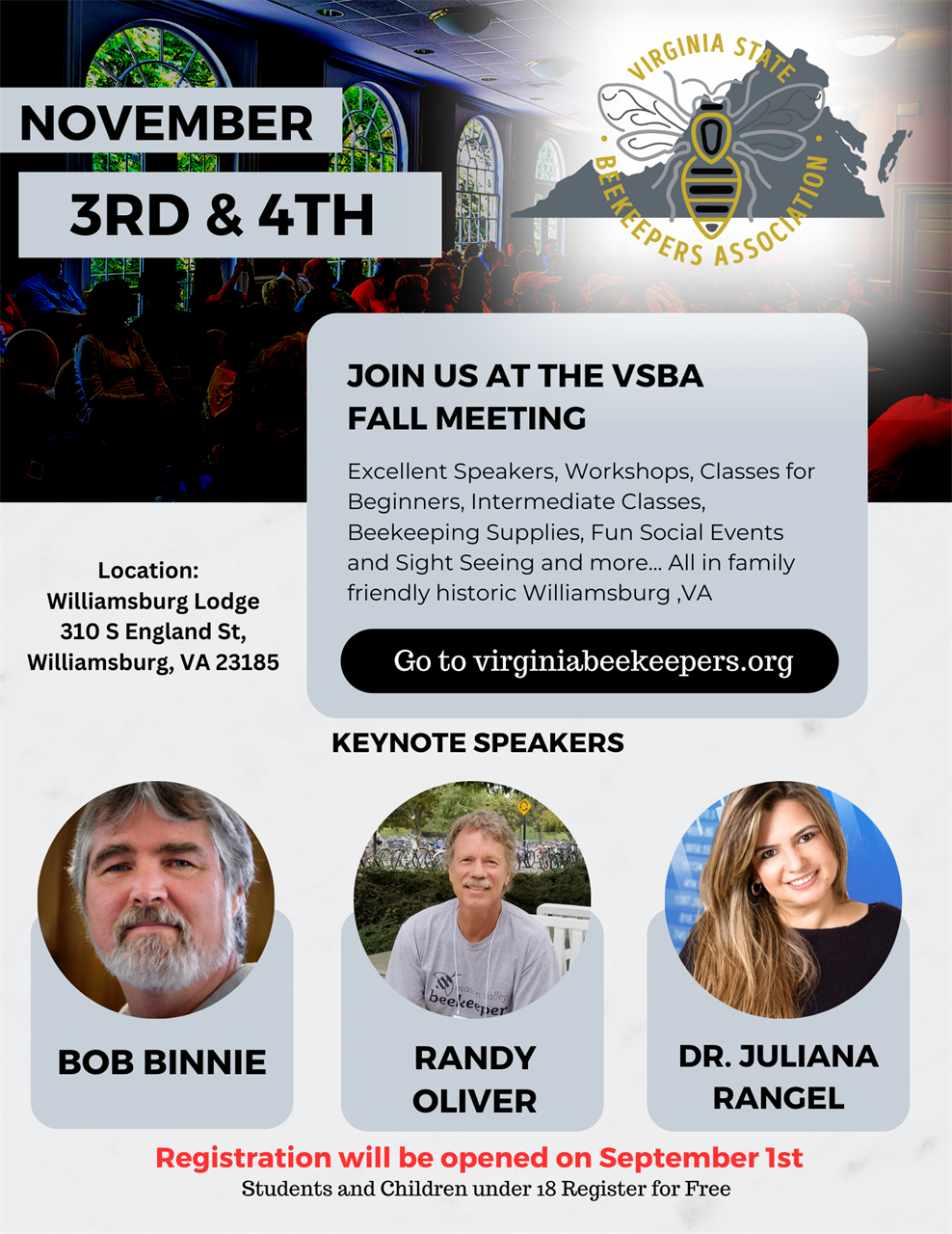
Virginia State Beekeepers Association (VSBA)
Reminder: VSBA Annual Meeting and Master Beekeeper Testing
The Fall VSBA meeting will be November 3 & 4th in Williamsburg, VA. Lots of educational and engaging workshops and activities. Randy Oliver, one of the premier honeybee researchers in the U.S. will give presentations along with many others.
Testing for Apprentice, Journeyman, and Master Beekeeper certifications also takes place at the VSBA. If you’re behind on your studying, consider coming to the study group. More information about the VSBA programs can be found on their website: https://www.virginiabeekeepers.org/
Girls Who Hike Virginia, (a 501(c)(3) nonprofit), is looking for donations of honey sticks or other items for their Adventure Summit in October. They expect approximately 80 attendees and would love for them to have a honey stick for their hike. Find out more about Girls Who Hike Virginia from their social media or website https://www.gwhva.org/page/1938622-about-us

Meet Your Friendly Neighborhood Beekeeper: Jacob Schwartz
Q: How long have you been a beekeeper and how many hives do you manage?
A: I have been a beekeeper for 3 years and I currently manage 9 Colonies.
Q: What inspired you to become a beekeeper?
A: When I was a child around the age of 10-12 years old, I loved to visit the zoo in my hometown. My favorite part of the zoo was to visit the honeybee exhibit! I could stand there for hours (while the rest of my family saw the rest of the zoo) and watch the bees work away, always trying to strengthen and grow the colony. I was fascinated that each bee knew exactly what they’re role was in the hive and that they had a specific job and purpose. Bees were so fascinating and I knew from that moment that someday, I’d love to learn more about bees and eventually own bees!
Q: What is the best thing about beekeeping for you?
A: Currently I have come to enjoy teaching new beekeepers how to manage and keep bees. When I started beekeeping, I was extremely hungry for knowledge and learned everything I could either read and experience whether or not it was in my own hives or in Jody and Theo’s hives at Dandelion Springs Apiary. With many mentors teaching me how to manage my own bees, I eventually found fulfillment in spreading all the lessons and opportunities I had been blessed with by great mentors. Though I am a young beekeeper with much to learn, I enjoy working shoulder to shoulder with new beekeepers that are diving into the world of beekeeping. The sense of accomplishment when those beekeepers do well the next season is amazing to say the least.
Q: What’s challenging about beekeeping for you?
A: The most challenging thing for myself in the world of beekeeping is to not overextend. I know every beekeeper has dreams of managing x amount of hives and trying different methods as they learn and grow. The issue I have is wanting to overextend past the bandwidth I have. Understanding where all of your commitments are whether it be financial, work, school, family commitments, etc. can be hard to manage together no less throwing on management of many hives and all their different intricacies and issues. The best way I try to deal with this is to under commit and try to over perform.
Q: What fun, surprising story would you like to share?
A: My wife would tell you that the best part of my beekeeping experience is beeing chased out of my yard by angry bees but my favorite beekeeping story was when my neighbor and I were asked if we’d be willing to do a cut-out for a family that had an issue with bees inside the overhanging porch roof. My neighbor and I are not carpenters and we made sure the home owners knew that before we came to cut into their home. That being said…we were able to cut a small section out of the roof area to get into this sealed off overhang space that was inaccessible to manage without cutting into it. The only issue with the hole we cut was that there was a metal liner in the roof that we were not able to cut
through once we made the initial hole.

Luckily for my neighbor, he was not small enough to get into the roof space to extract the bees. Which meant that I was nominated to crawl into the dark space with upwards of 80k bees (it was a massive hive that had probably been there for years). It ended up being so tight in that area that I could practically just move my arms and look left and right and I had the uncomfortable thought of “what if my suit were to fail right now and these bees became extremely mad…”. Luckily for me we were doing the removal in the spring during the honey flow and they were the most gentle bees I’ve ever experienced. They literally let me scoop them out of the main cluster with only a medical glove. We managed to get all of the bees out of the overhang space when I made the mistake shifting my weight and almost falling though their roof! Thankfully I only broke their drywall under the overhang and not all of my bones on the concrete porch below lol. At the end of the day we made out with homemade cooking from the homeowners, a large amount of honeycomb, and 2 hives worth of free honeybees!
Q: In what ways do you feel like you are making an impact on the environment and/or the community?
A:I try to make a small difference in the local environment by supporting sustainable practices when beekeeping. My goal would be to encourage the community to learn as much as they can about all pollinators and how to manage home spaces to best support wildlife and pollinators. I try to use my hives as a talking point to do this. The best impact I have on my community is to assist new beekeepers in learning the ropes and encouraging them to seek as much knowledge on beekeeping as they can.
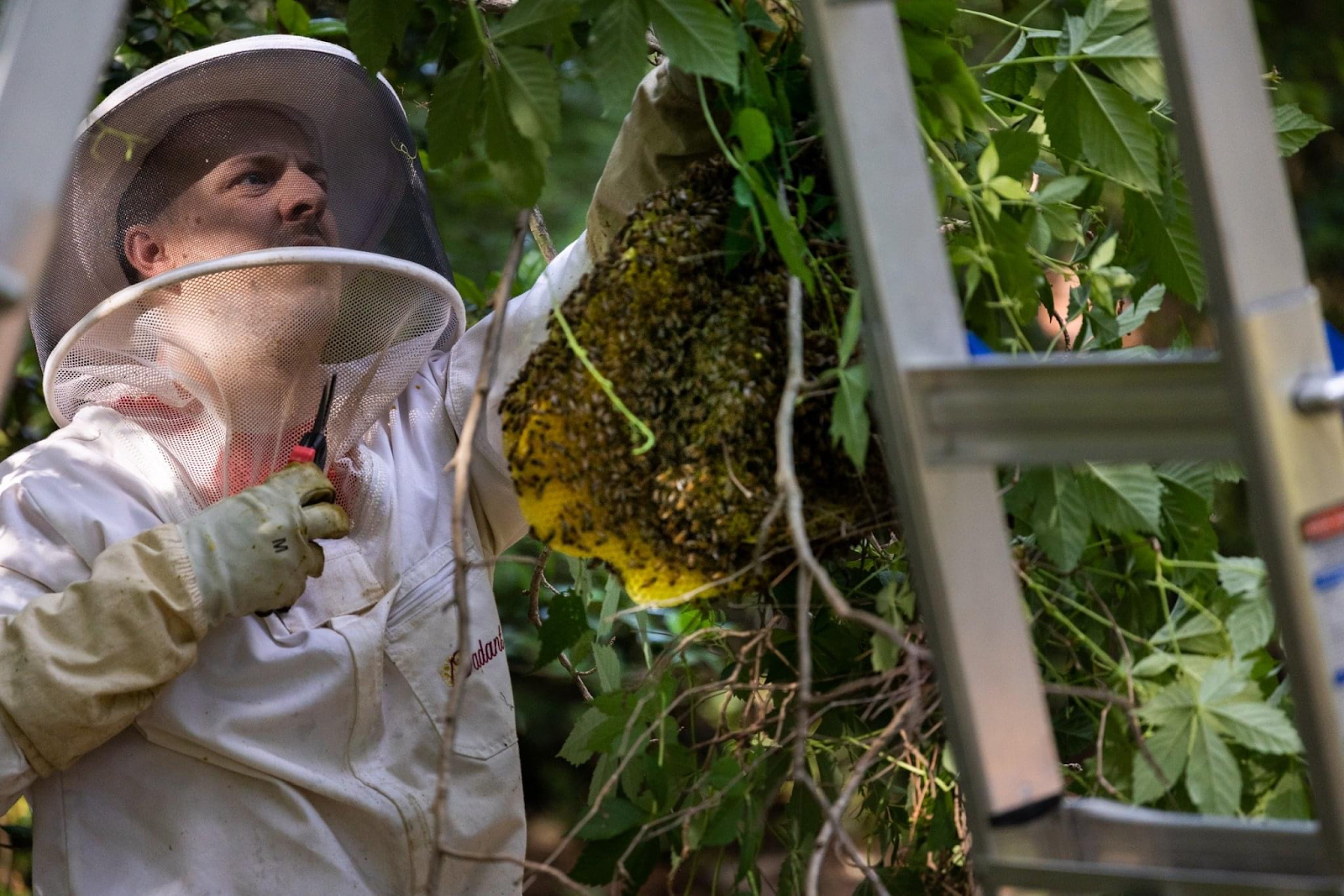
Thank you for the opportunity to share my experiences, stories, and thoughts on beekeeping!
Beekeepers in the News
As you may know, Hollee has been working hard to introduce lots of people to the beauty and wonder of beekeeping and to diversify the cadre of local beekeepers. Her film, Beekeeping While Black: The Sacred Power of Bees has been accepted to another film festival! You can watch this 19 minute film here: https://youtu.be/hpod4jvh1Nk?si=cLeRfVOc18TPjaLb
If you have news items to share, please send them to the Rockwood email.
Bee Vocabulary – “Corbicula”
Also known as the Pollen Basket. This is a flattened depression on the outside of the bee’s back legs. It is used to carry collected pollen from flowers back to the hive. As the bee returns to the hive the beekeeper can often see full pollen baskets in a variety of vibrant colors.
This Month in the Hive (October)
The bees are settling down for the winter. Varroa mites may or may not be under control–time to work on this in earnest, if you haven’t already. You may see considerably more propolis as bees reduce their entrances and drafts. Egg laying has probably slowed to 200-300 per day. However, look for continued egg production and capped brood, as new bees are needed to keep the population strong for the winter. On cold nights, the cluster forms around the queen, and may remain tight until temperatures rise. Drones are gone by month end in almost all hives.
Typically in Central VA, the frost does not come until after mid October. Before this time, some gathering of nectar may still be occurring. Asters, daisies, and goldenrod may provide substantial amounts of pollen for winter brood.
There’s a lot to do to get ready for winter:
-
don’t forget to attend your bee club meeting
-
watch for robbing on warm days
-
mitigate pests including mice by installing mouse guards, after making sure there is no mouse inside the brood boxes
-
combine weak hives
-
finish feeding sugar solutions for the winter
-
remove all honey supers not intended as a source of honey for the winter
-
remove chemical strips, if you used them (assuming you have had them on for the required number of days)
-
reserve packages or nucleus hives for next April
-
install the plastic insert on the bottom of the screened bottom board if you use screened bottom boards. If you use solid bottom boards, decide whether to reverse the boards to utilize the small entrance on the “winter” side of the bottom board.
[From Northern Virginia Honeybee Annual Cycle]]
Final Word
If you are a member of RPBBA, you will receive a separate email with the Board of Directors election ballot. Please be on the lookout for it! If you are not a member of RPBBA, we encourage you to join and be active. You can join on our website.
We are always looking for ways to improve communications in the club. If you have any ideas or suggestions, please let me know.
I hope to see you at the meeting on Monday, October 9th at the Nature Center.
Hollee Freeman
Communications
Check us out at rockwoodbeekeepers.com!
Like us on Facebook!
Join our Facebook RPBBA Practical Beekeeping Group!
Keep up with what RPBBA is doing, see Calendar of Events!
*****************************************************************************
This is the official Rockwood Park Backyard Beekeepers email. RPBBA will never share your email with anyone outside of the organization or for non-club-related business without your permission. If you wish to update your email or be removed from our email list please complete this form.
 Rockwood Park Backyard Beekeepers