
It seems that we are all in the middle of an exciting & challenging time! Spring is coming in fast and furious. This means that your honey bee population is probably increasing and possibly preparing to swarm in the near future. Lots of beekeepers have installed swarm boxes or added a box on top of their colonies to increase the volume inside the hive. Soon it will soon be time to make splits-if you’re into that management technique.
📢March Club Meeting
During the March club meeting (7pm on the 11th), Keith White, co-owner of Honey and the Hive Beekeeping Supplies, will give a presentation on how to use bait hives to attract and collect honey bee swarms. Keith will demonstrate how he prepares and sets bait hives and share tips that he’s learned along the way for capturing swarms. Come learn or re-acquaint yourselves with this important information. Come at 6:30 for social time.
Monday, March 18th – join the study group at 7pm
Monday, March 24th – Honeybee Festival planning meeting at 7pm
The 2024 Honey Bee Festival will be held @ the Chesterfield County Fairgrounds
10300 Courthouse Rd, Chesterfield, VA 23832
June 22nd, 2024, 10AM – 4PM (Note: extended hours compared with past festivals)
Click the link to volunteer at one of our many stations and/or serving in a leadership role https://forms.gle/vvwUjwffUB8xhuLS9
📢 Calling All Swarm Chasers
We have a list of folks on our website (rockwoodbeekeepers.com) who are at the ready to remove swarms. Sometimes swarms can be easily removed; other times it requires an extensive cut-out. Emails are routed to active members in the club who have expressed interest in capturing swarms. These requests are immediate and you should have the flexibility to drop everything and help on short notice. If you are not already on the swarm list and would like to be, signup here. Even if you do not have the experience to go get the swarm yourself, you might want to tag along with an experienced beekeeper to see how it is done.
Keep the RPBBA Swarm Line handy to share with friends, neighbors, anyone who may need help with a swarm. Encourage people that you meet to call the swarm line instead of using pesticides or calling an exterminator.
RPBBA Swarm Line
(804) 404-BEE1 or (804) 404-2331

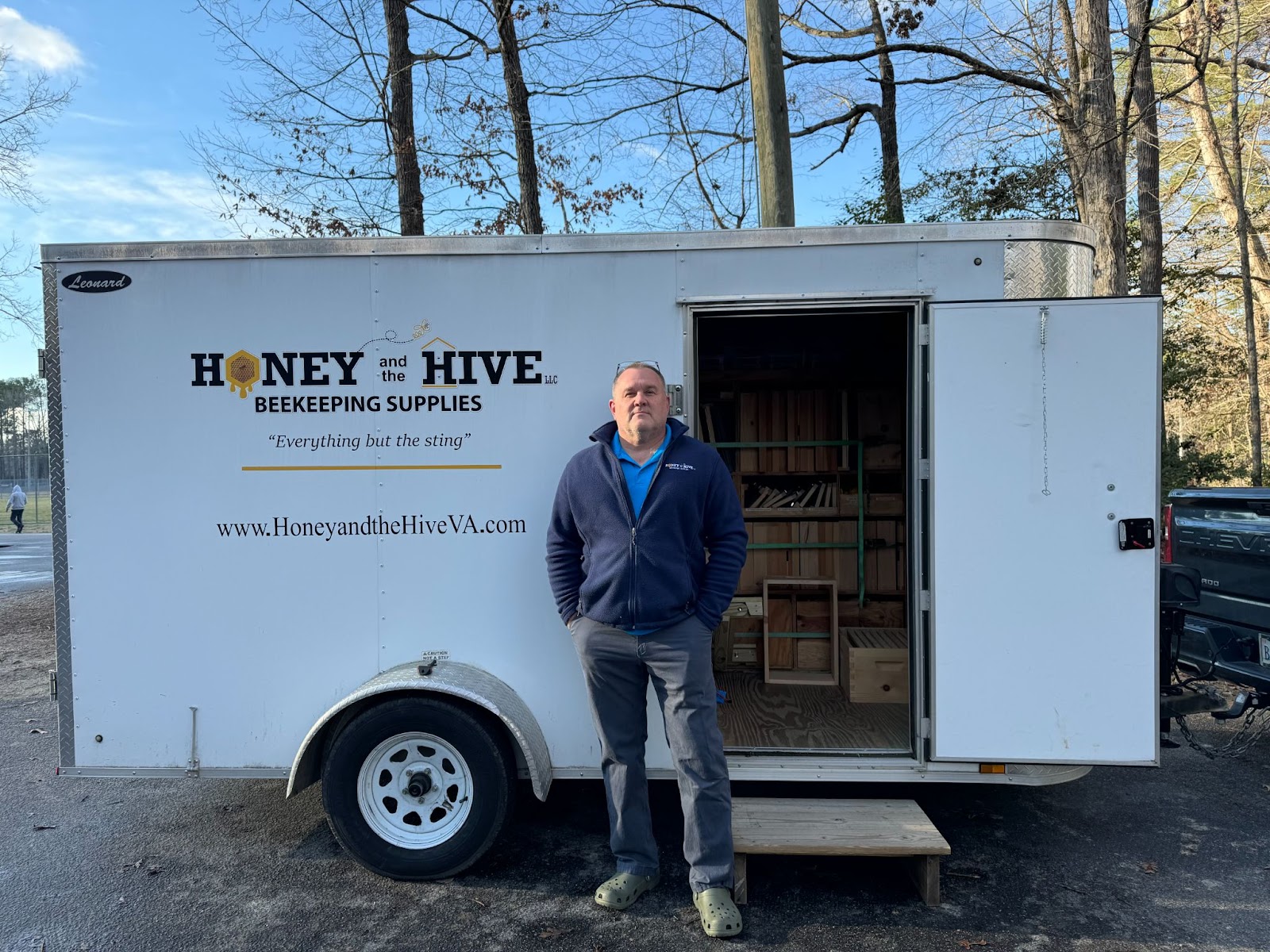
Q: How long have you been a beekeeper and how many hives do you manage?
A:I started keeping bees in 2016. I told the boss I was only going to have two colonies but I ended up buying three nucs and caught several swarms that first year. I also made a few splits and went into my first winter with nine colonies. The obsession has continued to grow since then and at last count, I have more than forty colonies.
Q: What inspired you to become a beekeeper?
A: A friend of mine keeps and he suggested that I start – he said I had a great place to have colonies. The suggestion took a couple years to take root but when it did, I went all in. Later, my mother told me that my grandfather also kept bees but he stopped before I was old enough to remember. So I guess you could say it runs in the family.
Q: What is the best thing about beekeeping for you?
A: It’s hard to pick just one thing. Catching swarms in the spring is a lot of fun and I like making splits and watching them grow into big, productive colonies. In a broader sense though, beekeeping is the perfect blend of several of my interests – the outdoors, gardening, and woodworking.
Q: What’s challenging about beekeeping for you?
A: It depends. (You really didn’t think I was going to pass on an opportunity to say that, did you?)
Queen rearing is a challenging aspect of being a sustainable beekeeper that I enjoy and continue to improve upon. With each grafting cycle I do, I get a little better and learn another nuance that makes my efforts more productive. I keep telling myself that next year might be the year that I’ll sell queens. Maybe 2024 will be the year.
Another challenge has been staying on the treatment-free path while continually hearing it can’t be done. I have been treatment-free since I started keeping. And aside from the three nucs I bought my first year and some queens I’ve purchased for genetic diversity, I don’t buy bees – I catch swarms and propagate from my survivors. After years of doing this, my overwinter losses are usually less than ten percent.
Q: What fun, surprising story would you like to share?
A: I already mentioned that my grandfather kept bees. He was also a woodworker and used lumber he harvested from the family farm in Madison County, VA. When he passed, I got quite a bit of this lumber. One of my first beekeeping-related woodworking projects was an observation hive for my garage made from this 60 to 70 year old walnut and cherry. I put a swarm in it in May of 2016 and with the exception of a four-day period in 2018, it has been continuously occupied. It’s Bee TV and a bee vending machine all in one.
Q: In what ways do you feel like you are making an impact on the environment?
A: On a very local scale, I’d like to think that I’ve had positive impacts on both the number of pollinators in the area as well as the forage that’s available for them. And as a result of our beekeeping supply business Honey and the Hive, I have had many opportunities for community outreach and education promoting beekeeping throughout the greater Richmond area.
📰Beekeepers in the News
Huge shout out to Mr. C, who provided snacks for the 1st session of the Beginning Beekeeper class. This thoughtful gesture was very much appreciated. Teamwork makes the dream work.
Hollee was recently featured on Channel 12 news talking about writing, teaching and beekeeping. https://www.12onyourside.com/video/2024/02/16/dr-hollee-freeman-discusses-writing-teaching-beekeeping/
If you do interesting stuff in the community related to bees, environmental stewardship or anything cool, shoot an email to the Rockwood Club for a feature in the newsletter. rockwood.beekeepers
This Month in the Hive (March)
In March, the days become longer and the queen steadily increases her rate of egg laying. The brood nest will expand and migrate upward into areas where honey has been consumed. The brood nest is now about 6-8 inches across, and may extend across several frames. Look for drone brood along the bottom edges of frames with brood. Remove some drone brood with a cappings scratcher and look for Varroa mites. If you find Varroa in 30% or more of the drone brood cells, perform a mite count, and decide whether to treat for mites.
The hive may consume as much as 7 lbs of nectar and pollen per week (net of inflow) when cold, rain, snow, or icy conditions prevail. Be sure to check for remaining honey and pollen stores. Food stores can run dangerously low until a heavy nectar flow starts. It may be necessary to continue feeding the hive and that the hive is slightly tilted forward to shield rain from the bottom board.
If using a screened bottom board, you should resist the urge to remove the insert. Leave it in until consistent warmer weather arrives in late April. In late March, you may consider reversing the deep brood supers, or the medium supers that some beekeepers use for brood. This will allow for a better distribution of the brood, and stimulate the growth of the colony. If the brood nest extends across the brood supers, do not reverse until there is a large enough population to keep both halves of the brood nest from death due to chilling.
On a sunny day early in the month, when there is little wind and the bees are flying, have a quick look inside the hive. A temperature above 54 degrees should do for this task. Remove frames for a quick inspection. Inspect for disease and see if the queen is laying eggs. Eggs laid in January and February will all be hatched into new workers by mid-late March and the population will be much higher than in January. You may want to add a pollen patty if you have not yet done so but be careful to add a small piece and watch carefully-you don’t want to entice mites.
[From https://buzzwordhoney.com/wp-content/uploads/2012/12/Northern-Virginia-Honeybee-Annual-Cycle.pdf]
Bee in the Know with your Bee Vocabulary – “split”
If you have a large, healthy hive, it is possible to create a new colony from it by making what is called a split. The basic concept of making a split is that you take a portion of an established colony and transfer it to a separate hive thereby creating two colonies. There are many reasons for making a split. Some beekeepers make splits to increase their apiary or to sell to other beekeepers. Others use splits as a form of swarm control, mite control or to reduce the size of a large colony.
Final Word
If you are not a member of RPBBA, we encourage you to join and bee active. You can join on our website. Please participate in meetings and volunteer to help with the Honey Bee Festival.
We are always looking for ways to improve communications in the club. If you have any ideas or suggestions, please let me know.
-Hollee (please excuse any typos-I’m trying to get this out for the weekend:)
Hollee Freeman
Communications
Check us out at rockwoodbeekeepers.com!
Like us on Facebook!
Join our Facebook RPBBA Practical Beekeeping Group!
Keep up with what RPBBA is doing, see Calendar of Events!
*****************************************************************************
This is the official Rockwood Park Backyard Beekeepers email. RPBBA will never share your email with anyone outside of the organization or for non-club-related business without your permission. If you wish to update your email or be removed from our email list please complete this form.
 Rockwood Park Backyard Beekeepers