Hello beekeepers and honey bee enthusiasts!

This is an exciting & challenging time in the beekeeping world! The climate is a little whack-a-mole but, nevertheless, the blossoms are showing their beauty and sharing their sweet scents between the rainy days. This means that your honey bee population is probably increasing and possibly preparing to swarm. In fact, you may have even experienced a swarm or two or four OR prevented a swarm or two or four already!
Keep the RPBBA Swarm Line handy to share with friends, neighbors, anyone who may need help with a swarm. Encourage people that you meet to call the swarm line instead of using pesticides or calling an exterminator.
RPBBA Swarm Line
(804) 404-BEE1 or (804) 404-2331
📢April Calendar of Events (all meetings take place at Rockwood Park Nature Center)
Monday, April 8th @7pm – Monthly Club meeting (6:30pm social gathering)
Monday, April 15th @7pm – Study Group
Tuesday, April 16th @7pm – Honey Bee Festival Planning Committee meeting
Tuesday, April 30th @7pm – Honey Bee Festival Planning Committee meeting
April Meeting
Did you know that there are about 450 species of native bees in Virginia!
As beekeepers, we often get asked questions about all kinds of bees and bee relatives such as wasps, solitary bees, Mason bees, hornets, carpenter bees, bumblebees and more!!
Join us at the club meeting as area naturalists introduce you to some of the other bees and bee relatives that share the environment with us!
7pm Monday, April 8th
(6:30pm social gathering)
@Rockwood Park Nature Center Add to Google Calendar

Huge thanks to our HBF co-chairs and volunteer committee leads who are well underway with festival planning.
There are many opportunities to participate in this year’s festival. Committees include: operations, guest experiences (plantings & club table), education, children’s area, bake sale, and publicity. In addition to day-of volunteers, we are also looking for help on Friday evening with setup and Saturday with take down.
Volunteers can be anyone, not just RPBBA members. Beekeeping experience or knowledge is NOT required. The only requirement is a willingness to help. If you need service credit just know that RPBBA is a non-profit organization. Volunteers are provided a free Honey Bee Festival t-shirt and we promise to provide an enjoyable experience with good company. More details, including a signup form, can be found here:https://forms.gle/vvwUjwffUB8xhuLS9
In particular, the festival needs a cadre of volunteers for the operations/logistics committee. This committee is the ‘bones’ of the festival and needs volunteers to help direct traffic (vehicular and human), picking up supplies, repairing equipment, making sure other committees have what they need, etc. Operations help is needed in advance to prepare for the big day. Many helping hands makes for less work.
The RPBBA Bake Sale tent is a major source of funds that allows our club to conduct the festival each year. We are on the lookout for anyone who can bake and/or donate items to the club for sale at the festival. Cookies, cakes, pies, anything goes (with proper labeling). Can’t bake? How about donating a case of water? More details including the signup form, can be found here: https://rockwoodbeekeepers.com/bake-sale-sign-up/
The 2024 Honey Bee Festival will be held @ the Chesterfield County Fairgrounds
10300 Courthouse Rd, Chesterfield, VA 23832
June 22nd, 2024, 10AM – 4PM (Note: extended hours compared with past festivals)
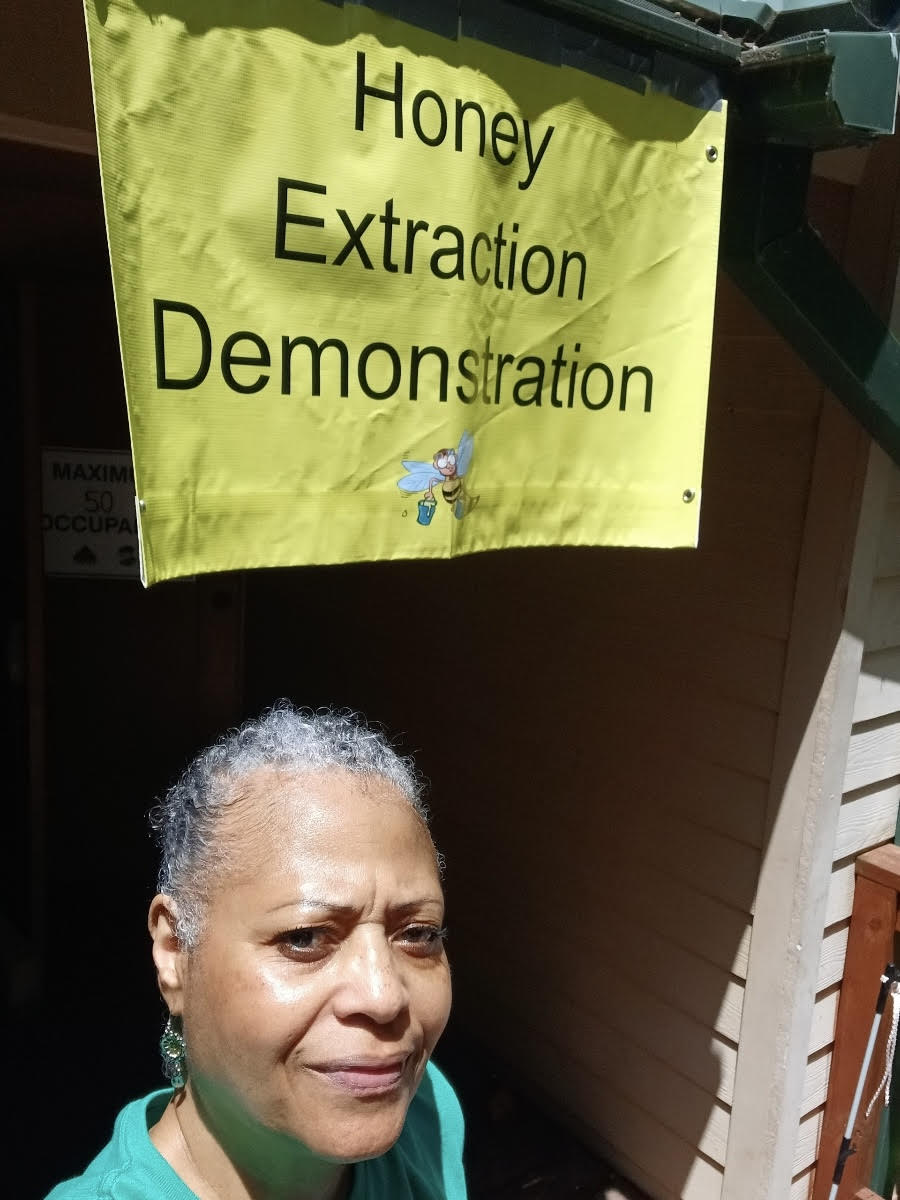

Q: How long have you been a beekeeper and how many hives do you manage?
A: I am expecting my 1st nuc any day now!
Q: What inspired you to become a beekeeper?
A: I had a family member who had beehives and gave us honey regularly. I was curious when I visited the hives. I was amazed how organized the bees worked. I thought it would be something my husband and I could do when we retired.
Q: What do you anticipate will be the best thing about beekeeping for you?
A: To help people to connect with our community, to make a difference in the environment and have fun! It is important that bees pollinate plants which provide food and shelter for other animals. A small beehive can make a difference to the gardens and farms in our area. “I heard the low humming of bees can have a calming effect, too. “

Q: What do you anticipate will be challenging about beekeeping for you?
A: Finding evidence of the Queen, how to prevent and recover a swarm, and pest maintenance.
Q: What fun, surprising story would you like to share about getting involved in beekeeping?
A: Ordering my first nuc of bees! I am getting excited in setting up my new hives! I also got my brother-in-law who lives in Tennessee to start his beehives this spring along with me. We are both so excited!


Bee Vocabulary – “Brood Nest”
Bees will use the available cells across frames for various purposes. They will use some cells to store pollen or honey. Other cells will be created for worker, drone or queen cells, which are collectively called the brood nest.
LIST: Common Beekeeping Terms You Should Know – Backyard Beekeeping
This Month in the Hive (April)
On colder days, the bees continue to form a cluster. The brood nest may be as much as 10 inches in diameter. The brood nest continues its slow migration upward into empty honeycomb. The bees will bring pollen and nectar into the hive. The queen is laying several hundred eggs per day at the beginning of the month and the population is growing fast. At the end of the month, the queen will lay 800-1000 eggs per day. The worker population will double this month. Drones will number above 200 by month end.
A congested hive in April will lead to swarms, typically in the last week of April and early May. Congestion exists where the combination of honey, pollen, brood and bees fills 80% or more of the available space. In a congested hive (for reasons about which there is no consensus) the worker bees begin to raise new queens in April. This is done by building “swarm cells” – peanut-like wax cells that often hang down between brood supers, or on the face of brood frames. From depositing the egg to the emergence of a new queen is 16 days. A hive that is storing honey by mid-late April is a hive to watch for swarming.
Henbit, wild mustard, dandelions, redbuds, pears, cherries, “Japanese” magnolias, plums, shadbush, chickweed, and many ornamental shrubs will provide substantial amounts of pollen and sufficient nectar for brood production on sunny days. Many hives that have consumed sugar syrup in March will cease taking it in early April. By mid-April, apples, peaches, crab apples, American holly and autumn olive may begin to supply ample amounts of nectar and some very strong hives will begin to make and cap honey. At the end of the month, nectar flows will be strong from many sources.
Generally, it should be understood that swarms are not good for honey production. Hive bodies should be reversed when the likelihood of 4 or more days of consistent cold (45 degrees or less) weather has passed, or around April 1 in most years. This will reduce congestion by encouraging the queen to expand egg-laying upward and outward into empty brood frames.
Remove any feeders where the syrup becomes moldy. Remove a feeder when 1 quart is not consumed in 1 week.
Place a bait hive for swarms nearby if you have decided to use such a hive. Be prepared to place a queen excluder and honey supers on top of the hive toward the end of April. On a warm day, do a complete inspection of the hive. Can you find any evidence of the queen? Are there plenty of eggs and brood? Is there a compact pattern to her egg laying? If not, locate a new queen and replace any weak or failing queen.
The final touches should be put on new hives and supers that will soon be full of bees and honey. Package bees should be installed as early as possible this month to take advantage of the heavy nectar flows at month end. Watch out for evidence of swarming (queen cells, live queen with no fresh eggs; queen that is reduced in size to fly with swarm). Remove frames with queen cells to a nucleus hive (with at least 2 frames of bees) or cut the queen cells from the frames and use them to requeen weak hives, or destroy them.
[From https://buzzwordhoney.com/wp-content/uploads/2012/12/Northern-Virginia-Honeybee-Annual-Cycle.pdf]
What’s in Bloom (according to Maymont)
1st Week: Maple, Birch, Oak, Cherry, Pear, Silver Bell, Crabapple, Dogwood, Redbud, Camellia, Pearlbush, Sweet-Breath-of-Spring, Forsythia, Boxwood, Flowering Quince, Barberry, Azalea, Periwinkle, Narcissus, Candy tuft, Violets, Tulip, Pansy, Wildflowers
2nd Week: Crabapple, Silver Bell, Cherry, Dogwood, Redbud, Boxwood, Flowering Quince, Wisteria, Barberry, Lilac, Azalea, Periwinkle, Narcissus, Candy tuft, Violet, Pansy, Tulip, Wildflowers
3rd Week: Azalea, Dogwood, Cherry, wisteria, Violet, Pansy, Tulip, Lilac, Barberry, Periwinkle, Candy tuft, Wildflowers
4th Week: Azalea, Dogwood, Wisteria, Violet, Pansy, Tulip, Lilac, Periwinkle, Candy tuft, Wildflowers
Happy Beekeeping!
-Hope to see you all at the meeting on April 8th at 7pm at Rockwood Park Nature Center.
Hollee Freeman
Communications
Check us out at rockwoodbeekeepers.com!
Like us on Facebook!
Join our Facebook RPBBA Practical Beekeeping Group!
Keep up with what RPBBA is doing, see Calendar of Events!
*****************************************************************************
This is the official Rockwood Park Backyard Beekeepers email. RPBBA will never share your email with anyone outside of the organization or for non-club-related business without your permission. If you wish to update your email or be removed from our email list please complete this form.
 Rockwood Park Backyard Beekeepers