RPBBA Dec’23 Newsletter

Happy December everyone!

It may be a slow month in the apiary but there is a lot going on as we begin preparing for spring. Read about all of the interesting activities happening! 

RPBBA Calendar of Events

📅 Monday, Dec 4th – Honeybee Festival brainstorming & planning meeting. 7pm virtual https://us02web.zoom.us/j/84388360511  Bring your ideas and questions!

📅Monday, Dec 11th- Annual Holiday Potluck @6:30 at the Nature Center. Main dish, water and utensils will be provided. Bring a covered dish and any other beverages you’d like (no alcohol is permitted in the Nature Center) 

Note: The holiday potluck is in place of our regular meeting. There will not be a study group meeting in December. 

 2024 Beginner Beekeeping Course

The Rockwood Park Backyard Beekeepers Association (RPBBA) is holding their annual Beginning Beekeeping Course over 4 Saturdays (02/03, 02/17, 03/02 and 03/16).

Attendees will receive instruction on the

🐝History, Hive organization & location, 🐝Woodenware and equipment,

🐝Dynamics of the Colony, 🐝Diseases, Pests and Predators,

🐝Getting Started, 🐝The Beekeeping Year, 🐝Floral Sources, and 🐝Bee Field Day (hands-on apiary day)

Participants who are unable to make a class at RPBBA, may attend and receive the same instruction at Huguenot Beekeepers Association, which has classes on alternating Saturdays. 

The cost is $105 through Jan12th and $120 thereafter. We are limited to 40 participants. Registration includes 3 books and a 1-year membership to RPBBA. For more information, including a signup form, please see our website https://rockwoodbeekeepers.com/beginner-beekeeping

Will you be selling nucs, packages or queens this year?

If you plan to have bees for sale next year, let us know by adding your information to the Resources list here: Click here*.

*This is simply a list of local suppliers; RPBBA does not endorse or give preference. Buyers are encouraged to do their own research before making their decision to purchase from any supplier.

Be a Mentor

With the 2024 Beginner Beekeeping course kicking off soon, we will have new beekeepers looking for assistance. If you are a RPBBA member and willing to be a Mentor, please sign up here. You must be willing to have your contact information shared with other RPBBA members.

The goal is to create a current list of willing mentors, with their general location, to share with those near them.

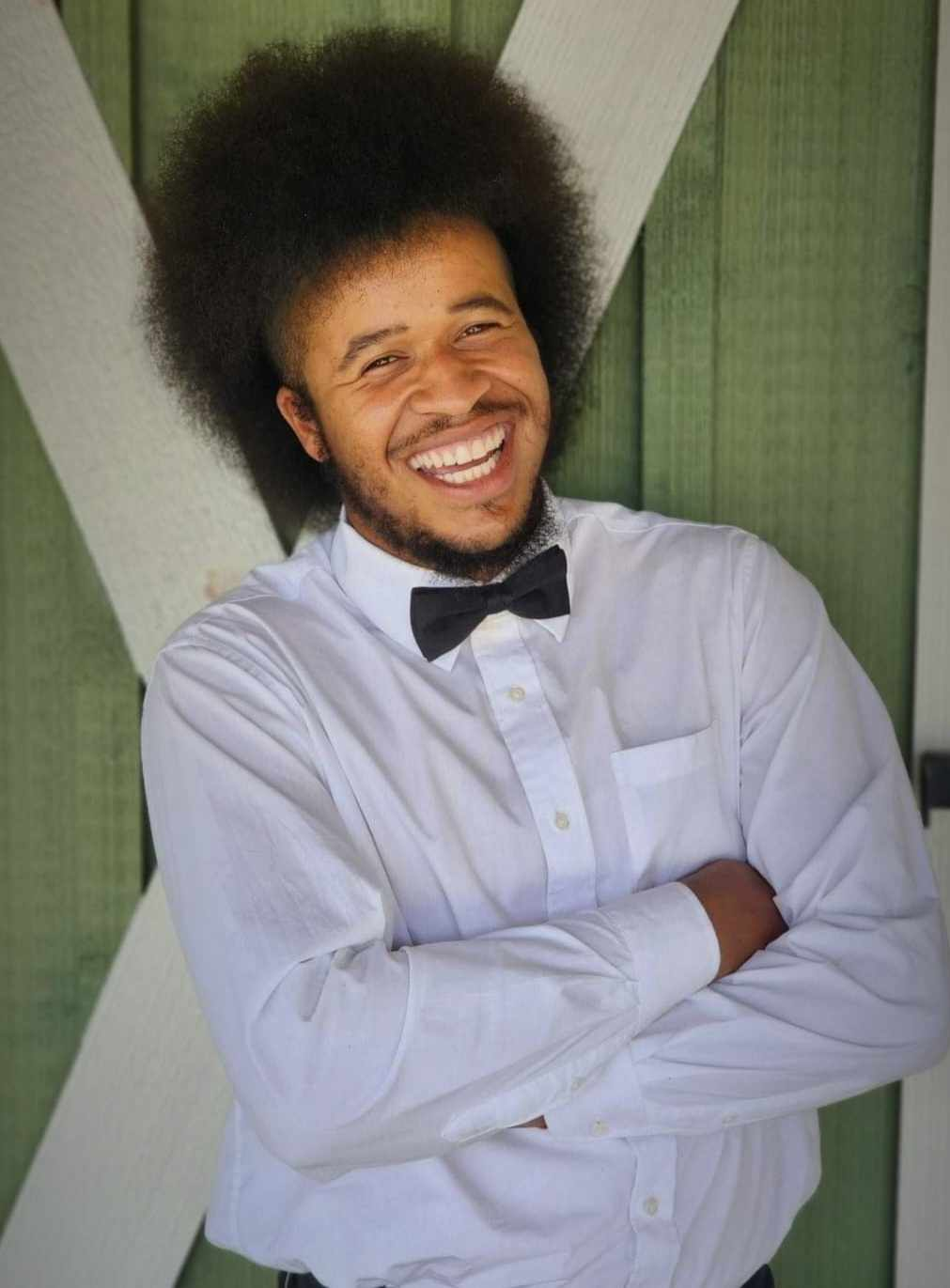
Meet Your Friendly Neighborhood Beekeeper: Kyree Tanner 

Q: How long have you been a beekeeper and how many hives do you manage?

A: I have been raising bees for almost 8 years. I am managing 60 hives right now.  I spent a lot of time doing an internship with another friend that’s more on the commercial side of beekeeping. He has 800 hives. By working with him, I just built up the faith and sense to know what to do for a colony based on their behavior.

Q: What inspired you to become a beekeeper?

My aunt and a good friend inspired me to become a beekeeper and I now have a passion for it. My aunt and my friend kept saying to me that if there is something that you are passionate about and want to do, then put your mind to it and it will happen.

After that, I told my friend that I wanted to raise bees, and he said ok! He was an elderly guy who went to auctions to buy stuff.  One night, he and his wife invited me over for dinner. After dinner he left the table and came back with some bee supplies that he got from an  auction. He said to me, “It’s yours.”  That’s how I got started into the beekeeping world. 

Q: What is the best thing about beekeeping for you?

The best thing about beekeeping is that hard work pays off (i.e. reap what you sow). Harvesting the honey makes you feel successful and that there always a huge market and demand for honey and bee essentials.

Q: What’s challenging about beekeeping for you?

The challenging thing about beekeeping is keeping your colonies healthy as possible so they can last forever. Plus, meeting the colony standards. I’m sure just about every beekeeper can agree as well.

Q: What fun, surprising story would you like to share?

The funniest story of my beekeeping life occurred when I was getting into beekeeping. I was in the 8th grade and I can remember leaving school early because I got a call from the post office that my bees had arrived. 

I left school and went to pick up my package of bees. I was super excited. I got home, got everything straight and suited up to install my bees. However, I totally forgot to zip up my suit! I only had on shorts and a tank top! Well, those bees were nailing me left and right so I came out of the bee suit and started running. Of course, they were still nailing me so I stripped down to my underwear and I ran down to the powerline where there’s a neighbor who can see me right out of their back kitchen window. I said to myself – I don’t care if they see me like this! I finally get away from the bees and said, “God,  it’s in your will but I’m not a quitter.”  After that, I walked back up the power line picking up my clothes and getting back in my suit. I went back to the bees and they were just as calm as they could  be! God took care of them and answered my requests.

Q: In what ways do you feel like you are making an impact on the environment and/or the community?

I feel like the more people I mentor, tell how important bees are and get them into raising bees– I feel like it’s improving pollination, as well as our food sources and world. Researchers have predicted that if bees were to leave the face of the earth, we, as humans, would lose the majority of our essential life within 4-5 years. Without bees, the availability and diversity of fresh produce would decline substantially, and human nutrition would likely suffer. Crops that would not be cost-effective to hand- or robot-pollinate would likely be lost or persist only with the dedication of human hobbyists.

Heart of Virginia Beekeepers 2nd Annual Conference

The Heart of Virginia Beekeepers are hosting their second annual beekeeping conference on January 13th at Hampden-Sydney College in Farmville. 

For more information, including registration, visit The Heart of Virginia Beekeepers

🐝🐝🐝

Give the gift of bees. Rick McCormick has a great idea! Consider giving the gift of honeybees to a family in need through Heifer International. Click the link for more information. https://www.heifer.org/gift-catalog/animals/gift-of-honeybees.html 

This Month in the Hive (December)

The bees are in a tight cluster now. Egg laying has pretty much halted. You may see bees flying on sunny days when temperatures are over 50 degrees. Weeks after the winter solstice, the queen’s egg laying will recommence, but not this month:)

The hive may consume 10-12 pounds of honey during this month, depending on the weather. Mild weather may actually cause more honey consumption due to increased movement.

You should stay out of the hive this month. Make sure the entrance and ventilation holes are not blocked. Make sure the mouse guard is not chewed through. Plug any large holes in the brood boxes to prevent drafts.

Read a good book on beekeeping; study the latest research reports on bee health. Review what worked well and what you might want to change next year. Request catalogs.

Final Word

If you are not a member of RPBBA, we encourage you to join and bee active. You can join on our website. We are always looking for ways to improve communications in the club. If you have any ideas or suggestions, please let me know -Hollee 😀
RPBBA Nov Newsletter. Enjoy !

Hello Beekeepers !

Summer/Fall/Winter–it’s all here at the same time! Just a few simple things to consider as you complete your winter prep (there’s more to it than this but this is a good starter list) – remove extra space (boxes) in the hive, remove any queen excluders, Langstroth top entrances should be open to allow ventilation through the hive.

RPBBA Calendar of Events

📅 Monday, Nov 6th – Honey Bee Planning meeting @7pm

📅 Monday, Nov 13th – Club Meeting @ 7pm

📅 Monday, Nov 20th – Study Group @ 7pm

November Meeting

During our November Club Meeting we will have presentations about products from the hive. This will be an informative and delightful meeting. Doors open at 6:30pm for socializing.

yDJYv2qIaOEFZSFAcP4ZINEGyil9bSzqd1gFZnBMVD5QMmKgUiTn_XVzSlIx5L7TtKh2pDuOSN4JsPfykEd5nLdR2DTezU11iQyJmRW_w6et1ZeyS4szKBiwge5niIxShc1B2HHeKAPR5BSf9IJRCW8

2023 Beginner Beekeeping Course

RPBBA’s Beginning Beekeepers Classes will start on Saturday, Feb 2nd at the Rockwood Park Nature Center and will continue every 2 weeks for 4 sessions. The class is held from 9am-4pm each session.

Participants will receive instruction on:

🐝History, hive organization & location 🐝Woodenware and equipment

🐝Colony dynamics 🐝Diseases, pests & predators

🐝Getting started 🐝The beekeeping year

🐝Floral sources 🐝Bee Field Day (hands-on apiary day)

Register on the RPBBA website. This class fills up quickly.

rockwoodbeekeepers.com/beginner-beekeeping.

Will you be selling nucs, packages or queens this year?f9XchGGssg1sm21N37K0Qbd_6ucl3BkL-uEqdjaVMyRDKJfqeDWnClc1olq6QJJGK0XiNtKCNy2ZmGNDmLD0XAhM61HMbiinnai2daD2lpxiKJVMddSV1PJ-_XjksspJ-__TP9PKlHXJf9_1qg96MoU

Ever so often, the question pops up- how do I get started? Where can I get my bees? We are in the process of updating the 2023 Resources list. If you plan to have bees for sale next year, tell us your plans. Click here to have your information added to our 2024 Resources*.

*This is simply a list of local suppliers; RPBBA does not endorse or give preference. Buyers are encouraged to do their own research before making their decision to purchase from any supplier.

Virginia State Beekeepers Association (VSBA)

We are HERE at the VSBA and ready to learn, share and connect with other beekeepers and bee enthusiasts! QW0bXJawRa2EDpkDFf38nxF7nLyhBZBDTt_ahsyiInSSfeaZIXjjWO47PDt-rZbqiAvsemmUUMmNR6JhGO41NqeSXrrsapKiGvfczr17DvMS9sVxRtiML7AofDfkYLQnxyOjRkZHmozz6lzYH--RHys

Make your plans now to join VSBA for the Spring 2024 (July). Organizers are looking at some locations in SW Virginia (so you know it’s going to be beautiful!)

tXkgMqtbk-xaXlv-MsQWIGYTfghS3wXwDz90P7SRMRulxrI3Xd41_P9vu6g0TerOXVRp2dtY-TyuFxmCJnEXvmxR4Bdo7n9xurzvXvpuwcUcYu67zcHOcvxBqkkQ4I10I6GuqsrtX8lrwJXoV6x3Zi4Give the gift of bees. Rick McCormick has a great idea! Consider giving the gift of honeybees to a family in need through Heifer International. Click the link for more information. https://www.heifer.org/gift-catalog/animals/gift-of-honeybees.html

Heads Up: Winter Preparation Workshop

There’s a hands-on opportunity for winter preparation at Dandelion Springs Apiary on November 12th. Learn more and register here:

Winter Prep Workshop 2023 — Dandelion Springs Apiary

This Month in the Hive (November)

The cold weather has arrived (maybe). Colder temperatures will find bees gathered into a cluster that is broken only when the temperature outside the hive rises above 57 degrees. During these warmer days, bees will take cleansing flights.

This is the month to make sure that there are sufficient winter stores in your hives. It is becoming too cold to feed syrup.On a warm day, heft the hive and add honey frames or candy boards. You may consider feeding a pollen substitute in the form of a patty. If your hive(s) have sufficient honey now, you may need to wait until January/February to add candy boards and pollen patties.

It is generally a good idea to stay out of the hives in November unless there is an emergency. The queen should stop laying by the end of November and the population should be steady, with a few bees lost each day. Remember to keep snow and ice from blocking entrances and ventilation holes in the hives.

Use this time to clean and organize your materials, order bee gifts for the holidays, and say thank you to family and friends who’ve endured you and the bees during the spring and summer. Reserve packages or nucleus hives for next April if not already done.

[From https://buzzwordhoney.com/wp-content/uploads/2012/12/Northern-Virginia-Honeybee-Annual-Cycle.pdf]

g5gcWykFw9OAH8y7de3zJM2YyJq2s1rM0NZp-xhYw_DBNiWp_gq1OnaWaRJC79CE4rxtLEo2Vo0LIvIHwzQYHjTWbX-cXNmmmjZg35uQ6y7pXWnLcX9Go1eCLwzIAiNaXdKsLumVtI2sLiATWtf9gHE

Meet Your Friendly Neighborhood Beekeeper: Dr. Hollee Freeman

HOLc-By5ROp-s8iyJLXnD0WPS__c5TTp_hh0Z_c64z81EK1C1ya5tbLO4-fKzV21mH1p7d_eRCP_AIoi9ym_iyhAjtyXTTRuFUjij7fKhO9uYhjUTIaaTEC27nuywecDYfzUGUNmvrq0XjqtosKd5d4

Q: How long have you been a beekeeper and how many hives do you manage?

A: I have been a beekeeper for 5 years and I currently manage 8 colonies.

Q: What inspired you to become a beekeeper?

A: I have always loved nature and found myself observing and taking photos of bees. I wanted to install a few hives on the grounds of my workplace, but to no avail. I didn’t have enough information (or energy) to convince the staff that it was a great idea. A few months later, I visited a micro-farm co-managed by a friend. I noticed that she had beehives on the site. She agreed to let me tag along with her for a season and my love of beekeeping was born!

Q: What is the best thing about beekeeping for you?

A: The best thing about beekeeping for me is both the alone, quiet time (complete with the buzzing of the bees) that I experience when in my apiary AND the absolute delight when working with students and adults to learn more about honeybees and beekeeping.

Q: What’s challenging about beekeeping for you?

A: The most challenging thing for me is managing pests. I hope that with continued experiences and learning from more experienced beekeepers, I will be on the offensive with the pests and not the defensive!

Q: What fun, surprising story would you like to share?

A: One Saturday while working with students (who are refugees) in the Tusome Pamoja program, I asked the class, “what do you remember about class last week” (we’d visited one of my out-hives and talked about honeybees). I heard a quiet voice say “ba”. I walked closer to her and said- please say that again. I heard, “ba” again and I knew that I needed to tread lightly. I did not want to move away from this comment, yet I did not understand what she was trying to say.

A student near her said to me – she’s saying ball. “Ok! Ball”, I responded but I was still confused. I did not know what she was referencing and I didn’t want this to be the last time she spoke up in class.

After a few seconds of going through the Rolodex in my mind , I gasped – ?BALL! Yes! The bees get into a ball when it’s cold.” I made the shape of a ball with my hands. “A ball- a cluster! Wow you remembered THAT!”

This student who has only been in the United States for a few months remembered that the bees form a cluster when it’s cold. I was so happy and surprised at that comment! It made me happy to be a beekeeper.

Q: In what ways do you feel like you are making an impact on the environment and/or the community?

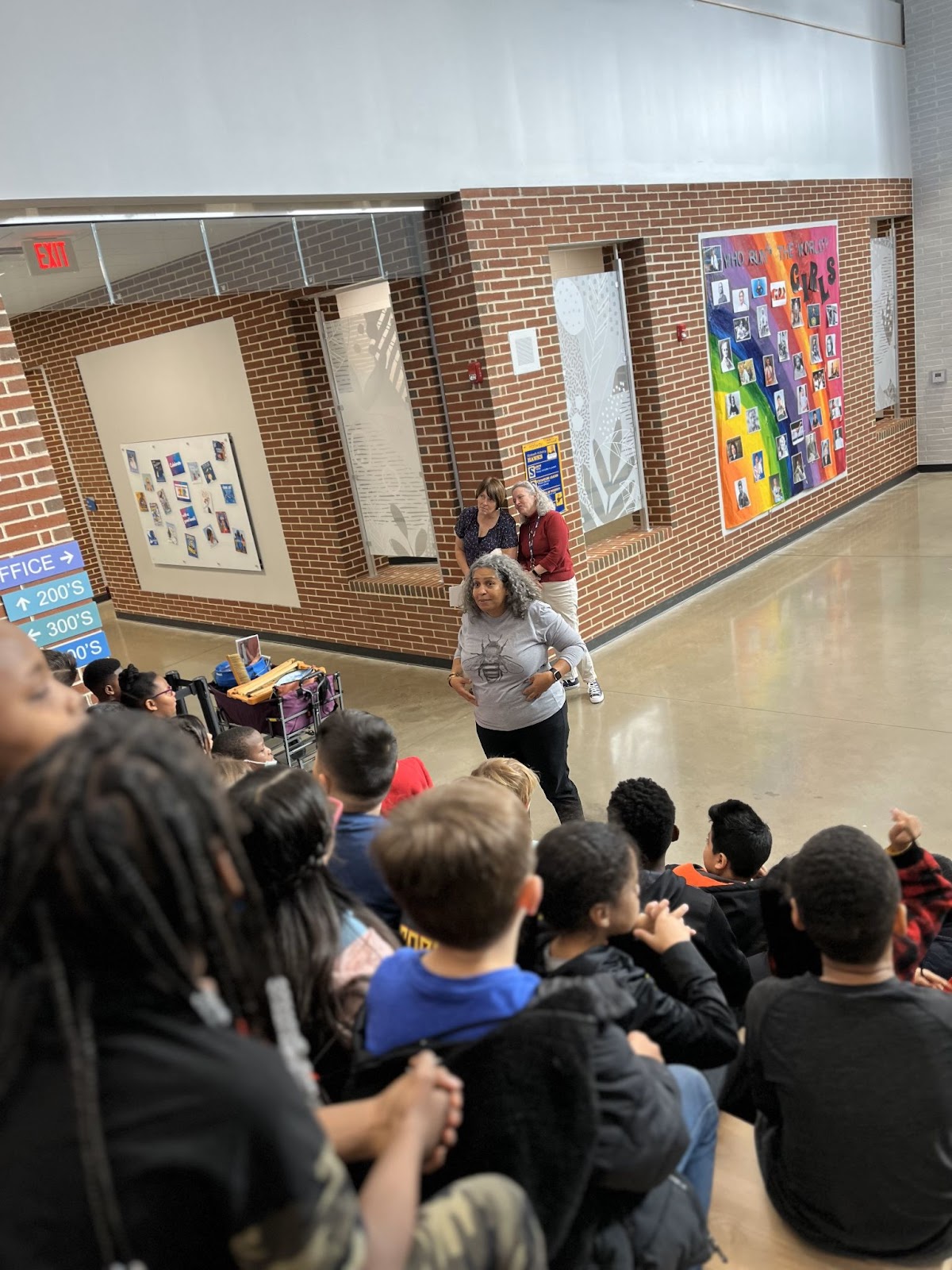
A: I am so delighted that I have the opportunity to share my love of honeybees and beekeeping with students and adults on a regular basis. Rick McCormick got me started sharing about bees during Maymont’s summer camp. This year, I was able to provide professional development to staff at Maymont in addition to work during their summer camp. I also work with students in many schools and organizations such as Fit4Kids. I co-manage the CityBeesRVA program to provide access to community members and I have created a BIack Beekeeper Coalition to add more racial and age diversity into the world of beekeeping. We have grown from 4-17 new beekeepers within a year! I also provide beekeeping classes to students in the Tusome Project, as well as the Cultural Roots HomeSchool Co-op through a grant that I successfully acquired. Through these avenues, I am introducing students (and adults) to not only the wonder of honeybees and beekeeping but environmental science more broadly. Even if participants don’t fall in love with bees and beekeeping, my goal is for them to have a newfound respect for this important insect. cv_KflgDQ-aN4jbZ864TZbSTs-DR3Fkhw36EmeUmlvLgA0avjhsnePBW5dDpgPfUJhPOjT7m4YTl-cofHl3I1RPkCjDWUA8Zm-LNJx1oBDQ4u_MIK-f9zJ-0UZvhhE0R3i9iVSQBIZhB3LLmD9ePIhAUTw2CUmH-gskRtG-d7LbkW8pTZ0WV2z8Ys5cmFLctXqRsfMkjlR7tvQVxczKdeQfSypiDO5inWOkeGa9ujfNWlNmIKcQao3wPwxzEy8cx_pUZwh16OP_io_q4AB-36Q3rl5m3Gu01mXqCbd8e4nTdig

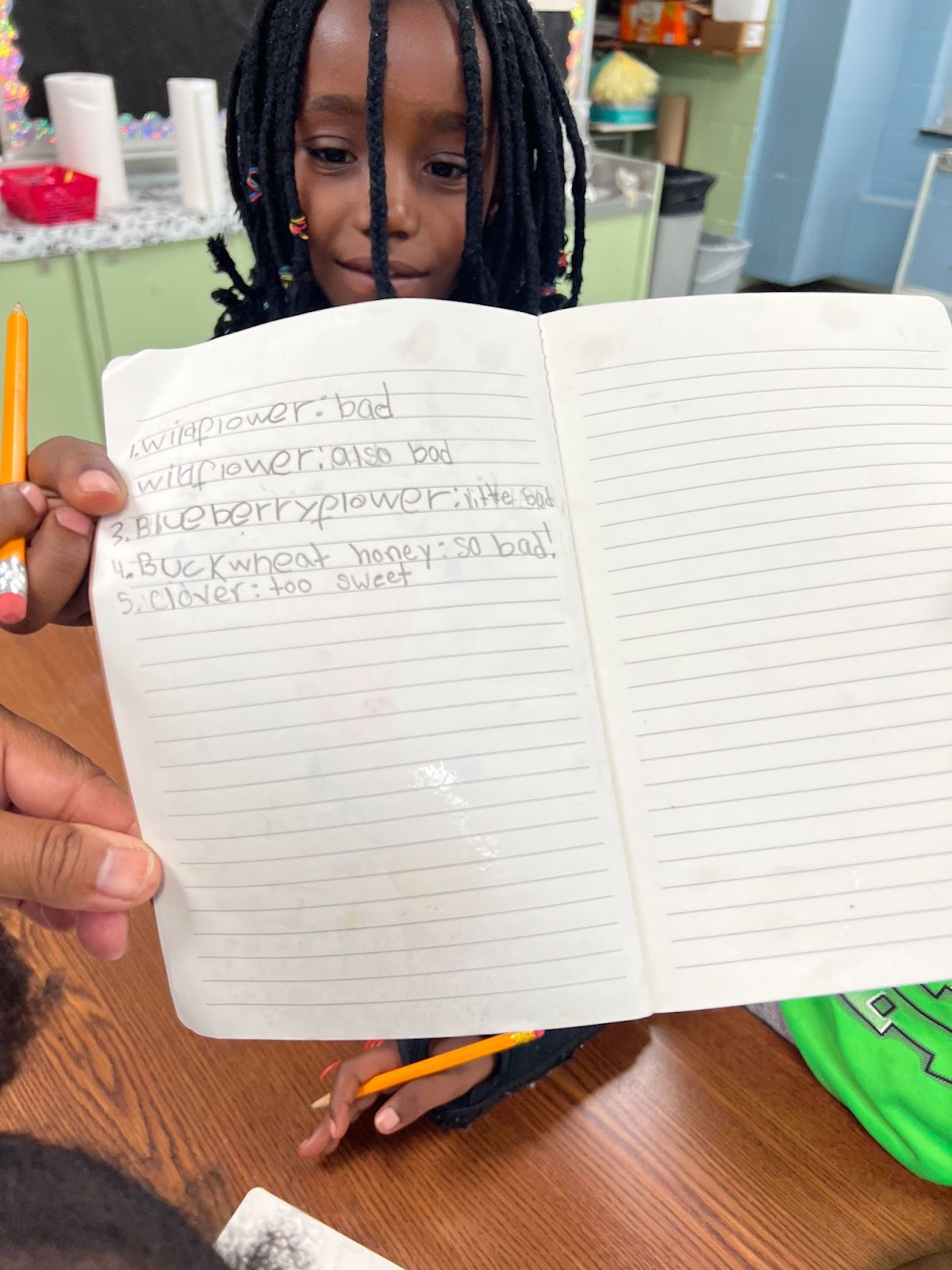
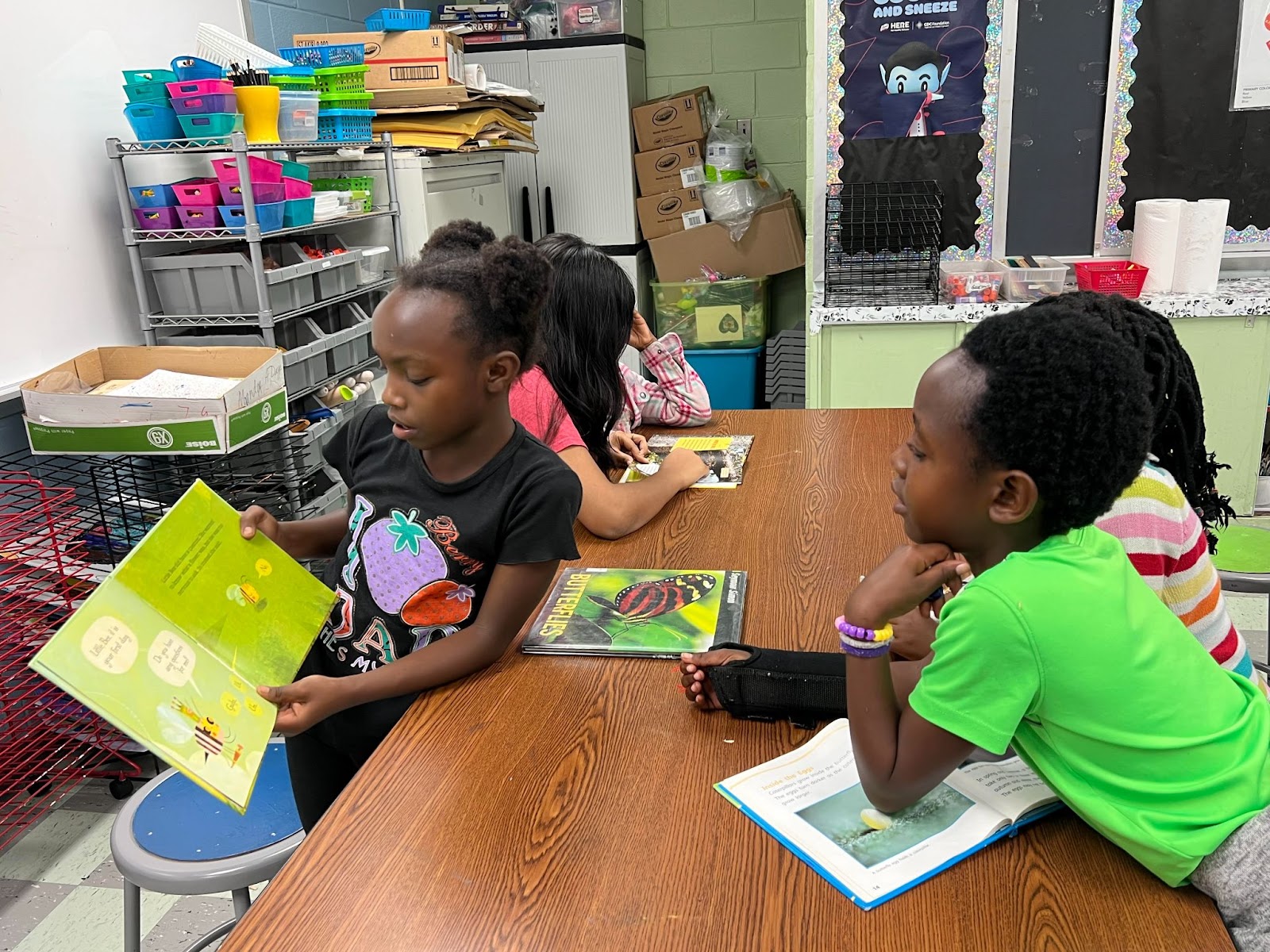
(left pic: Tusome Pamoja students reading bee books to each other. Right pic: The buckwheat honey did not go over well during the honey tasting in class.)

Bee Vocabulary – “candy board”

A candy board is a hardened sugar mixture that’s made to be emergency feed during times of cold weather. Think of it as a large sugar cube. It is placed inside the hive, sitting on top of your frames, just below the inner cover.

Final Word

If you are not a member of RPBBA, we encourage you to join and be active. You can join via our website. If you are a honeybee enthusiast looking to get started, check out the Beginner Beekeeping course.

We are always looking for ways to improve communications in the club. If you have any ideas or suggestions, please let me know.

-Hollee

Hollee Freeman
Communications 🐝

Check us out at rockwoodbeekeepers.com!
Like us on Facebook!
Join our Facebook RPBBA Practical Beekeeping Group!
Keep up with what RPBBA is doing, see Calendar of Events!

*****************************************************************************
This is the official Rockwood Park Backyard Beekeepers email. RPBBA will never share your email with anyone outside of the organization or for non-club-related business without your permission. If you wish to update your email or be removed from our email list please complete this form.

RPBBA October newsletter ENJOY!

Hello beekeepers and honey bee enthusiasts,

Hopefully your bees are finally settling down as we ease into cooler weather. Be attentive- hive pests such as the small hive beetle and wax moths may be on the rise. For those who attended any of the workshops held recently on winter prep, we hope that you now have additional information to help you get your colonies as strong and healthy as possible going into the winter months.

If anyone out there is still looking for guidance, the club is here with many smiling faces and tons of experience to help. The RPBBA Practical Beekeeping Group (Rockwood Park Backyard Beekeepers Group) is a great first start for those who use Facebook. Also, you can also come out to a meeting or email us! There is still time for some last minute preparations.

RPBBA Calendar of Events

📅 We have rescheduled the Club Potluck/Picnic to Monday, Oct 9th @6:30 pm at the Nature Center- This potluck is in lieu of a formal meeting (note: limit of 2 people per member). Come on out to chat with club members and enjoy great food.

A flier and RSVP link was emailed to RPBBA members. The club will provide fried chicken, water, and tableware. Please bring

1. A side to share

2. Lawn chairs

3. Any soft drinks you might like

Alcohol is NOT permitted on the property.

If you have not already RSVP’d on SignUpGenius, now is the time. When you sign up, please leave a comment to let everyone know what you plan to bring. Thanks in advance. Add to Google Calendar We hope members and their families can join us.

📅 Monday, Oct 16th @7pm – VSBA Master Beekeeping Study Group

This study group meets monthly on the 3rd Monday of each month. The study group is a great way for RPBBA members to deepen their beekeeping knowledge. We are making our way through the VSBA Apprentice Study Guide. In addition to going through the study group content, we discuss and problem-solve for what folks are experiencing in their hives. The study group is open to all members who want to learn and there is no requirement for attendees to pursue certification.

The Annual Holiday Party will be held on Dec 11th. Stay tuned for more details.

Beginning Beekeepers Classes will start on Saturday Feb 2nd at the Nature Center and will continue every 2 weeks for 4 sessions. Watch for details since this class falls up quickly.

Club News – Board of Directors Nominations

It’s that time of year again – time to begin our change of leadership. The Board of Directors consists of a maximum of 9 members per by our By-Laws and Articles of Incorporation. We have 5 Directors (elected in late 2020, for 2021-23). These 2 years terms are coming to an end for the following people:

  1. Stan Houk

  2. Dennis Marshall

  3. Rick McCormick

  4. Steve Syrett

  5. Kyree Tanner

As a club, we can choose to renew the Board of Directors for another 2 year term or replace them with newly nominated and elected members.

The role of the Board of Directors (BOD) is to select Officers (President, Vice President, Secretary, Treasurer, Communications) for next year, vote on club business, and oversee the functions of the club (e.g. the club picnic, holiday party, selecting a Honey Bee Festival chair, etc). The BOD meets a few times a year, as needed, for discussion. If you wish to nominate someone for the Board of Directors or even volunteer yourself, please send an email to rockwood.beekeepers November 1st. Each person nominated to serve on the Board of Directors will be contacted by a member of the Nominating Committee to confirm their interest & willingness to serve.

Speaking of the Nominating Committee, the club is in need of volunteers to join the Nominating Committee. Any RPBBA member can make nominations. However the purpose of the Nominating Committee is to receive the nominations, verify willingness to serve with those nominated, and put forth a slate of candidates for election. This committee should have at least 3 members. If you are interested and willing to volunteer as a member of the nominating committee, please email rockwood.beekeepers November 1st. The club needs you.

Please consider volunteering or, if you are nominated, please consider serving. We need new ideas, new perspectives and can always use more energy from new people helping. Your involvement in the club helps make RPBBA the best it can be. Thank you.

Members of the club will visit the site of the Chesterfield County Fairgrounds soon to begin to plan for the Honey Bee Festival. Send us an email if you are interested in helping out with this walk-through.

Yeuin5Yri8I0qg9eBpYflYlaIg80mjFQYXkcjGaZMuWpZSBhSRPL83OboQkuJDU_8F87e95GvLo60_cGGKIHPGpt20inhD8rnYJ8uS4EiKpTj3ig0SuPAFxO49SCc9a9y0_akRnpD9cm9QpoObhc9Tc

Virginia State Beekeepers Association (VSBA)

Reminder: VSBA Annual Meeting and Master Beekeeper Testing

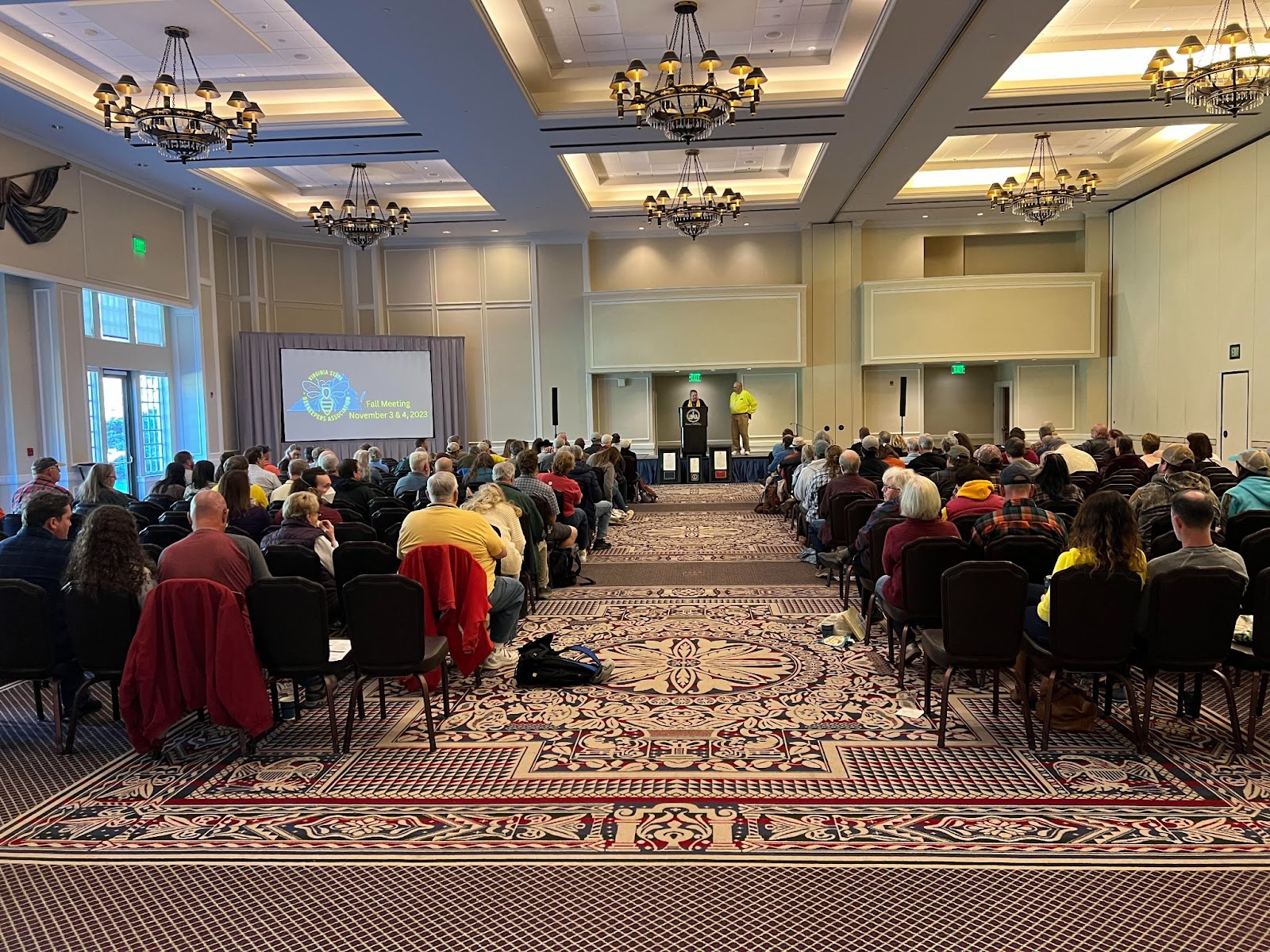
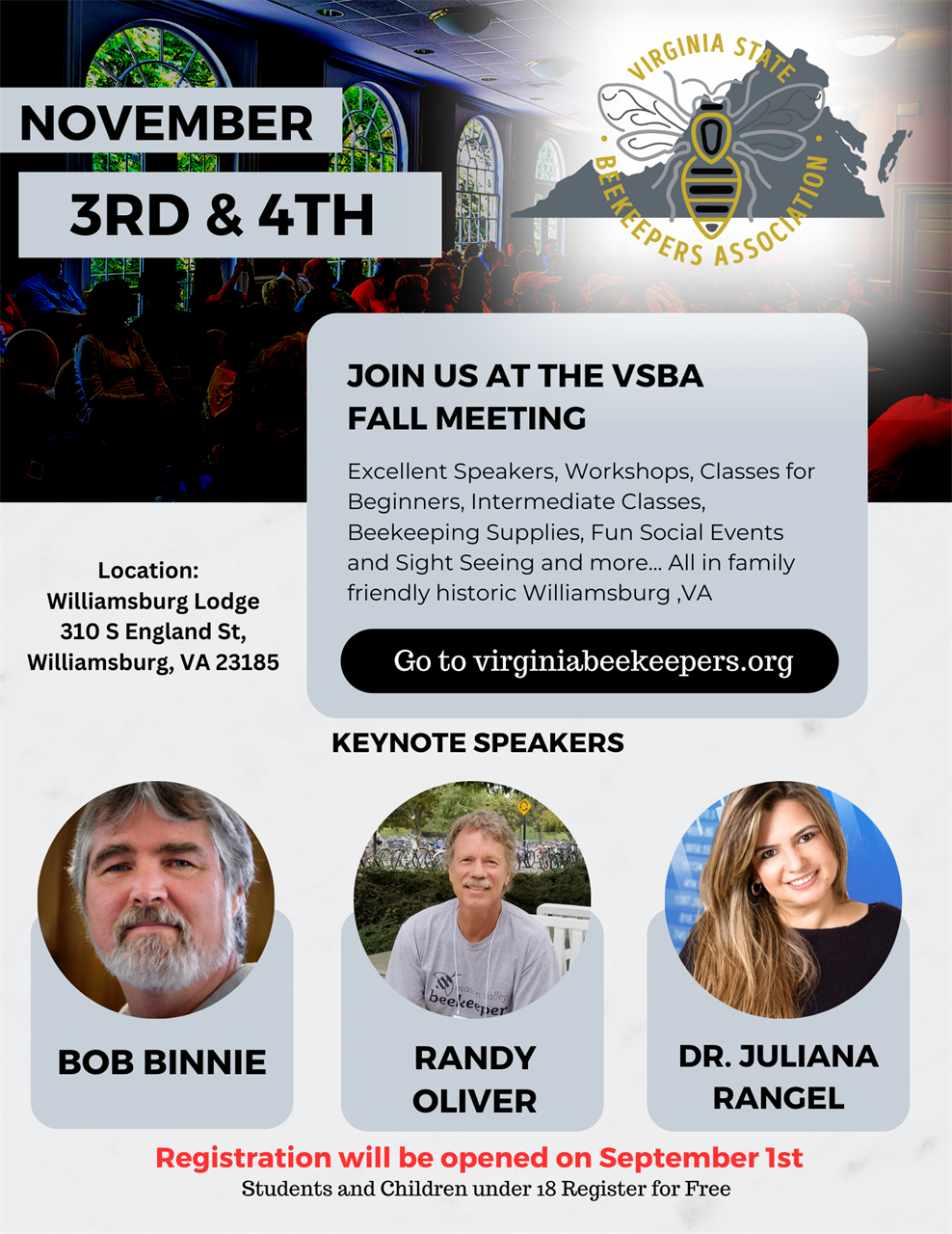
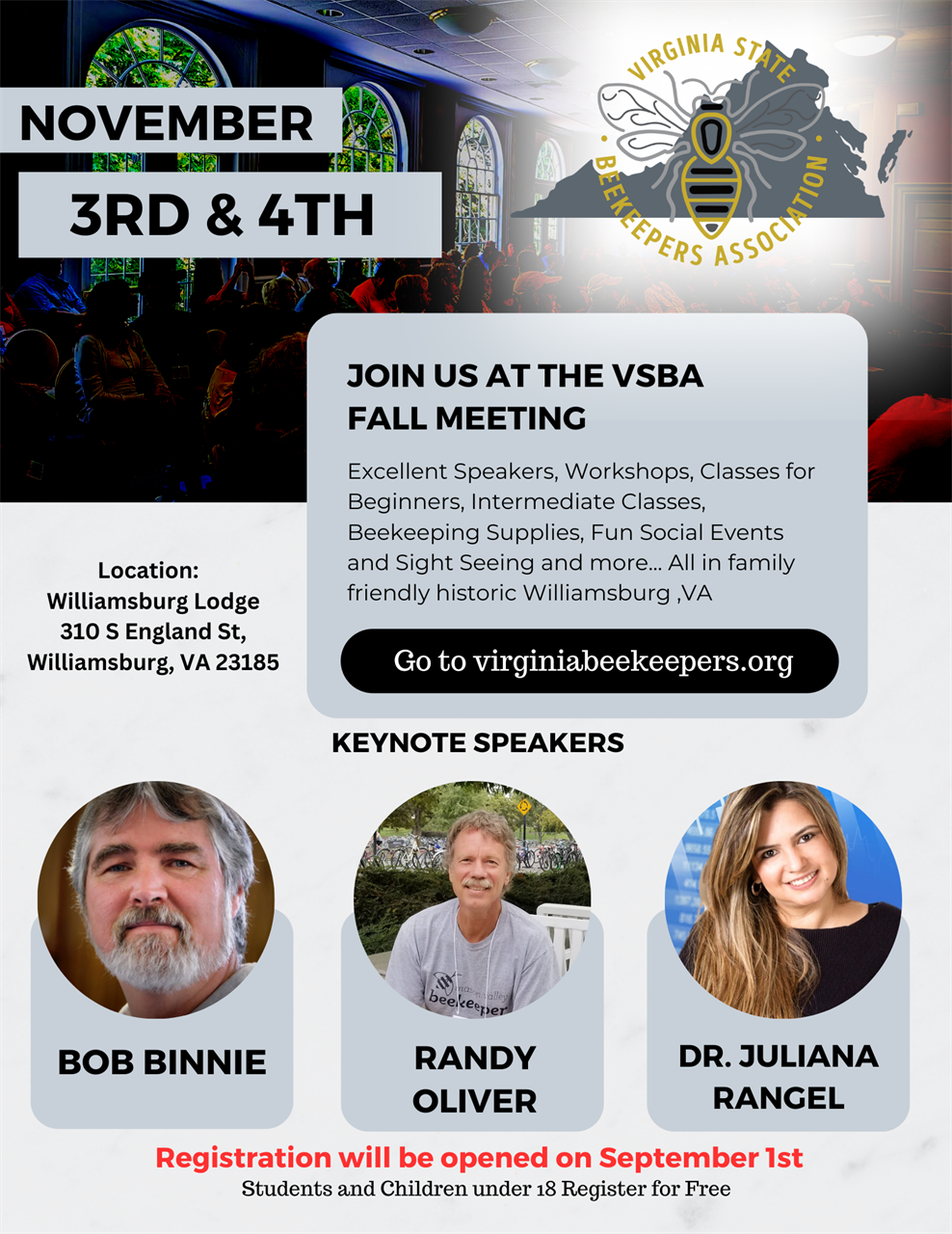
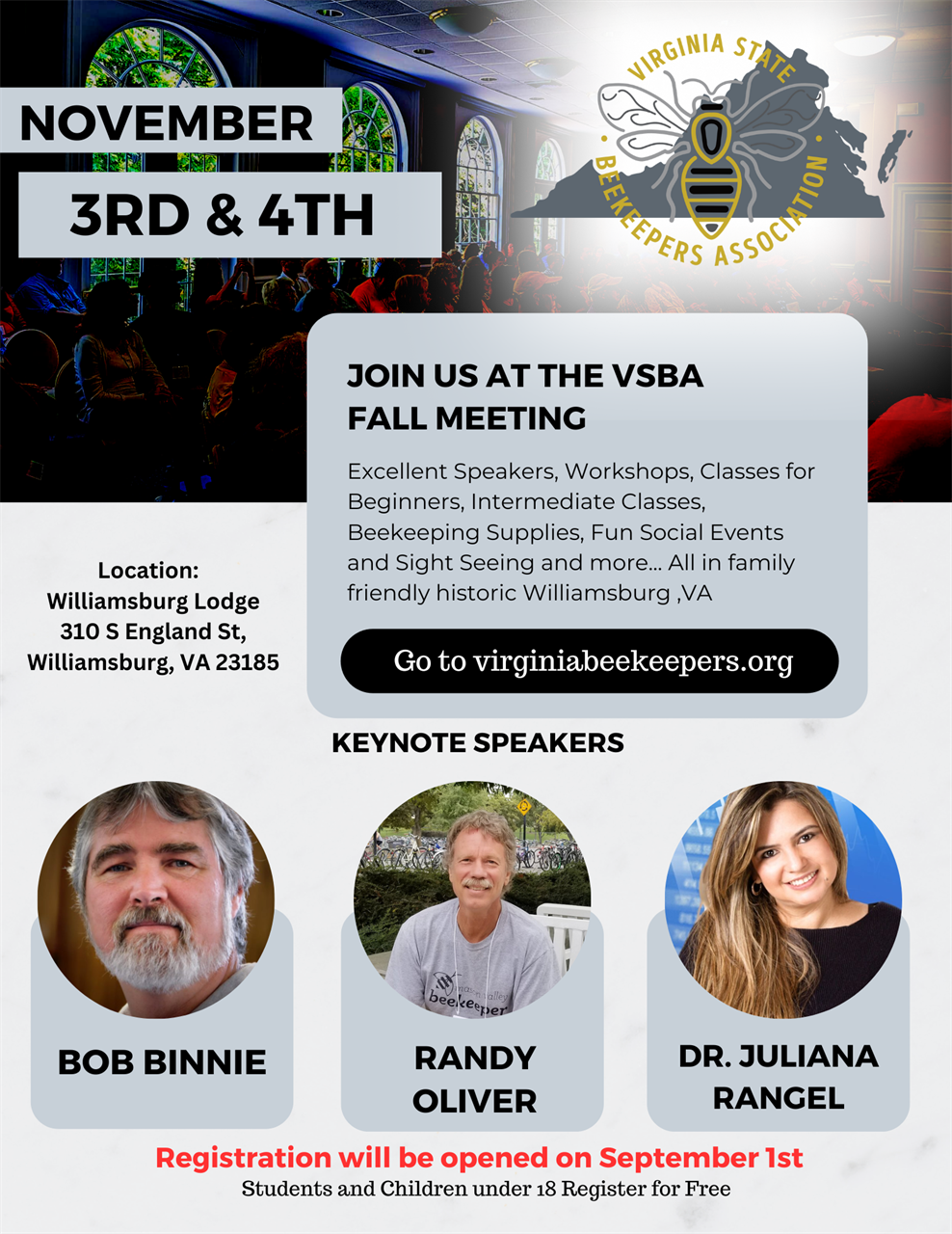
The Fall VSBA meeting will be November 3 & 4th in Williamsburg, VA. Lots of educational and engaging workshops and activities. Randy Oliver, one of the premier honeybee researchers in the U.S. will give presentations along with many others.

Testing for Apprentice, Journeyman, and Master Beekeeper certifications also takes place at the VSBA. If you’re behind on your studying, consider coming to the study group. More information about the VSBA programs can be found on their website: https://www.virginiabeekeepers.org/

Girls Who Hike Virginia, (a 501(c)(3) nonprofit), is looking for donations of honey sticks or other items for their Adventure Summit in October. They expect approximately 80 attendees and would love for them to have a honey stick for their hike. Find out more about Girls Who Hike Virginia from their social media or website https://www.gwhva.org/page/1938622-about-us

iWfINtjcAsElf0NZLvzgrLbqMwJGosTOYQeMvMjsnChWMQZRVrAqgslTkveKhNwBaGv3H7Jdgq9ApuFHu8QSsRh0bv1aIf15GA0FKzIFQN9opdSj0YM9-ZsTFP1K36YURyjo25rbEpcsyl6NdQlmvcM

Meet Your Friendly Neighborhood Beekeeper: Jacob Schwartz

Q: How long have you been a beekeeper and how many hives do you manage?

A: I have been a beekeeper for 3 years and I currently manage 9 Colonies.

Q: What inspired you to become a beekeeper?

A: When I was a child around the age of 10-12 years old, I loved to visit the zoo in my hometown. My favorite part of the zoo was to visit the honeybee exhibit! I could stand there for hours (while the rest of my family saw the rest of the zoo) and watch the bees work away, always trying to strengthen and grow the colony. I was fascinated that each bee knew exactly what they’re role was in the hive and that they had a specific job and purpose. Bees were so fascinating and I knew from that moment that someday, I’d love to learn more about bees and eventually own bees!

Q: What is the best thing about beekeeping for you?

A: Currently I have come to enjoy teaching new beekeepers how to manage and keep bees. When I started beekeeping, I was extremely hungry for knowledge and learned everything I could either read and experience whether or not it was in my own hives or in Jody and Theo’s hives at Dandelion Springs Apiary. With many mentors teaching me how to manage my own bees, I eventually found fulfillment in spreading all the lessons and opportunities I had been blessed with by great mentors. Though I am a young beekeeper with much to learn, I enjoy working shoulder to shoulder with new beekeepers that are diving into the world of beekeeping. The sense of accomplishment when those beekeepers do well the next season is amazing to say the least.

Q: What’s challenging about beekeeping for you?

A: The most challenging thing for myself in the world of beekeeping is to not overextend. I know every beekeeper has dreams of managing x amount of hives and trying different methods as they learn and grow. The issue I have is wanting to overextend past the bandwidth I have. Understanding where all of your commitments are whether it be financial, work, school, family commitments, etc. can be hard to manage together no less throwing on management of many hives and all their different intricacies and issues. The best way I try to deal with this is to under commit and try to over perform.

Q: What fun, surprising story would you like to share?

A: My wife would tell you that the best part of my beekeeping experience is beeing chased out of my yard by angry bees but my favorite beekeeping story was when my neighbor and I were asked if we’d be willing to do a cut-out for a family that had an issue with bees inside the overhanging porch roof. My neighbor and I are not carpenters and we made sure the home owners knew that before we came to cut into their home. That being said…we were able to cut a small section out of the roof area to get into this sealed off overhang space that was inaccessible to manage without cutting into it. The only issue with the hole we cut was that there was a metal liner in the roof that we were not able to cut

through once we made the initial hole. aQa-OzjISZFbbqagmp7Y_z1vfHM6CdeUd-cV8wvbsIeCglP-APj0OLtd7y5O5qQTWDifosPo0XRlM_yy8wyneRXtRSBKUtHVI-YIvTozpr1HRpcV8JWYz-RwS-gSXc1tDgp0HWOO7KGsyAq3u12gXEI

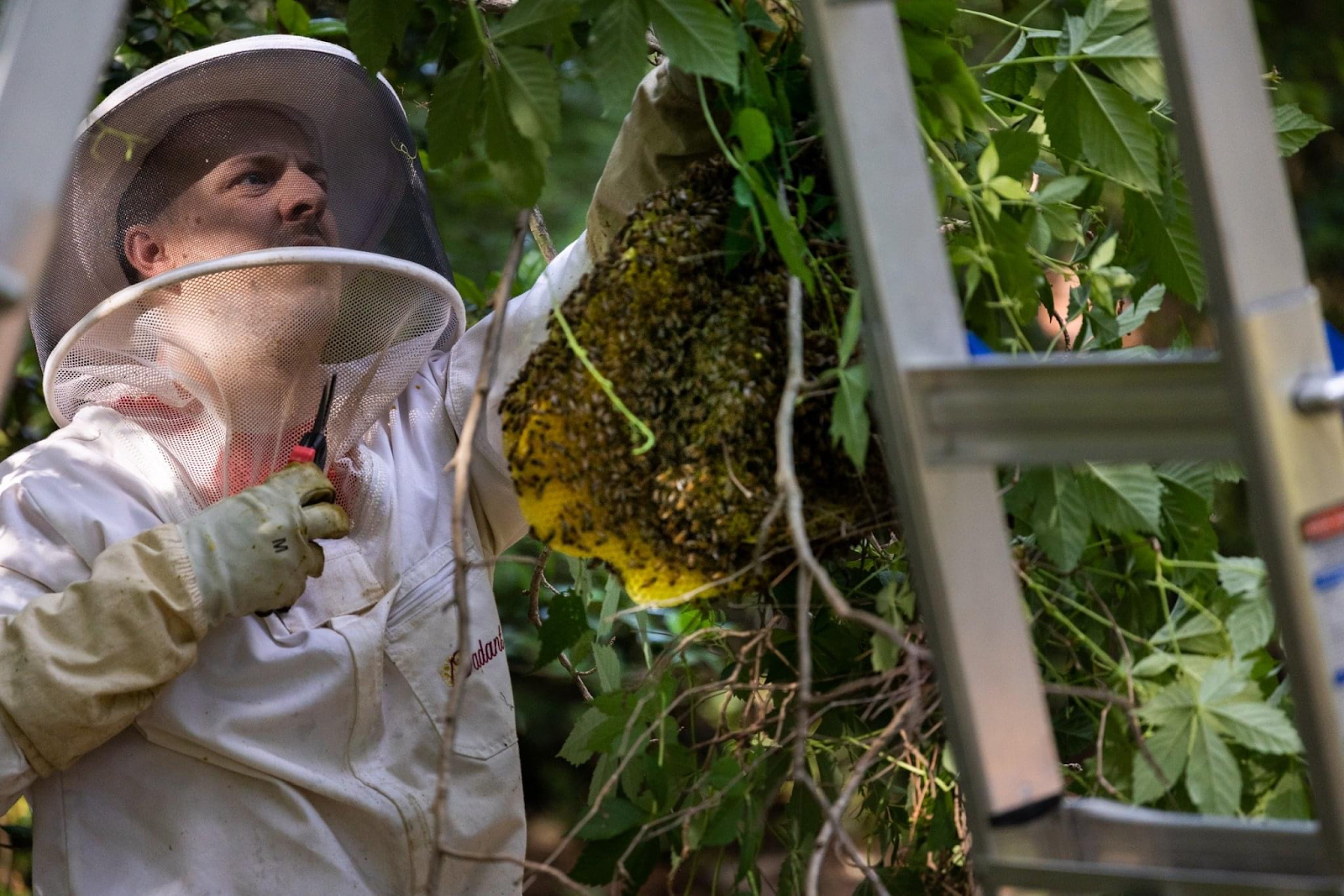
Luckily for my neighbor, he was not small enough to get into the roof space to extract the bees. Which meant that I was nominated to crawl into the dark space with upwards of 80k bees (it was a massive hive that had probably been there for years). It ended up being so tight in that area that I could practically just move my arms and look left and right and I had the uncomfortable thought of “what if my suit were to fail right now and these bees became extremely mad…”. Luckily for me we were doing the removal in the spring during the honey flow and they were the most gentle bees I’ve ever experienced. They literally let me scoop them out of the main cluster with only a medical glove. We managed to get all of the bees out of the overhang space when I made the mistake shifting my weight and almost falling though their roof! Thankfully I only broke their drywall under the overhang and not all of my bones on the concrete porch below lol. At the end of the day we made out with homemade cooking from the homeowners, a large amount of honeycomb, and 2 hives worth of free honeybees!

Q: In what ways do you feel like you are making an impact on the environment and/or the community?

A:I try to make a small difference in the local environment by supporting sustainable practices when beekeeping. My goal would be to encourage the community to learn as much as they can about all pollinators and how to manage home spaces to best support wildlife and pollinators. I try to use my hives as a talking point to do this. The best impact I have on my community is to assist new beekeepers in learning the ropes and encouraging them to seek as much knowledge on beekeeping as they can.koEp7-TgW7RrGvz_OKcgZq1A6k-jg2mrMNlGvJ8fzonYH7Hx35m01Cyrg8vtS7Jce6Q6d6TGf1n1EpfX9yatTwwsAZpMAC5zRQK0xtP51VM1A6asT4_6xMM6-2gbyzwk3frI2xnO8D2fNuVt39s48Ks

Thank you for the opportunity to share my experiences, stories, and thoughts on beekeeping!

Beekeepers in the News
As you may know, Hollee has been working hard to introduce lots of people to the beauty and wonder of beekeeping and to diversify the cadre of local beekeepers. Her film, Beekeeping While Black: The Sacred Power of Bees has been accepted to another film festival! You can watch this 19 minute film here: https://youtu.be/hpod4jvh1Nk?si=cLeRfVOc18TPjaLb

If you have news items to share, please send them to the Rockwood email.

Bee Vocabulary – “Corbicula”

Also known as the Pollen Basket. This is a flattened depression on the outside of the bee’s back legs. It is used to carry collected pollen from flowers back to the hive. As the bee returns to the hive the beekeeper can often see full pollen baskets in a variety of vibrant colors.

This Month in the Hive (October)

The bees are settling down for the winter. Varroa mites may or may not be under control–time to work on this in earnest, if you haven’t already. You may see considerably more propolis as bees reduce their entrances and drafts. Egg laying has probably slowed to 200-300 per day. However, look for continued egg production and capped brood, as new bees are needed to keep the population strong for the winter. On cold nights, the cluster forms around the queen, and may remain tight until temperatures rise. Drones are gone by month end in almost all hives.

Typically in Central VA, the frost does not come until after mid October. Before this time, some gathering of nectar may still be occurring. Asters, daisies, and goldenrod may provide substantial amounts of pollen for winter brood.

There’s a lot to do to get ready for winter:

  • don’t forget to attend your bee club meeting

  • watch for robbing on warm days

  • mitigate pests including mice by installing mouse guards, after making sure there is no mouse inside the brood boxes

  • combine weak hives

  • finish feeding sugar solutions for the winter

  • remove all honey supers not intended as a source of honey for the winter

  • remove chemical strips, if you used them (assuming you have had them on for the required number of days)

  • reserve packages or nucleus hives for next April

  • install the plastic insert on the bottom of the screened bottom board if you use screened bottom boards. If you use solid bottom boards, decide whether to reverse the boards to utilize the small entrance on the “winter” side of the bottom board.

[From Northern Virginia Honeybee Annual Cycle]]

Final Word

If you are a member of RPBBA, you will receive a separate email with the Board of Directors election ballot. Please be on the lookout for it! If you are not a member of RPBBA, we encourage you to join and be active. You can join on our website.

We are always looking for ways to improve communications in the club. If you have any ideas or suggestions, please let me know.

I hope to see you at the meeting on Monday, October 9th at the Nature Center.

Hollee Freeman
Communications 🐝

Check us out at rockwoodbeekeepers.com!
Like us on Facebook!
Join our Facebook RPBBA Practical Beekeeping Group!
Keep up with what RPBBA is doing, see Calendar of Events!

*****************************************************************************
This is the official Rockwood Park Backyard Beekeepers email. RPBBA will never share your email with anyone outside of the organization or for non-club-related business without your permission. If you wish to update your email or be removed from our email list please complete this form.

2023 VA. State Fair

Sharing the below on behalf of RBA
🐝🐝🐝🐝🐝🐝🐝🐝🐝🐝🐝🐝🐝🐝

Hello All

It is time for the State Fair of VA 2023 and again this year the Richmond Beekeepers Association will be sponsoring the Virginia Beekeepers Honey Booth.  This year as in the past we will need volunteers from all the bee associations to work the booth.  The State Fair of VA runs for 10 days, starting Friday September 22nd thru Sunday, October 1st.  We will need volunteers to fill two shifts a day, first shift 10:00am to 4:00 pm and the second shift 4:00pm to 9:00pm each of the 10 days.  The volunteer’s bee association will receive a portion of the profits made from the sale of honey and other products of the hive, based on the number of shifts worked.  This is a great way to earn money for your club and also meet other beekeepers from the central Virginia area.  All beekeepers in VA can sell their honey at the VA Beekeepers Honey Booth.  The honey must be properly labeled with their contact information and they must  also volunteer to work at least one shift in the honey booth.  The beekeeper will receive wholesale price for their honey sold minus 22% which goes to pay fees for the booth, taxes, insurance and other expenses incurred in running the honey booth. The beekeeper needs to bring their products to Meadow Pavilion on Thursday September 21st between 3:00pm and 7:00pm.

The State Fair of VA is located at Meadow Farm in Doswell, VA (just past Kings Dominion) in the Meadow Pavilion with other agriculture displays.  Admission tickets will be sent to each volunteer for each day worked.

We will be using SignUpGenius again this year for volunteers to sign up for their shift or shifts they wish to work.  The link is http://bit.ly/vastatefair.  Once you have signed up you will receive conformation via email.  If you have any questions or concerns or need help to sign up please contact Steve White at 804-337-9235 or email slwhite63@gmail.com or Gay Stapleton at 804-672-8408 or email at rbrtstapleton@yahoo.com.

Bob Stapleton,

Honey Booth Co-Chairman

RPBBA newsletter Sept 2023

Hello beekeepers and honeybee enthusiasts!

We are experiencing the hottest summer on record since 1940 when records first collected (UN World Meteorological Organization and European Climate Service)! Even though it’s hot hot hot, it’s time to think about preparations for overwintering. Lots to think about: maybe a final honey harvest, feeding, treating for mites, combining weak hives with strong ones, etc. We will be covering all that and more at our meeting this month. Come on out and get some valuable information. 

September Meeting & Study Group

Our meeting this month will be 7pm, Monday, September 11th at the Rockwood Park Nature Center. We will discuss Fall actions needed to prepare hives for winter. Whether this will be your 1st winter or you’re a seasoned beekeeper, this is good information to have and share. We hope to see you all there. Doors open at 6:30pm. Add to Google Calendar

Study group meets on September 18th at 7pm at the Rockwood Park Nature Center.

RPBBA Club Picnic 

The club picnic will be held on September 23rd from 4-8pm at Gregory’s Pond Fishing Club (3501 Gregory Pond Rd).  If you have not already marked your calendar and RSVP’d on SignUp Genius, now’s the time. Add to Google Calendar We hope all members and their families can join us. A flier and RSVP link was emailed to RPBBA members. The association will provide fried chicken, soft drinks/water & tableware. Please sign up to bring: 

  1. A Side to Share
  2. Lawn Chairs
  3. A Picnic Blanket for your family 

Grills will be set up in case anyone needs them. Alcohol is permitted, BYOB, but please keep in mind this is a family-style event. Fishing is allowed from the pond, BYOP&B, bring your own pole & bait. If you’ve got other fun outdoor games like cornhole or horse shoes, bring ’em!

Virginia State Beekeepers Association (VSBA)

Join us at the VSBA fall meeting. There will be engaging speakers, workshops for beginner and intermediate beekeepers, supplies, fun social events, sightseeing and more! 

Come meet beekeepers from far and wide, learn some important information and talk about bees all weekend! What could be better? Nothing! 

See the VSBA website for details and to register https://www.virginiabeekeepers.org/

State Fair of Virginia

The always fun State Fair of Virginia will take place at Meadow Farm in Doswell, VA (just past Kings Dominion) from Friday, September 22nd- Sunday, October 1st. https://www.statefairva.org/

VDACS Beehive Distribution Program

Applications for the program are currently being accepted through September 12th 

https://www.vdacs.virginia.gov/plant-industry-services-beehive-distribution-program.shtml

Beekeepers in the News

The Virginia Climate Action folks visited Hollee’s apiary for a workshop on National Honeybee Day. Together they completed a hive inspection and honey extraction. It was a great event for a great cause. Huge thanks to Mr. C for the assist. 

Meet Your Friendly Neighborhood Beekeeper: Christine Moran 

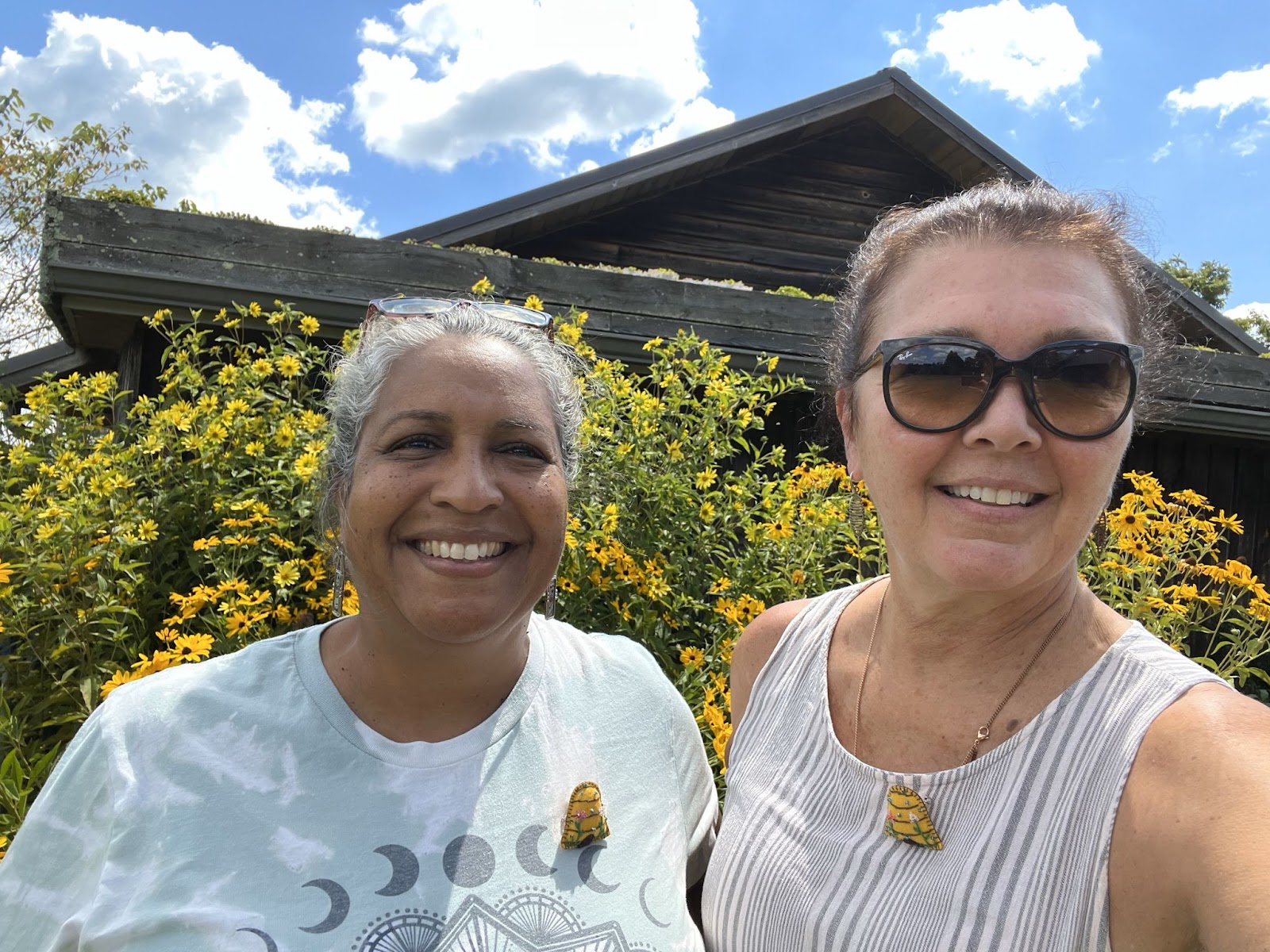
[Hollee (L) & Christy (R) at Spikenard Farm Honeybee Sanctuary learning about biodynamic beekeeping.]

Q: How long have you been a beekeeper and how many hives do you manage?

A: I began beekeeping in 2016 under the mentorship of Rick McCormick. In a good year, I have 6 hives and in a low year 2.

Q: What inspired you to become a beekeeper?

A: I was certified as a Master Gardener a few years previously. I became interested in how native bees, bumblebees and honey bees contribute to my flowers and vegetables.

Q: What is the best thing about beekeeping for you?

A:   During the pandemic, I was home 24/7. We have one acre with no grass!! So, I began to watch ALL the bees on our property. When one is moving too fast, the tiny native bees are missed. I love watching the bumblebees play as they gather. I have also learned to respect the contribution of wasps. I maintain all sorts of habitats on the property for all the pollinators. I worry about butterflies. Their population is low, but I keep their resources active.

Q: What’s challenging about beekeeping for you?

A: My greatest challenge is SHB!! I’m constantly reading and recently visited Spikenard Sanctuary to learn their methods.

Q: What fun, surprising story would you like to share?

A:  Rick was helping me inspect a large hive. I cover each box with a towel to keep the girls calm. It was standing at least 5 high when the whole stack fell over.  We both were shocked and laughing at the same time! Because of the towels, the girls were relatively calm. Inspection proceeded!🐝(This bee inspection episode was recorded!!)

 Q: In what ways do you feel like you are making an impact on the environment and/or the community?

A:  I believe in leading by example. If I can show or tell one person about bees and sustainable living, then I have succeeded!🐝

This Month in the Hive 

As John Davis mentioned during our August club meeting, this is the perfect time to think about your goals for fall/winter, what steps you will take to get there, and what resources you need.

The hive population is decreasing due to reduced egg-laying by the queen. Also, drones may begin to get kicked out of the colony toward the end of this month. Typically, we have a frost in mid-October and the bees will begin to cluster when the temperature inside the hive drops below 57 degrees.

In a year with adequate rainfall (4-6 inches, spread across the month), asters, daisies, ragweed, clovers, tickseed, and goldenrod may provide substantial sources of nectar. In these conditions, strong hives may make up to 20 pounds of honey during September. 

In years with drought conditions, however, September can be disastrous for the hive, with the bees consuming the honey and pollen that should be saved for winter.Feeding of syrup and pollen substitutes may be essential since September is proving to be a month with very little rainfall. 

Consider removing the queen excluder if you left it on the hives after the harvest. Check on the queen. If you are going to use it, feed and medicate with Fumagillin in syrup to fight nosema towards the end of the month. (Only the first 2 gallons of syrup per hive are medicated if you are using it.) Add chemical mite treatments if you did not do so in August and if you are using those treatments. Now is the time to use menthol crystals for tracheal mite control, if you are going to do so. If it is dry, or you made up splits in July, feeding continues until the bees will take no more syrup.

[adapted from https://buzzwordhoney.com/wp-content/uploads/2012/12/Northern-Virginia-Honeybee-Annual-Cycle.pdf]

Bee Vocabulary – “candy board”

A candy board is a way to feed your bees through winter. During colder temperatures, the honeybees will form a cluster to keep warm. As they eat through their food stores, they’ll move upward in the hive. A beekeeper can make a candy board and place it at the top of the hive to supplement feeding to avoid starvation. There are various mixtures for candy boards. Think of it like a large sugar block or sugar brownie.

Final Word

If you are not a member of RPBBA, we encourage you to join and be active. There is a constant flow of activities within the club to be as active as you want to be. You can join on our website.

If you have an event that you’d like to share or if you would like to be featured in our Beekeeper for the Month, please email 

We are always looking for ways to improve communications in the club. If you have any ideas or suggestions, please send an email to rockwood.beekepers@gmail.com

We hope to see you at the meeting 7pm, Monday, September 11th at the Rockwood Park Nature Center. Our club meetings are open to members and non-members with no pressure to join. I hope you can bee there!

Attend bee meetings and state and local fairs and festivals. Give honey to your neighbors, and make sure they understand how good the bees are for gardens, flowers, and the growing environment in general.

-Hollee

VDACS Beehive Distribution Program

Applications for the Beehive Distribution Program (Program) will be accepted August 28, 2023, through September 12, 2023. When the application period opens on August 28, a link to an online application will be made available on the program’s webpage.

The Program provides equipment directly to eligible individuals for the construction of new beehives. Residents of the Commonwealth of Virginia who are 18 years of age or older at the time an application is submitted may apply during the application period to receive up to three (3) beehive units per year. No more than three (3) beehive units may be distributed per household. Recipients of beehive units will be selected at random from qualifying applications.

For more information on the program, equipment options and eligibility visit https://www.vdacs.virginia.gov/plant-industry-services-beehive-distribution-program.shtml

August Newsletter RPBBA

Hello fellow beekeepers and honeybee enthusiasts!

Have you been in your apiary lately? If so, you may have noticed that your sweet Spring honey bees have turned into feisty, defensive, Summer honey bees. Also, the dearth is here and with less pollen and nectar sources available, bees may very well begin robbing. At this point in the season, you are likely noticing an uptick in hive pests. Now is the time to test and treat for Varroa mites. Also, watch for small hive beetles and wax moths.

RPBBA Calendar of Events for August 

📅 Monday, Aug 14th – RPBBA Meeting @ 7pm at the Rockwood Park Nature Center

📅 Monday, Aug 21th – Study Group @ 7pm at the Rockwood Park Nature Center

🐝 Saturday, Aug 19th – National Honey Bee Day

August Meeting

Our meeting this month will focus on Varroa mites. RPBBA member John Davis will lead the presentation, which is sure to provide new and engaging information! Doors open at 6:30pm for socializing, sharing about your hives and asking general questions. The meeting starts at 7pm. Add to Google Calendar

National Honey Bee Day

Saturday, August 19th is National Honey Bee Day 2022 in the United States. National Honey Bee Day (formerly National Honey Bee Awareness Day) is an opportunity to recognize the contribution of honeybees to our collective lives and to draw attention to the need to protect this critical species. National Honey Bee Day also pays homage to beekeepers, whose labors ensure there are well-managed, healthy bees to pollinate crops.

Virginia State Beekeepers Association (VSBA)

Beekeepers in the News

Our member, Hollee Freeman was featured on CBS6 this month for her efforts to expand the world of beekeeping, particularly for BIPOC folks through her organization, City Bees RVA. She has increased the number of BIPOC beekeepers (and those interested in beekeeping) in the Metro Richmond region from 4 to 17 in one year! 

Feel free to watch the story here.

https://www.wtvr.com/news/local-news/bees-rva-july-19-2023?fbclid=IwAR052gcyJjdaknmfWjTHgUjEEDrXzDh2vvfbgqhQ9U5iZswbx54rApewEr8

  Meet Your Friendly Neighborhood Beekeeper: Jimmy Rheinhart   

Q: How long have you been a beekeeper and how many hives do you manage?

A:  I have been a beekeeper since 2020, starting with 2 hives and currently managing 4 hives.  I am building 2 Long Langstroth Hives to keep and manage in West Virginia next spring.

Q: What inspired you to become a beekeeper?

A:  During Covid, my wife and I saw a documentary about honeybees and pollinators.  That started my research into becoming a backyard beekeeper.

Q: What is the best thing about beekeeping for you?

A:  I enjoy so many aspects of beekeeping, it’s hard to narrow it down to just one.  I would say, sharing the importance of honeybees and other pollinators with the younger generation.  For some reason, I get a lot of questions when people find out I am a beekeeper.

Q: What’s challenging about beekeeping for you?

A:  For me, the challenge is keeping the hives from swarming, while trying to keep only four hives.  Another challenge, like many beekeepers, it’s keeping the bees alive and thriving throughout the dearth and winter. 

Q: What fun, surprising story would you like to share?

A:  Catching my “first swarm ever” this year was a very memorable experience.  I was working on a car in my driveway when I heard a massive amount of bees flying.  I watched them fly to my swarm trap right in my backyard and stood in the middle of the swarm without a bee jacket or veil.  I was amazed at what was happening all around me.  I sat in my apiary chair and took it all in.  Nature is amazing.

Q: In what ways do you feel like you are making an impact on the environment and/or the community?

A:  My neighbors have said their backyard gardens have produced more in the past couple of years, than they ever have before.  A few of them have also quit using chemical pesticides and put out more habitat for local pollinators.  As for the environment, If we all do a little, a lot can get done.

Bee Vocabulary –  bearding 

We experienced a really hot & humid July and chances are- your bees were bearding. Bearding is when bees congregate on the front of the hive, hang from the bottom board or cluster around the entrance. They do this to provide increased ventilation and regulate the temperature for the bees on the inside. For healthy brood development, the temperature inside the hive needs to be kept between 90-97 degrees F. If there are too many bees inside the hive, fanning may not be enough–so they scoot on outside to decrease the heat load. 

When we have high temperatures and high humidity, bearding is likely to occur. Overcrowding, poor ventilation in the hive can also cause the hive to overheat. Also, in a dearth, there are few nectar-producing flowers available so the bees hang outside on the porch-just like people! 

Bearding is normal bee behavior and the bees should be left alone when they are cooling down their home. The bees know what they are doing. 

Info adapted from https://bestbees.com/ Talk to your Rockwood mentor/friend for more detailed information 🙂 

This month in the Hive (August)

The colony’s brood growth rate is slowing down. Drones are still around, but the workers will soon lose interest in feeding them. Outside activity slows down as the nectar flow decreases and eventually stops. Much of the flight activity is water-gathering, pollen collection, and orientation of new bees. On hot evenings and nights, the bees may beard, making them especially vulnerable to skunks.

Cucumbers, melons, carrots, and pumpkins need honeybees for pollination this month. Net honey production is unlikely in August due to heat and drought. The hive may consume 10 pounds of stored honey or syrup during a dry August.

Watch for a failing queen, especially a queen that is more than 1 year of age. Egg laying should continue at the rate of 400-500 eggs per day, and the brood nest should be at least 14 inches across. Watch for wasps and hornets attacking the hives to steal away live bees for the purpose of feeding their brood. If you have harvested honey, this is the time to examine the hive to make sure there is at least 10 pounds of capped honey-the bees will need this to overwinter.

Watch out for robbing. If you tend to re-queen- this is a good month (or in early September) to do it. Watch for wax moths and small hive beetles; ruthlessly combine hives that are too weak to defend against them now. Take losses now, rather than in the winter.

Many chemical mite treatments should be applied in early August, if they are going to be used. Carefully read the instructions and consider the temperature forecast before any treatment is applied, however. Honeybees may not be able to tolerate harsh chemical treatments combined with high temperatures. However, it is also not wise to allow Varroa mites to parasitize the bees that you hope will carry the hive into early winter.

The bees that are born in August will have to carry the hive through the early winter. Make certain that the hive has enough pollen and honey to generously feed the new brood. Skinny August bees will not make it to February.

[Adapted From https://buzzwordhoney.com/wp-content/uploads/2012/12/Northern-Virginia-Honeybee-Annual-Cycle.pdf]

What’s in Bloom (according to https://www.plantnovanatives.org/bloom-time-table)

Coral honeysuckle, Purple passion flower, Butterfly weed, Wild bergamot, Ox-eye sunflower, Swamp Milkweed, Culver’s root, Orange cornflower, New York ironweed, Buttonbush, Boneset, Blue lobelia, Joe-pye-weed, Early goldenrod, Wingstem, Obedient Plant, New England Aster

Final Word

If you are not a member of RPBBA, we encourage you to join and be active. Our club operates 100% on volunteers. There is a constant flow of activities within the club and a lot of work to be done to share the importance of honeybees. You can be as active as your schedule allows. Check out our website for more information. 

We are always looking for ways to improve communications in the club. If you have any ideas or suggestions, please let me know. If you do a cool thing, email me at the RPBBA email address so I can put it in the newsletter.

I hope to see you at the meeting 7pm, Monday, August 14th at the Rockwood Park Nature Center. Our club meetings are open to members and non-members with no pressure to join. Come on out if you can make it. It’s sure to be a fun, learning experience. 

-Hollee  (please excuse any typos)

RPBBA July Newsletter + zoom link for mtg re: HBF on Thursday

Hello beekeepers and honey bee enthusiasts!

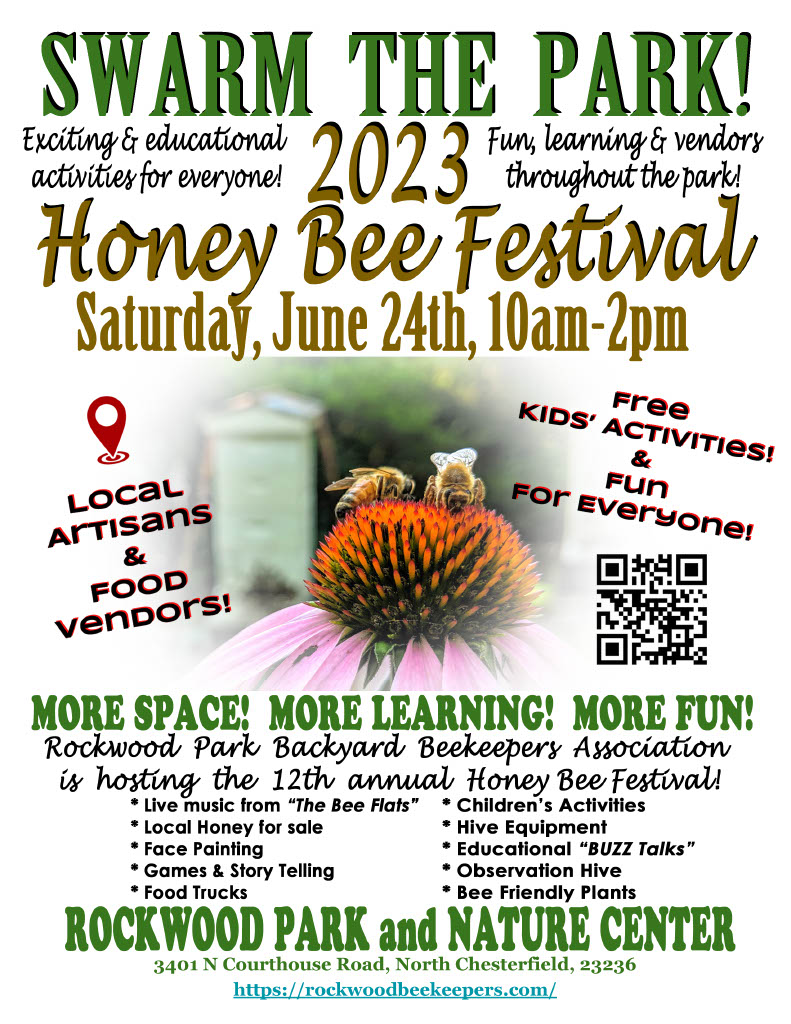
Wow, we did it! The Swarm the Park 12th Annual Honey Bee Festival is in the record books. This event is at the core of our mission of education. I’m sure it gives all of us a boost in pride and gratitude that we have for our fellow volunteers and club members! The day certainly could not have happened without many helping hands. Thank you again to all of our volunteers and club members! I hope everyone has had some time to rest and recuperate from the buzz of preparations and day-of tasks.

If you have not done so already, please fill out the quick feedback form.We would love to get your feedback about your experiences. Your candid feedback will greatly assist us as we begin planning for next year’s festival. Please take a few moments and use this link to provide feedback for us: https://forms.gle/HEhuYMrjhrzjDCXA7

RPBBA Calendar of Events for July

📅 Thursday, July 6th – RPBBA HBF recap meeting via Zoom @ 7pm https://us02web.zoom.us/j/85646333633

📅 Monday, July 10th – RPBBA Meeting @ 7pm at the Rockwood Park Nature Center

📅 Monday, July 17th – Study Group @ 7pm at the Rockwood Park Nature Center

July Meeting

This month, we are going to use our meeting as a time to recap on the Honey Bee Festival and engage with our fellow beekeepers with some lively mini-workshops.

Add to Google Calendar

🐝 VSBA Master Beekeeping Study Group

For those who have never checked it out, the study group is a great way for RPBBA members to further their beekeeping knowledge. Several members have used the study group and were successful in recently passing their State Apprentice exams. However there is no requirement for attendees to pursue certification. The study group is informal and is a good way to learn more about honey bees and beekeeping from veteran and new beekeepers. During the Study Group, questions from the VSBA Apprentice Study Guide are posed for the group to discuss and answer together, as well as any questions that come from the group.

The study group meets monthly on the 3rd Monday of each month. They’ll next be meeting Monday, July 17th, 7pm, at the Nature Center. The group will continue to go through the VSBA Apprentice Study Guide questions, provide answers, and discuss. Those interested to attend are encouraged to download the guide in advance and start working through the questions on their own. Add to Google Calendar

Varroa Mite Workshop

On Tuesday, July 18, 2023 from 8:30am to 12 noon, Dr. James Wilson, VA Tech Collegiate Assistant Professor, and Keith Tignor, VDACS State Apiarist, will present information on the life cycle and control of the Varroa mite. Find out how this pest is impacting honey bee populations and what beekeepers can do to minimize colony losses resulting from Varroa mite infestations. Presentations will include discussion of integrated pest management strategies to control this mite. Both presenters will be available in the Randolph Farm apiary during the afternoon to demonstrate how to inspect a hive to identify, sample for and control this pest. VSU Randolph Farm Pavilion is located at 4415 River Road, Petersburg, VA 23803

To register or view additional information visit https://www.ext.vsu.edu/events/2023/07/18-varroa.

LjMj447l0Y_JtEv2ylrKR4Ojqthg-XfRc6ps5GijjB3vhnN37AW5NzJHJsZSHaUhqRDs0z-42014dfwmErbwBjQMTv2Y1Ot3jF_GVMzwRAaBA2LZXb8aQdkr5WPICJPQSUhShaKhTc6lE9f_6KTsTRw Meet Your Friendly Neighborhood Beekeeper: Blue Stubblefield

9yNaT0ohs4l16MX6e8uFk3dIxQGH6-k7AI1Cbg0A4L0JrAaE2y5aUJolR9ug9t-Dy8-QW_Y0NazvIkjsSK2JDFywD--z0OsvnqdUwED0ecbia1OtnSvy6PfmuNwqibiI0COZvx4CFF97h1uE6XsTv7Y

Q: How long have you been a beekeeper and how many hives do you manage?

I got my 1st nuc last spring so just over a year now. I have 2 hives in my yard.

Q: What inspired you to become a beekeeper?

I grew up in an old farmhouse in Southside, VA and had bees living in one wall. I remember one summer it got so hot we put out pots to catch the honey dripping from the tongue and groove ceiling in my room. I guess I just always felt a certain connection with the bees! My dad began renovating the house in recent years and tried to relocate those bees to hives but they didn’t make it. I was pretty upset about losing my “home bees” and then felt inspired to take care of some of my own.

Q: What is the best thing about beekeeping for you?

I love that beekeeping is an encompassing sensory experience every time I go in the hive. The smells, sounds, and feel. The beauty and every once in a while, the taste! I’m able to go in the hive, get away and focus on just my bees and only that matters at the moment. I’m constantly amazed at all there is to learn about these little creatures and am really enjoying the journey of becoming a better beekeeper.

Q: What’s challenging about beekeeping for you?

There are so many challenges as a new beekeeper. Every time I get to a new step in the process something seems to pop up that I had no idea about! At the moment though, my biggest challenge is that I just found out I am “moderately” allergic to bees. I have to really suit up well, keep my epipen on hand and I like to have someone with me when in the hives. I have small hands and those thick gloves really make me more clumsy during inspections. I am not liking having to use them but hope that at some point I can go back to thin gloves then maybe none at all once I’ve been taking immunotherapy shots for a while. No way am I giving this hobby up if I can help it!

Q: What fun, surprising story would you like to share?

Weeks ago I was in my hive when I spotted a “spot” in a funny place. A white dot on a drone! I knew it was a paint mark but my queen wasn’t marked and that definitely wasn’t a queen. I went to the Facebook group and someone quickly got back to me that drones are used as practice for marking queens and I have a perfect example of “drone drifting” there in my hive. How cool is that!?

Also, I split a hive and then it swarmed at least 4 times after. I thought that was also pretty surprising!

Q: In what ways do you feel like you are making an impact on the environment and/or the community?

Because of my bees, I’ve really gotten into planting flowers – especially more natives this year. I hope folks see the hives and flowers in my yard and it puts a smile on their face. Maybe they’ll even be inspired to try more flowers and/or bees on their own land. I’ve had so many people find out I have bees and ask if they can go in the hives with me and learn too. I love how bees spark such wonderful conversation and the opportunity to teach and pass on what feels like sacred knowledge.

ad4Ziv-Or9DQK_Mm-HBtZFHA4rQnPCQGvaCc5etim53JjmildQ534MD5CHpFdtE7JyySmAgexBmxauwZRux-1D4z-xHt4VlHjlaGeT1JRNXgKiCskl0x8Gpu8Tk0eyTmNAIZIknOd7HQatL0fW_AF6c

This Month in the Hive (July)

On hot and humid nights, you may see a curtain of bees cooling themselves on the exterior of the hive. Swarming is still possible, but it becomes less likely as the month advances. The Varroa parasitic mite continues to increase its population at the expense of the bees, and it will require treatment or management, soon. The bees continue to raise 3000-5000 replacement bees per week in July, and may consume a larger amount of honey and pollen than is collected if the month is dry. The stronger hive populations will peak at 50,000-60,000 worker bees.

Late June and July are harvest times for the Northern Virginia beekeeper. After supers and frames are removed for extraction, the best practice is to return the supers and frames to the hives for cleanup. The bees may manage to store 5 pounds or more of honey during July, but they will eat more than they collect if the month is dry. Continue inspections of the hive to make sure the hive is healthy. Catalpa, bee bee tree, linden, milkweed, butterfly weed, horsemint, fireweed, and globe thistle will bloom. Heartsease and smartweed bloom this month, starting in damp bottomlands. Cucumber, melons, some soybean varieties, sunflowers, some vetches, verbena, and clover will supply supplemental nectar or pollen, where cultivated. If you can find a field of alfalfa, soybean, or buckwheat in bloom, these plants are major nectar sources and produce distinctive honey flavors.

Watch for bees fanning droplets of water to cool the hive. Especially around the harvest, watch for robbing activity near the entrance. Look for a falloff in egg production, as the brood nest shrinks gradually down to about 60-75% of its peak size.

Make sure the water source for the bees is clean and accessible. Harvest honey. Return wet supers to the hives. After the supers are cleaned of honey by the bees, remove excess supers and stack them with moth-repellent PDB crystals. Watch for signs of robbing and take steps to discourage robbing if it starts. Select perfect frames of comb for honey competitions. Attend the club picnic. Learn how to filter and bottle honey for the most competitive local and state fair honey judging. Decide if, when and how you are going to treat for Varroa. Order any supplies or equipment that you need for mite treatments.

If you are going to make splits to overwinter, the first half of July is the last time to do it. You will need to be prepared to feed any split during the dry months of July and August. About half the time, you will need to feed splits in September and October as well.

[From https://buzzwordhoney.com/wp-content/uploads/2012/12/Northern-Virginia-Honeybee-Annual-Cycle.pdf]

What’s in Bloom (according to Maymont)

Crepe Myrtle, Rose, Daylily, Annuals, Perennials, Buddleia, Rose of Sharon, Abelia

https://maymont.org/explore/gardens/whats-in-bloom/

Bee Vocabulary – “Afterswarm”

The first swarm to leave the parent colony with the mother queen is called the primary swarm. If the colony is still crowded from subsequent brood emergence when the first virgin queens emerge, another swarm may launch. This is an afterswarm and is sometimes referred to as “cast” swarms. These swarms are usually smaller and are accompanied by a virgin queen.

Final Word

Between the VSBA semi-annual conference, the Honey Bee Festival, work out in the apiary, honey extracting (the list goes on), it’s been a busy summer so far. We hope you are able to make Monday’s meeting to recap the festival and to meet some new members.

If you are not a member of RPBBA, we encourage you to join and be active. You can join on our website.

We are always looking for ways to improve communications in the club. If you have any ideas or suggestions, please let me know.

-Hollee

(p.s. Please excuse any typos)

Hollee Freeman
Communications 🐝

Check us out at rockwoodbeekeepers.com!
Like us on Facebook!
Join our Facebook RPBBA Practical Beekeeping Group!
Keep up with what RPBBA is doing, see Calendar of Events!

*****************************************************************************
This is the official Rockwood Park Backyard Beekeepers email. RPBBA will never share your email with anyone outside of the organization or for non-club-related business without your permission. If you wish to update your email or be removed from our email list please complete this form.

Beware of Scammers on Facebook

READER BEWARE: We’ve become aware of someone trying to use our event to request vendor fees as a cover for their scam. Please know this person is a scammer and not related to the Honey Bee Festival or our organization in any way. We were full on vendors for the festival months ago. Any requests for vendor fees at this time are a scam and should be reported to the police. Thank you.

RPBBA June Newsletter

Hello beekeepers and honey bee enthusiasts!

June is going to be very busy for us. Our apiaries are keeping us busy AND it’s crunch time for the Honey Bee Festival and other bee-related events.

Honey Bee Festival – Saturday, June 24th from 10am-2pm at Rockwood Park

and Nature Center Add to Google Calendar

Here are a few things you can do to get involved:

  1. Sign up to volunteer and receive a free shirt rockwoodbeekeepers.com/volunteer-sign-up

  2. Choose something to bake for the Bake Sale

  3. Loan the club canopy or table

  4. Sign up to have some of your honey supers extracted extract your honey supers

  5. Supply drones for the Drone Petting Zoo.Sign up here Drone Petting Zoo

  6. Invite friends on social media

Calendar of Events

Bumblebee Jamboree

Bumblebee Jamboree will kick off National Pollinator Week on June 17th at Maymont Children’s Farm from 10:30am – 2:30pm. This is a free event hosted by Chesterfield County Master Gardeners of the Virginia Cooperative Extension. Follow the Pollinator Path at Maymont by taking a self-guided stroll through the Children’s Farm. Mark your calendar now and bring the kids out! Click here for more information.

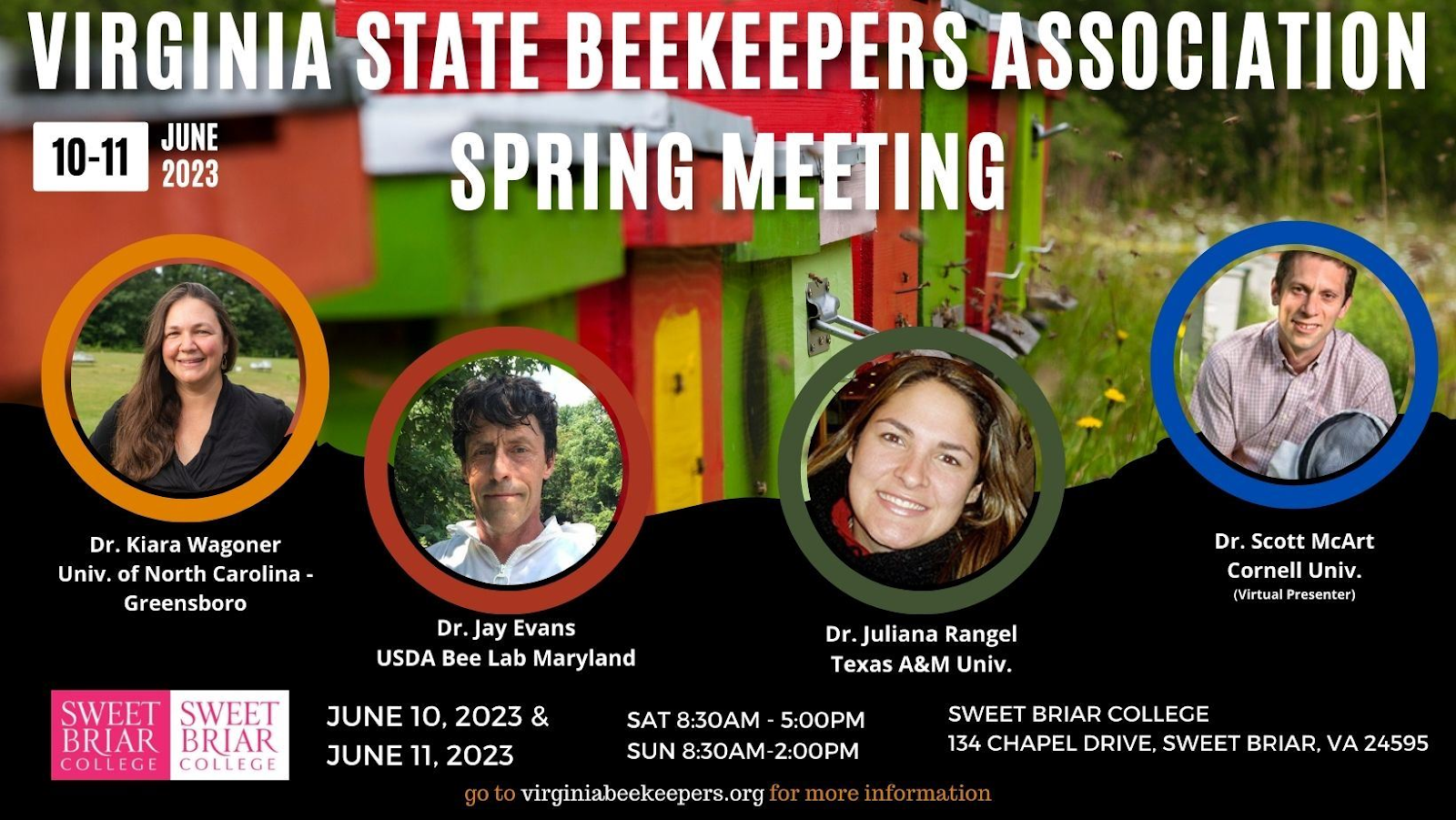
The Virginia State Beekeepers Association Spring Meeting will be held on June 10th & 11th @ Sweet Briar College. Speakers include Brooke Savage, Dr. James Wilson, Bob Wellemyer and more. VSBA will have lots of workshops including a Greenhouse tour, honey show preparation, pollinators tour & discussion, Honey Bee Microscopy, updates from our State Apiarist, testing of the Va State Master Beekeeper Program and much more.

More information about the VSBA programs can be found on their website: https://www.virginiabeekeepers.org/

Meet Your Friendly Neighborhood Beekeeper:

Michelle Clark

Q: How long have you been a beekeeper and how many hives do you manage?

I started with 2 hives in 2020 and I do my best to keep it at that number. Each year I set out a swarm trap in hopes of catching my own bees should they swarm. I catch one from time to time. I usually give them away. Two hives is perfect for me.

Q: What inspired you to become a beekeeper?

I strive to live more naturally. If I can grow or make something on my own, I will. My interest in beekeeping started as an interest in honey somewhere in the 2015/2016 timeframe. At the time though I lived in a strict HOA, had a 1yr old, and another on the way. It was a few years before we moved, my kids were a little bit older, and I had the time. In January of 2020 I attended a workshop Honey & the Hive hosted at Southern States. During those few hours of learning, I decided beekeeping seemed doable. Soon after that, I signed up for the RPBBA beginner beekeeping class.

Q: What is the best thing about beekeeping for you?

I enjoy watching my hives. I keep them in our backyard close to the house. I watch them from the window above my kitchen sink. Sometimes I’m brave enough to get an up close look without my veil. Is the entrance crowded? Are they bringing home a lot of pollen? What color is the pollen?

Q: What’s challenging about beekeeping for you?

Mistakes are made. It’s a learning curve. When I started, for a while I didn’t realize I needed to push the frames together. That made for a mess. Another time I got bees inside my vail and ended up with 2 stingers hiding among my hair. Last Fall I put 3x the recommended amount of Apiguard in my hives because I thought I remembered the instructions from using it previously. My mind mixed up Apiguard with Apivar. Whoops. My bees hit the trees, quick.

Q: What fun, surprising story would you like to share?

I’m feeling pretty proud of myself. I’ll share two stories.

(1) As some of you already know, and probably many do not, the military brought our family to El Paso over winter. [Yes, I’ll be back for the HBF]. I successfully moved both my hives cross country with tips from John Davis. Thanks John; you’re the best!

(2) I have heard several RPBBA presentations on how to split your hives. This year, I finally did it! For fear of my hives swarming, raising then open mating new queens, and ending up with mixed “Africanized” genetics, I gave splits a go. I made two 5-frame nucs. I sold one; the other I still have. It did so well, so quickly, they swarmed before I realized they’d successfully mated a new queen. I’ve been giving them eggs & larva from my original hive to give them another go at raising a new queen.

Q: In what ways do you feel like you are making an impact on the environment and/or the community?

There’s no denying the reward of pollination our honey bees provide. In our communities though, beekeeping isn’t a common hobby. In El Paso, bees are seen as more of a pest than community helpers. I’m always willing to share the knowledge I have, and a little bit of honey.

Beekeepers Out and About & in the News

There is one more pollinator garden in Richmond thanks to Rick McCormick and RPBBA. Rick designed and installed the garden at the Anna Julia Cooper school in Churchill. RPBBA provided the funds necessary for this task.

The pollinator garden has marigolds and cherry tomato starts, as well as other flowers. The kindergarteners, along with some helpers from 2nd and 3rd grades, did a lot of the planting along with Master Gardeners, Dennis and Mary Lloyd. The installation took over 3 hours and it’s DONE. Great job Rick.

Bee Vocabulary – “Bee Space”

Ever wonder why beekeepers push their frames tightly together in their hives? Our old friend, Lorenzo Langstroth, discovered that bees will build excess comb in any space larger than ⅜ inch. Any space less than ⅜ inch, bees will fill with propolis and/or wax. Proper bee space allows bees to move around in the colony (back to back) and allows you, as the beekeeper, to inspect the hive without destroying carefully built comb.

This Month in the Hive (June)

Hives that haven’t swarmed will be running over with bees and the brood nest may very well extend across two supers. The population of youE strongest hives may exceed 50,000 workers. The queen’s rate of egg laying may drop a little this month. However, she should be moving around the brood nest, laying eggs in cells that have been cleaned from prior use.

Sumac, clovers, strawberries, wild blackberries, speedwell, linden trees, chestnut, chokeberry, huckleberry, grape, holly, blackhaw, honeysuckle,and many ornamentals will provide nectar flows. June is generally a good month for honey production in Northern Virginia, but most of the nectar flows are over by the end of the month. A strong hive may cap as much as 30-40 pounds of honey in June, if good nectar flows are nearby and moisture is sustained in the soil. If soil moisture persists into July, you may want to plan on a small second harvest later in the summer.

Heat can be a serious challenge for the hive at this time. Look for bees bringing in water and placing it around the hive to evaporate for the cooling effect. Watch for swarm cells, wax moths, ants, mice and small hive beetles attacking the combs. If a hive is so weak in June that it can not defend itself against beetles, ants or moths, then you should consider combining it with a much stronger hive.

Watch for supers above the queen excluder where all the center frames in the super are full of capped honey. Move the full center frames to the outside edges of the super, and move less full frames to the center. This will assist the bees to fill and cap all the frames completely.

Inspect the hives weekly to make certain your hives are healthy and the queen is doing her job. You do not need to see a queen if you see a good pattern of eggs, wet larvae (or “worms”) and capped brood. Supers full of honey may be removed at any time you are prepared to begin extraction or keep them in the freezer. (You do not want to store supers of honey for more than a day or two at room temperature, due to ants, spiders, wax moths, and dust.)

Make sure your bees have a source of water within 200 feet of the hive. You may increase your hives by splitting strong colonies after the harvest. There is a slight chance of a need to add more honey supers this month. Keep watching for swarming which may still occur.

Decide if your hives are going to have an upper entrance. If so, you may want to drill a 1 inch circular hole in a super (not close to a handle), which hole can be guarded by the bees in summer and plugged with a cork during the winter. Some beekeepers screen over the hand hole in the inner cover, and then prop up the hive cover slightly to provide ventilation, but not enough to permit access to rodents and large insects.

Confirm queen orders for July hive splits.

[From https://buzzwordhoney.com/wp-content/uploads/2012/12/Northern-Virginia-Honeybee-Annual-Cycle.pdf]

What’s in Bloom (according to Maymont)

1st Week: Magnolia, Tree Lilac, Rhododendron, Azalea, Nandina, Smoke Tree, Rose, Waterlily, Daylily, Yucca, Annuals, Perennials, European Linden, Mock Orange, Weigelia, Laburnum, Calycanthus, Abelia

2nd Week: Magnolia, Golden Raintree, Mimose, Rose, Azalea, Nandina, Hydrangea, Sourwood, Waerlily, Daylily, Annuals, Perennials, Catalpa, Tree Lilac, Abelia, Calycanthus

3rd Week: Magnolia, Golden Raintree, Mimosa, Sourwood, Rose, Azalea, Daylily, Annuals, Perennials, Catalpa

4th Week: Magnolia, Golden Raintree, Mimosa, Sourwood, Rose, Azalea, Daylily, Annuals, Perennials, Catalpa

https://maymont.org/explore/gardens/whats-in-bloom/

Final Word

If you are not a member of RPBBA, we encourage you to join and be active. You can join on our website. Meetings are open to non-members also. Come meet some other beekeepers and find out what RPBBA is all about.

If you have not volunteered for the Honey Bee Festival, please do so. This is a major (and fun) even for our bee club.

We are always looking for ways to improve communications in the club. If you have any ideas or suggestions, please let me know.

-Hollee

Hollee Freeman
Communications 🐝

Check us out at rockwoodbeekeepers.com!
Like us on Facebook!
Join our Facebook RPBBA Practical Beekeeping Group!
Keep up with what RPBBA is doing, see Calendar of Events!

*****************************************************************************
This is the official Rockwood Park Backyard Beekeepers email. RPBBA will never share your email with anyone outside of the organization or for non-club-related business without your permission. If you wish to update your email or be removed from our email list please complete this form.