
Needed: More Honey Supers for Extraction
A Message for All Honey Bee Festival Volunteers
Hello Honey Bee Festival Volunteers,
I hope this message finds you well and filled with excitement for the upcoming Festival! On behalf of the Rockwood Park Backyard Beekeepers, I want to extend a big thank you for your invaluable contribution and dedication to making this event a success. Our Planning Committee has been hard at work over several months but the Festival would not be possible without many helping hands, including yours.
This year our festival is bigger, with more vendors and exhibitors, increasing our pollinator educational offering. We have a new location, the Fairgrounds, thanks to Chesterfield County supporting our growth and the community’s interest. The duration of the Festival is 2 hours longer, until 4pm, allowing our guests more time to visit and enjoy.
As we approach the big day, I would like to remind everyone that setup will begin Friday. The Fairgrounds will be open at 8am for us to begin. If you are able to help out Friday, please come when you can. Sherry Giese, our co-lead organizing the plant giveaway, plans to be there the full day helping us to greet volunteers. Look for the lady with a bunch of volunteer t-shirts. Saturday morning, we’ll resume setup at 8am and have a lot of moving pieces with vendors and exhibitors arriving.
If you are not sure which committee you’ve been placed, or have not heard from your committee lead, please reach out. I’m happy to facilitate the connection to your committee lead(s).
We encourage you to invite friends, family, and neighbors to join us Saturday, June 22nd for a day filled with fun, music, learning, and celebration of our beloved honeybees and all pollinators.
Once again, thank you for volunteering. Your contribution and time makes a real difference. We are incredibly grateful to have such dedication within our community.
Looking forward to seeing you all on Friday for setup and Saturday for the Festival!
Michelle Clark
Worker Bee
Check us out at rockwoodbeekeepers.com!
Like us on Facebook!
Join our Facebook RPBBA Practical Beekeeping Group!
Keep up with what RPBBA is doing, see Calendar of Events!
*****************************************************************************
This is the official Rockwood Park Backyard Beekeepers email. RPBBA will never share your email with anyone outside of the organization or for non-club-related business without your permission. If you wish to update your email or be removed from our email list please complete this form.
WANTED: Drones for the Honey Bee Festival
RPBBA June Newsletter

Hello beekeepers and honey bee enthusiasts!
June is going to be very busy for us. Our apiaries are keeping us busy AND it’s crunch time for the Honey Bee Festival.
Honey Bee Festival
Saturday, June 22th from 10am-4pm at the Chesterfield Fairgrounds

You do not have to be a beekeeper or a member of a bee club to volunteer for the festival. Volunteers can be kids, family, friends, co-workers, etc. The only requirement is a smile, flexibility and a willingness to help. All volunteers receive a free HBF tee-shirt, learn a lot and have a ton of fun!
More details, including a signup form, can be found here:https://forms.gle/vvwUjwffUB8xhuLS9
Here are a few things you can do to get involved:
👉Choose something to bake for the bake sale
👉Loan the club a canopy or table
👉Allow RPBBA to extract your honey supers
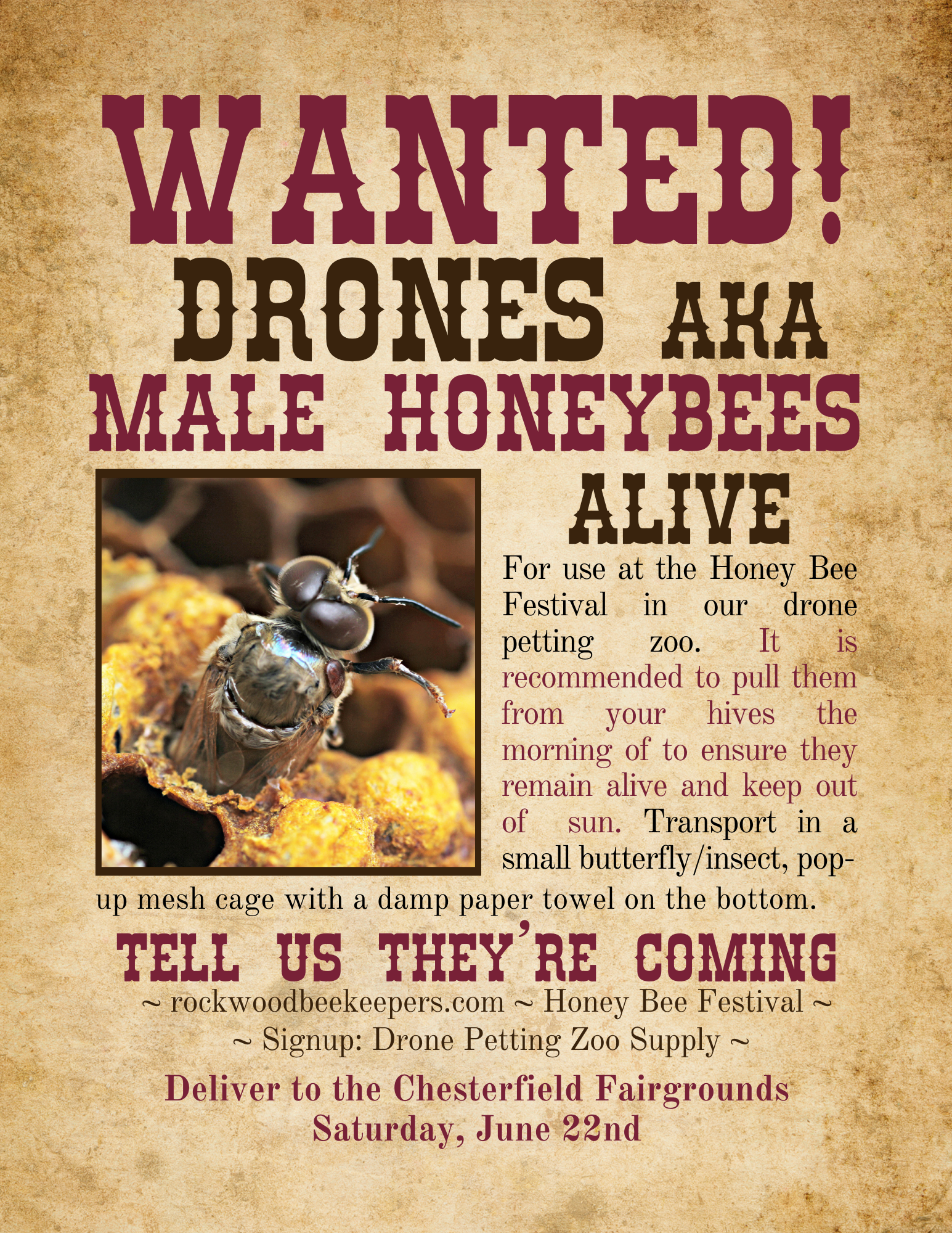
👉Supply drones for the Drone Petting Zoo
👉Spread the word on social media: our website, a flier, and an event setup are all on Facebook and all can be shared
A Message from Your Friendly Bake Sale Lead, Pam Kimball
Howdy fellow beekeepers and bakers!
Rockwood Honeybee Festival will soon be here and it’s time to start thinking about baking some goodies for the bake sale! Don’t forget the bake sale makes money for the club….so get your thinking caps on as to what to make!
What to Make:

You can make cookies, cupcakes (without icing), breads, snickerdoodles, etc.

Put one serving size per individual baggie.

Label what is in baggie (for example, toffee chip cookies).

Make sure to identify if it has nuts or is gluten-free.


When to Bring:
-
Friday- you can drop-off baked goods at Chesterfield Fairgrounds from 8am to 5 pm. There will be a table inside the building labeled ‘Baked goods’. Just drop them off there.
-
Saturday-we will have a table near the entrance and the kids area. The festival starts at 10 am so try to bring before or around10.
Happy baking and see you at the festival!

For the June club meeting, we will have Jason Aldridge, Ecosystem Restorationist from Undoing Ruin https://undoingruin.com/ lead us in a short walk and talk around the paved path around the nature center. We will discuss what makes a healthy habitat for pollinators, other animals and ourselves. Jason is a specialist in habitat restoration and establishing new native habitats.
After the walk-n-talk, Don et al;, will lead a discussion about the HoneyBee Festival and how we can ensure that we are prepared.

Waaaaay back in the day :), Krisit Orcutt and Ken Woodard wanted to bring more attention to the nature center and to reach out to young people to help them understand that pollinators are a part of the backyard environment. Norfolk, VA was putting on a festival so Kristi and Ken decided that the metro Richmond region should have one as well!
The 1st festival celebrated the installation of the observation hive in the Rockwood Park Nature Center. County supervisors alerted the press and the festival was “on and popping”, as the youngsters say.
We are on the 13th festival (took a pause during the height of covid) and the current HBF looks like the first one, only much larger. The early festivals also had face painting, vendors, honey sales, a bake sale, drone petting zoo, Buzz Talks and more.
Here’s to another successful HBF! And huge thanks to Kristi and Ken who had the forethought and the follow-through to make this a part of the fabric of the metro Richmond and Virginia community.


Bee Vocabulary – “Bee Space”
Ever wonder why beekeepers push their frames tightly together in their hives? Our old friend, Lorenzo Langstroth, discovered that bees will build excess comb in any space larger than ⅜ inch. Any space less than ⅜ inch, bees will fill with propolis and/or wax. Proper bee space allows bees to move around in the colony (back to back) and allows you, as the beekeeper, to inspect the hive without destroying carefully built comb.
This Month in the Hive (June)
Hives that haven’t swarmed will be running over with bees and the brood nest may very well extend across two supers. The population of your strongest hives may exceed 50,000 workers. The queen’s rate of egg laying may drop a little this month. However, she should be moving around the brood nest, laying eggs in cells that have been cleaned from prior use.
A strong hive may cap as much as 30-40 pounds of honey in June, if good nectar flows are nearby and moisture is sustained in the soil. However, most of the nectar flows are over by the end of the month. But, if soil moisture persists into July, you may want to plan on a small second harvest later in the summer.
Heat can be a serious challenge for the hive at this time. Look for bees bringing in water and placing it around the hive to evaporate for the cooling effect. Watch for swarm cells, wax moths, ants, mice and small hive beetles attacking the combs. If a hive is so weak in June that it can not defend itself against beetles, ants or moths, then you should consider combining it with a much stronger hive.
Watch for supers above the queen excluder where all the center frames in the super are full of capped honey. Move the full center frames to the outside edges of the super, and move less full frames to the center. This will assist the bees to fill and cap all the frames completely.
Inspect the hives weekly to make certain your hives are healthy and the queen is doing her job. You do not need to see a queen if you see a good pattern of eggs, wet larvae (or “worms”) and capped brood. Supers full of honey may be removed at any time you are prepared to begin extraction or keep them in the freezer. (You do not want to store supers of honey for more than a day or two at room temperature, due to ants, spiders, wax moths, and dust.)
Make sure your bees have a source of water within 200 feet of the hive. You may increase your hives by splitting strong colonies after the harvest. There is a slight chance of a need to add more honey supers this month. Keep watching for swarming which may still occur.
Decide if your hives are going to have an upper entrance. If so, you may want to drill a 1 inch circular hole in a super (not close to a handle), which hole can be guarded by the bees in summer and plugged with a cork during the winter. Some beekeepers screen over the hand hole in the inner cover, and then prop up the hive cover slightly to provide ventilation, but not enough to permit access to rodents and large insects.
Confirm queen orders for July hive splits.
[From https://buzzwordhoney.com/wp-content/uploads/2012/12/Northern-Virginia-Honeybee-Annual-Cycle.pdf]
What’s in Bloom (according to Maymont)
1st Week: Magnolia, Tree Lilac, Rhododendron, Azalea, Nandina, Smoke Tree, Rose, Waterlily, Daylily, Yucca, Annuals, Perennials, European Linden, Mock Orange, Weigelia, Laburnum, Calycanthus, Abelia
2nd Week: Magnolia, Golden Raintree, Mimose, Rose, Azalea, Nandina, Hydrangea, Sourwood, Waerlily, Daylily, Annuals, Perennials, Catalpa, Tree Lilac, Abelia, Calycanthus
3rd Week: Magnolia, Golden Raintree, Mimosa, Sourwood, Rose, Azalea, Daylily, Annuals, Perennials, Catalpa
4th Week: Magnolia, Golden Raintree, Mimosa, Sourwood, Rose, Azalea, Daylily, Annuals, Perennials, Catalpa
https://maymont.org/explore/gardens/whats-in-bloom/
Final Word
If you are not a member of RPBBA, we encourage you to join and be active. You can join on our website. Meetings are open to non-members also. Come meet some other beekeepers and find out what RPBBA is all about.
If you have not volunteered for the Honey Bee Festival, please do so. This is a major educational and of course, fun event for our bee club and the community.
We are always looking for ways to improve communications in the club. If you have any ideas or suggestions, please let me know.
-Hollee
Hollee Freeman
Communications
Check us out at rockwoodbeekeepers.com!
Like us on Facebook!
Join our Facebook RPBBA Practical Beekeeping Group!
Keep up with what RPBBA is doing, see Calendar of Events!
*****************************************************************************
This is the official Rockwood Park Backyard Beekeepers email. RPBBA will never share your email with anyone outside of the organization or for non-club-related business without your permission. If you wish to update your email or be removed from our email list please complete this form.
RPBBA May newsletter
Hello beekeepers and honey bee enthusiasts!
April has proven to be quite busy in many apiaries. We have been splitting colonies, catching swarms and adding supers for quite a few weeks, it seems! The flowers and trees are blooming and the temperature is stabilizing a bit. If the rain keeps up and doesn’t wash out the young buds and blossoms, we are in for a good season.
Keep the RPBBA Swarm Line handy to share with friends, neighbors, anyone who may need help with a swarm. Encourage people that you meet to call the swarm line instead of using pesticides or calling an exterminator.
RPBBA Swarm Line
(804) 404-BEE1 or (804) 404-2331
May Calendar of Events (all meetings take place at Rockwood Park Nature Center)
Monday, May 13th – RPBBA Monthly Meeting, 7pm (social gathering 6:30pm)
Monday, May 20th – Beekeeping Study Group, 7pm and WORLD BEE DAY!
Tuesday, May 14th & 28th – Honey Bee Festival Planning Committee, 7pm Zoom
May Meeting- During the May meeting, Sue Rawlings from the East Richmond Beekeeping Association, will share her work as an advocate for having the honeybee designated as the VA state pollinator. Following up on the April meeting, we will discuss semantics of this designation and ways we can talk about the benefits of honeybees as they relate to and possibly impact native bees. We will also have a short micro skills segment during the meeting to discuss laying worker issues.

Leading up to the festival, please consider the following:
-
Volunteering on the day of the festival (and/or the Friday before) The festival is larger this year and therefore, we need more volunteers:)
We are happy for all the help we can get; however the following festival areas are in need of the most help.
•Education
•Bake Sale
•Operations
•Guest Experiences (plantings & club table)
You do not have to be a beekeeper or a member of a bee club to volunteer. Volunteers can be kids, family, friends, co-workers, etc. The only requirement is a smile, flexibility and a willingness to help. All volunteers receive a free HBF tee-shirt, learn a lot and have a ton of fun!
More details, including a signup form, can be found here:https://forms.gle/vvwUjwffUB8xhuLS9
-
Other Ways to Pitch In We have several sign-up’s open to support our committee’s. Here’s how you can help
👉Choose something to bake for the bake sale
👉Loan the club a canopy or table
👉Allow RPBBA to extract your honey supers
👉Supply drones for the Drone Petting Zoo
-
Spread the Word What fun is a festival without attendees? Word of mouth and social media are helpful tools to invite others. We have information about the festival on our website, a flier, and an event setup on Facebook. All can be shared. Please help to spread the buzz so we can make this year’s festival a success.
Beekeeping Study Group
For those who have never checked it out, the study group is a great way for RPBBA members to further their beekeeping knowledge. There is no requirement for attendees to pursue certification. The study group is open to all members who want to learn. During the study group sessions, questions from the VSBA Apprentice Study Guide VSBA Apprentice Study Guide are posed for the group to discuss and answer together. There is much to learn during open discussion with our peers!
The study group meets monthly on the 3rd Monday of each month.

Q: How long have you been a beekeeper and how many hives do you manage?
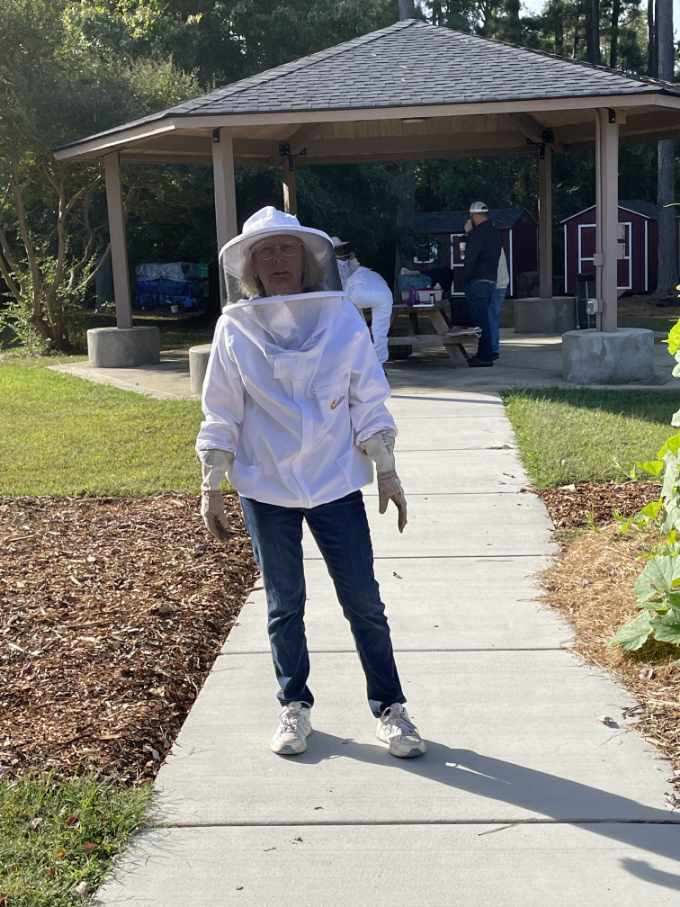
I got involved with beekeeping about 4 years ago. Although I don’t have my own hives, I am part of the Chesterfield Master Gardeners Bee Team. The program started when a hive was donated and Rick McCormick started mentoring the team.
Q: What inspired you to become a beekeeper?
While enjoying a beautiful evening on my deck I decided it would be nice to have a hive in my yard so I could take honey out of it whenever I wanted. LOL. I googled beekeeper associations and found Rockwood Park Backyard Beekeeper Association. I signed up for the next available class and have attended as many classes as I can since then, including events and classes at Dandelion Springs and the monthly study group. I am inspired by all the members of RPBBA and Rick McCormick who are always willing to answer your questions, which usually begin with IT DEPENDS. 🙂
Q: What is the best thing about beekeeping for you?
It is so rewarding when your knowledge pays off and you understand what MAY be going on in the hives. I enjoy being a member of the Bee Team and sharing information with each other. I look forward to learning more and sharing more.
Q: What’s challenging about beekeeping for you?
I find myself second guessing myself and can’t decide what to do. You get different answers to your questions and just hope you make the right decision. I am certain this will get better with experience and study.
Q: What fun, surprising story would you like to share?
There are always surprises, like when your sugar board is full of comb and drone brood. What is fun is our team doing an event and seeing the look on children’s faces when they see our observation hive. I also enjoy being a member of this association. I am so grateful for all of you and your support. I want to give Rick McCormick a special thank you for his mentorship.
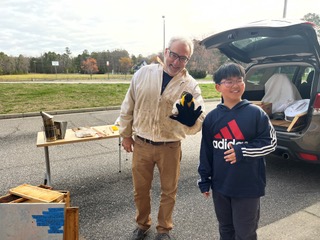
Gene DiSalvo participated in Kaechele Elementary School’s Career Day (Henrico County Public Schools) for the 2nd year. This year it was too cold to have an observation hive, but the bee puppet was a hit with kids of all ages! Gene was swamped with kids asking questions and also sharing their knowledge about honey bees and other pollinators (funny when you have a half-dozen kids all excitedly talking to you at the same time)! It was encouraging to hear how much they know about this important pollinator and care about its future existence.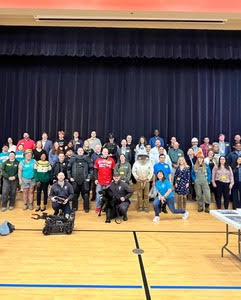
See if you can spot Gene in the group picture.
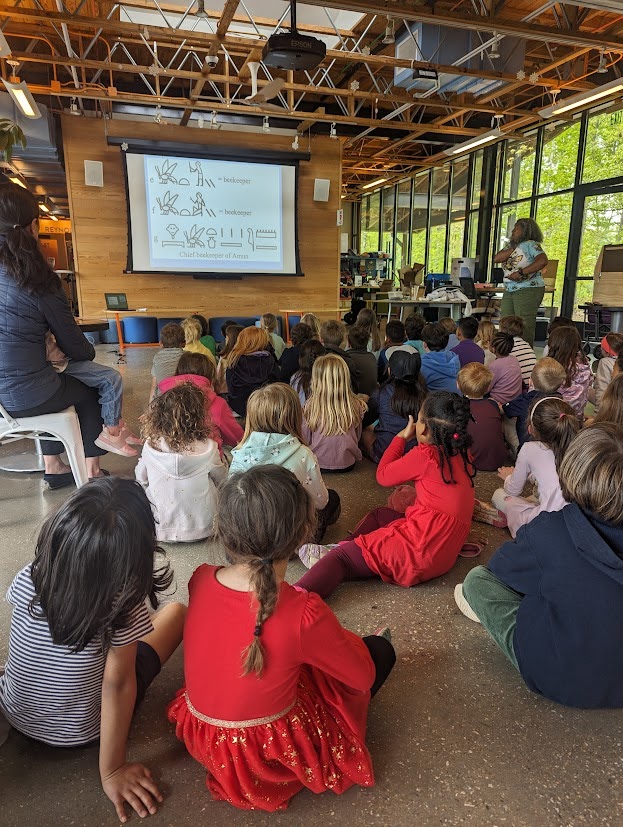
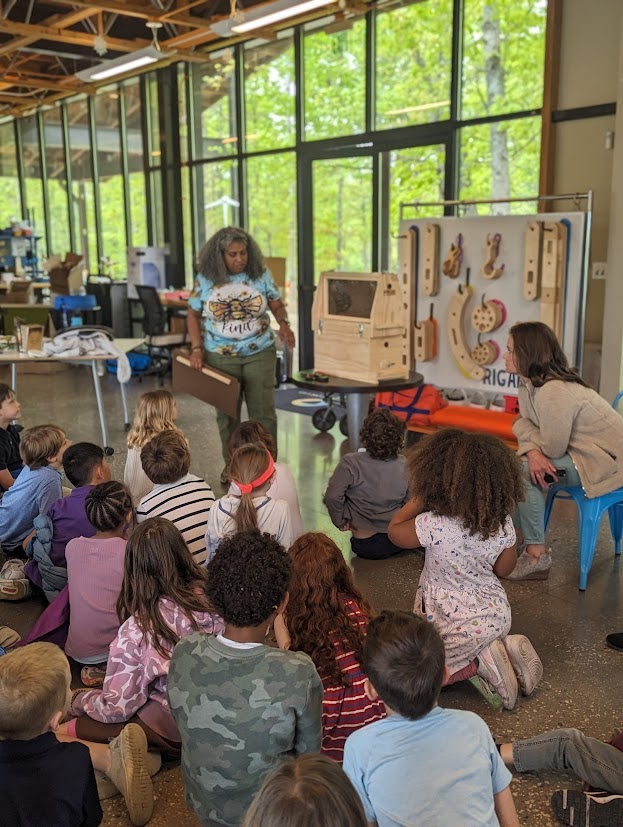
Hollee Freeman worked with students at the Steward School grades pre-K-12th grade all in one day, as well as participated in their Nature Play Expo. She covered topics such as bees and sleeping, cognition, personality, learning and emotions + the regular stuff :0.
Some of the questions asked by the 12th grade honors psychology class included:
-
How do bees communicate emotions with each other?
-
Do bees have different communication with different relationships?
-
Do bees inherit altruistic traits?
-
Do bees dream?
Huge thanks to Kristi Orcutt (and Alex Wright) who jumped right in to help during the Earth Day event at the Petersburg Oasis Youth Farm! 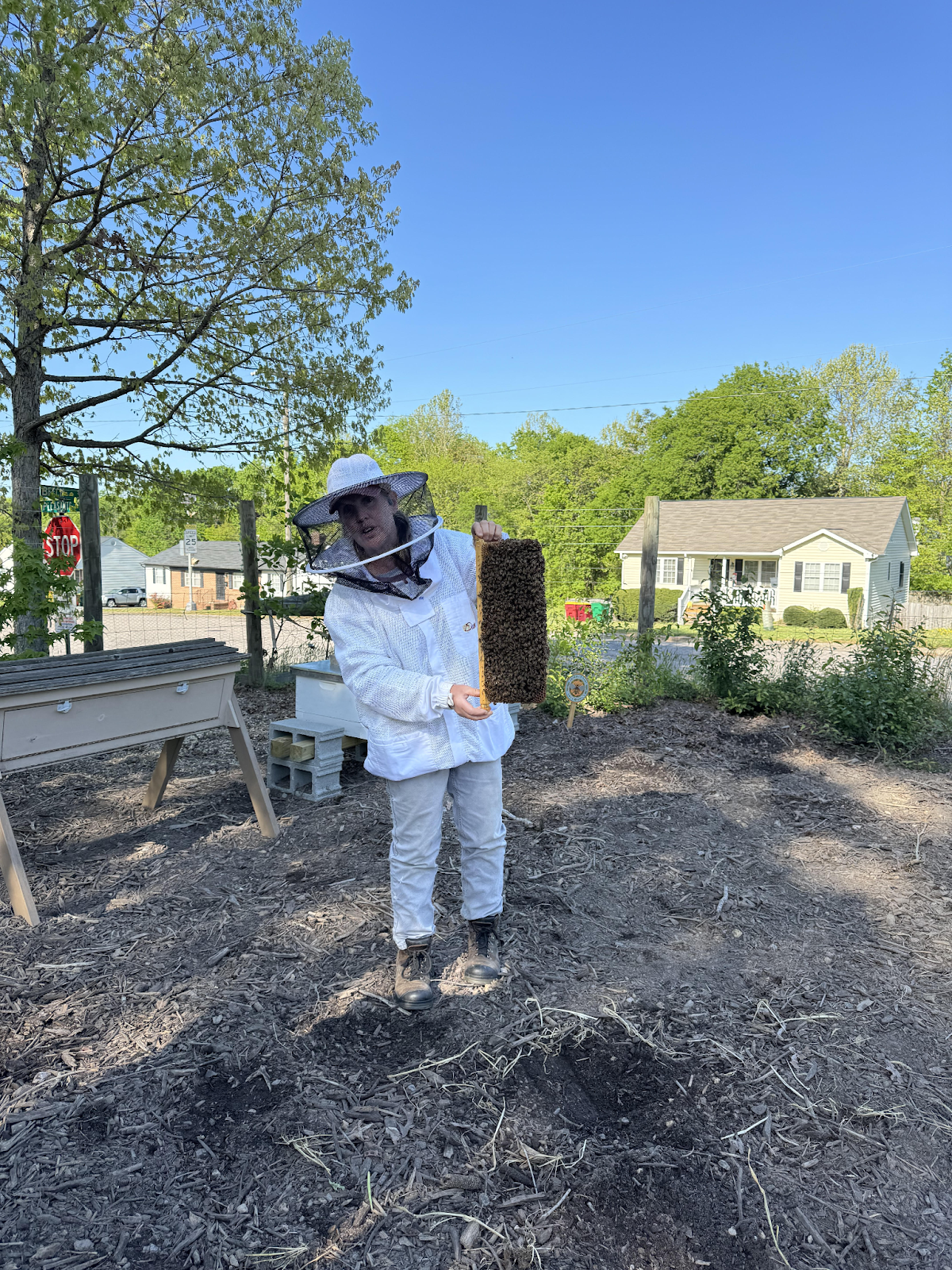
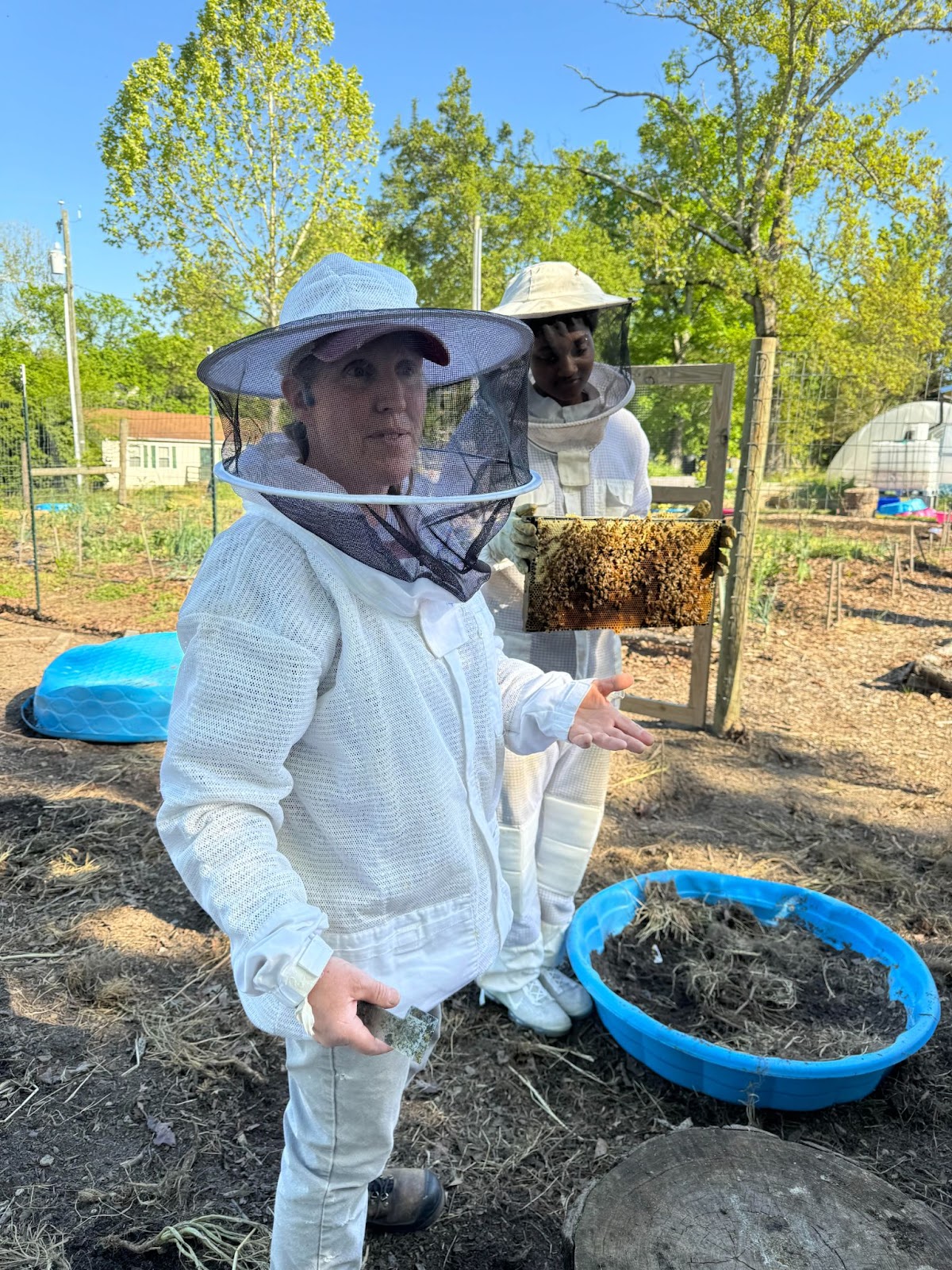
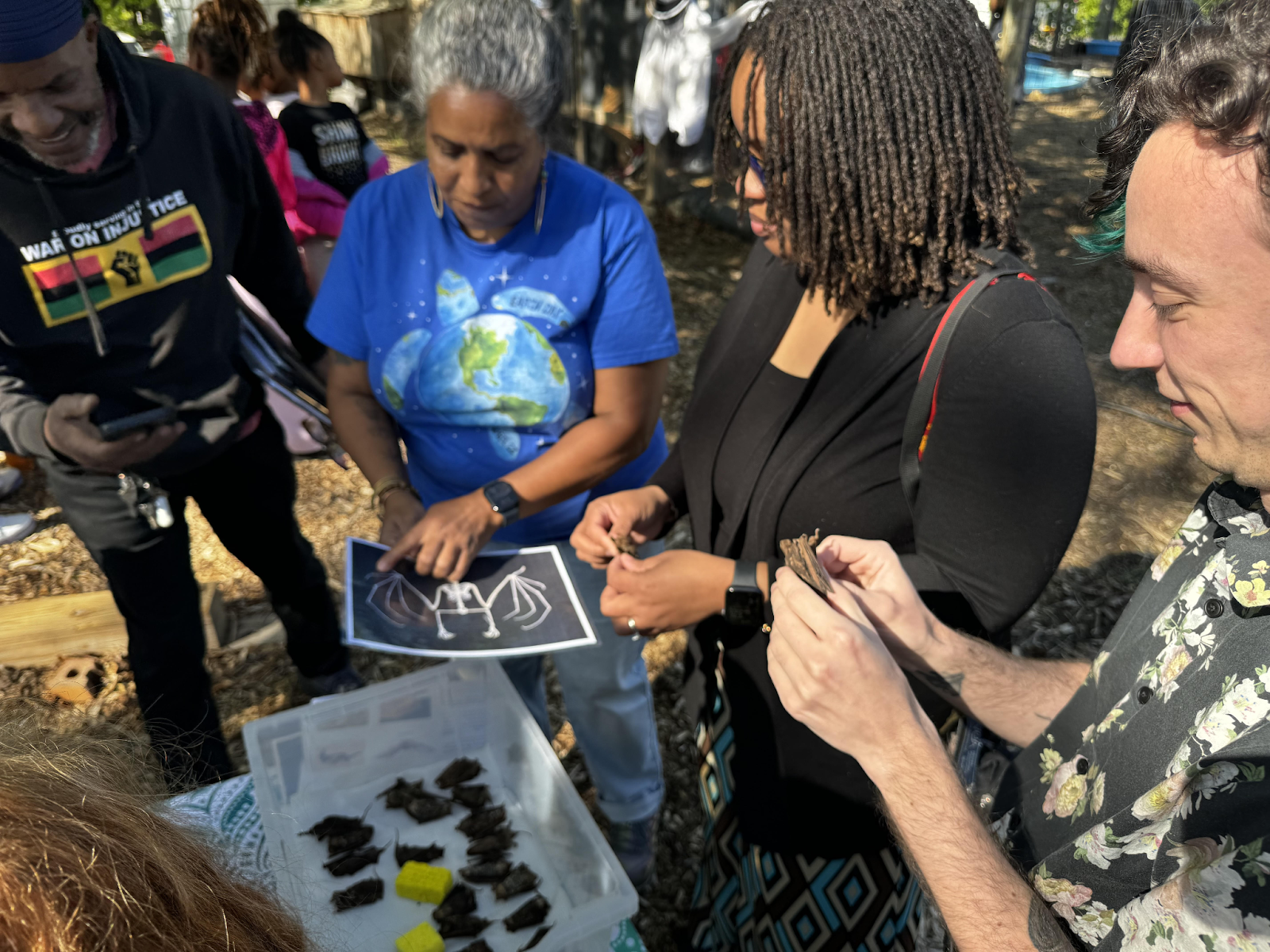
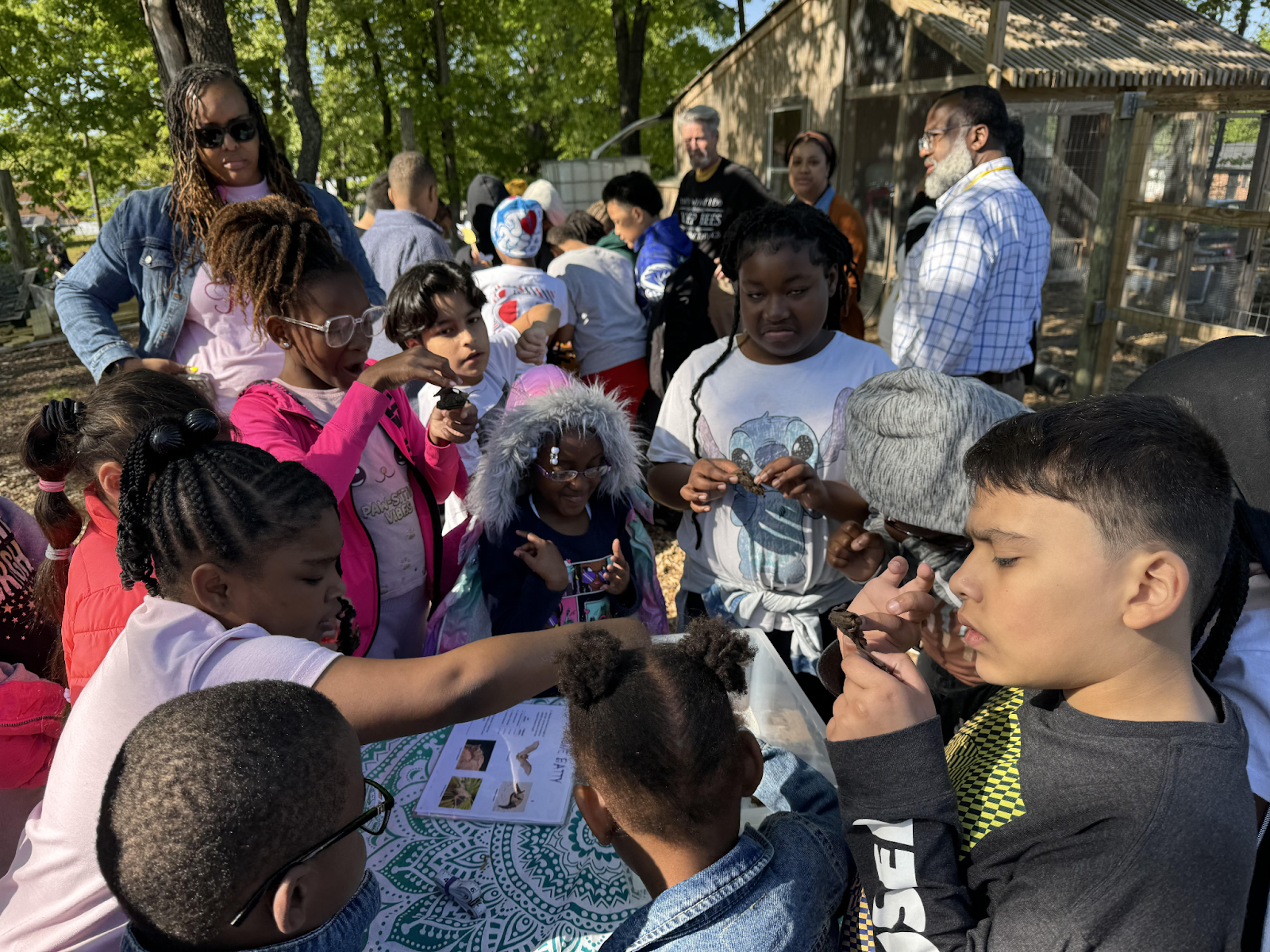
There were more than 100 children and adults in the space of 2 hours! Hollee was busy with the bats so Kristi jumping in was very much appreciated! Whew, thank you! #teamwork
This Month in the Hive (May)
This month, hives should be buzzing. You may be able to see pollen being brought into the hive since this is peak egg laying season for the queen. Your hives may be bursting with bees. The brood nest will extend across 7-8 frames and may reach into 2 full brood boxes in your stronger hives by the end of the month.
A strong hive may collect and store as much as 7 lbs of nectar per sunny, bright day. The bees will combine the nectar with enzymes they produce, and place the nectar in honeycomb cells to evaporate the nectar and age it into honey. Honey will be capped when it reaches under 18% water content. A strong hive working on a good nectar flow in May can cap as much as 80 pounds of mature honey during this month.
If the queen has over-wintered with the hive, then watch for queen cells/signs of swarming. Make certain that the queen has enough room to lay 800-1000 eggs per day, and that she may do so for the entire 21 day cycle for production of a worker. This will mean that a queen in peak fertility will need at least 1 deep and 1 medium super for brood production. (Many beekeepers provide 2 deep brood boxes for this purpose.) If the brood production area has become honey-bound (more than ½ the brood frames are more than ½ full of honey), then provide a larger brood nest or remove honey frames and substitute foundation.
Watch for a failing or disappeared queen. If all the brood is drone brood, then the queen is failing, or has disappeared and been replaced by laying workers. If this occurs, you should combine the queenless hive with a queenright hive or take other steps to requeen the hive.
At the end of May, look out for wax moths. These 1/2 inch wide, gray moths sneak into the hive at night and lay eggs in corners and other places where the bees are unable to remove the eggs. The adult moths will be harassed and forced to leave a strong hive, and eggs will be covered with propolis if not removed. In a weak hive, the eggs will hatch and begin a path of destructive chewing and defecating through the brood combs. Combine weak hives, reduce the size of the brood box, or reduce the entrance to discourage moth entry to weak hives.
Inspect the hive weekly. If you reversed the brood boxes earlier in the year, you may need to do so a second time in May or June. Consider doing so if the lower brood box is nearly empty of brood and the upper brood box is crowded. Make certain that each hive has more than enough supers to store the honey harvest.
Attend your bee club meetings and useful workshops. Make notes of which flowers/trees/shrubs bloom at which times. Order labels, bottles and caps, if needed. Buy, reserve or borrow extracting equipment for late June or July. Order queens for July hive splits. On strong hives, remove the mouse guard if you have not yet done so, unless you are using a mouse guard made of 1/2 inch hardware cloth, which does not obstruct air or bee movement.
[From https://buzzwordhoney.com/wp-content/uploads/2012/12/Northern-Virginia-Honeybee-Annual-Cycle.pdf]
Bee Vocabulary – Laying Workers
Workers become “laying workers” when their reproductive organs respond to the lack of queen pheromone in the colony. Their normally suppressed reproductive organs begin to activate and some of these workers start laying unfertilized eggs. This is their last ditch effort to save the colony. However, this effort, while commendable, cannot save the colony without new workers and thus, the colony dwindles down to basically nothing.
It takes resources, commitment and a good, solid schedule to bring the hive back to queenright (and even then, it may not work). Come to the May meeting and learn more.
For more information, check out the following articles:
https://www.beeculture.com/laying-workers-happens-fix/
https://www.honeybeesuite.com/category/bee-biology/
Looking To Expand Your Pollinator Garden?
This month Tulip Poplar, Black Locust, Wild Blackberry, Privet, Persimmon, yellow rocket, and Sweet Clover will bloom. Alsike Clover, Crimson Clover, Ladino (White Clover), Black Gum, poison ivy, Vetch, Holly, and Raspberries will also bloom this month. At the end of the month, hawthorn hedges will add their nectar.
Regional native plant guides are available that highlight the beautiful variety of Virginia’s native plants. PDF versions are free. Virginia Capital Region native plants provide visual beauty year round. Local native plants support more wildlife species than non-native plants. Native trees, shrubs, and vines that feed the insects, birds, and animals are essential for maintaining biodiversity. Local native plants are adapted to local temperature and rainfall fluctuations. Spraying pesticides for insects or diseases is generally not necessary for native Plants. The guide for RVA area natives can be viewed here: https://www.plantvirginianatives.org/plant-rva-natives
What’s in Bloom (according to Maymont)
1st Week: Maple, Birch, Oak, Cherry, Pear, Silver Bell, Crabapple, Dogwood, Redbud, Camellia, Pearlbush, Sweet-Breath-of-Spring, Forsythia, Boxwood, Flowering Quince, Barberry, Azalea, Periwinkle, Narcissus, Candy tuft, Violets, Tulip, Pansy, Wildflowers
2nd Week: Crabapple, Silver Bell, Cherry, Dogwood, Redbud, Boxwood, Flowering Quince, Wisteria, Barberry, Lilac, Azalea, Periwinkle, Narcissus, Candy tuft, Violet, Pansy, Tulip, Wildflowers
3rd Week: Azalea, Dogwood, Cherry, wisteria, Violet, Pansy, Tulip, Lilac, Barberry, Periwinkle, Candy tuft, Wildflowers
4th Week: Azalea, Dogwood, Wisteria, Violet, Pansy, Tulip, Lilac, Periwinkle, Candy tuft, Wildflowers
https://maymont.org/explore/gardens/whats-in-bloom/
Final Word
The bees are busy and we are busy. Please make time to come out to meetings and to our festivals. You can join the RPBBA on our website. Meetings are open to non-members. Come meet some other beekeepers and find out what RPBBA is all about.
We are always looking for ways to improve communications in the club. If you have any ideas, suggestions, or announcements, please let me know.
P.S. Jody and I are working on an article for the June newsletter about beekeeping and bee allergies. If you have bee allergies and wouldn’t mind being interviewed, please let me know.
Also, if you have cool events that you have done related to bees, plants or nature in general let me know.
Also, Also, I need a June Meet your Friendly Neighborhood Beekeeper. This is a great way to share your story and meet new people. Let me know if you wouldn’t mind answering 5 easy questions. 🙂
Enjoy your bees!
-Hollee
Hollee Freeman
Communications
Check us out at rockwoodbeekeepers.com!
Like us on Facebook!
Join our Facebook RPBBA Practical Beekeeping Group!
Keep up with what RPBBA is doing, see Calendar of Events!
*****************************************************************************
This is the official Rockwood Park Backyard Beekeepers email. RPBBA will never share your email with anyone outside of the organization or for non-club-related business without your permission. If you wish to update your email or be removed from our email list please complete this form.
RPBBA April Newsletter
Hello beekeepers and honey bee enthusiasts!

This is an exciting & challenging time in the beekeeping world! The climate is a little whack-a-mole but, nevertheless, the blossoms are showing their beauty and sharing their sweet scents between the rainy days. This means that your honey bee population is probably increasing and possibly preparing to swarm. In fact, you may have even experienced a swarm or two or four OR prevented a swarm or two or four already!
Keep the RPBBA Swarm Line handy to share with friends, neighbors, anyone who may need help with a swarm. Encourage people that you meet to call the swarm line instead of using pesticides or calling an exterminator.
RPBBA Swarm Line
(804) 404-BEE1 or (804) 404-2331
📢April Calendar of Events (all meetings take place at Rockwood Park Nature Center)
Monday, April 8th @7pm – Monthly Club meeting (6:30pm social gathering)
Monday, April 15th @7pm – Study Group
Tuesday, April 16th @7pm – Honey Bee Festival Planning Committee meeting
Tuesday, April 30th @7pm – Honey Bee Festival Planning Committee meeting
April Meeting
Did you know that there are about 450 species of native bees in Virginia!
As beekeepers, we often get asked questions about all kinds of bees and bee relatives such as wasps, solitary bees, Mason bees, hornets, carpenter bees, bumblebees and more!!
Join us at the club meeting as area naturalists introduce you to some of the other bees and bee relatives that share the environment with us!
7pm Monday, April 8th
(6:30pm social gathering)
@Rockwood Park Nature Center Add to Google Calendar

Huge thanks to our HBF co-chairs and volunteer committee leads who are well underway with festival planning.
There are many opportunities to participate in this year’s festival. Committees include: operations, guest experiences (plantings & club table), education, children’s area, bake sale, and publicity. In addition to day-of volunteers, we are also looking for help on Friday evening with setup and Saturday with take down.
Volunteers can be anyone, not just RPBBA members. Beekeeping experience or knowledge is NOT required. The only requirement is a willingness to help. If you need service credit just know that RPBBA is a non-profit organization. Volunteers are provided a free Honey Bee Festival t-shirt and we promise to provide an enjoyable experience with good company. More details, including a signup form, can be found here:https://forms.gle/vvwUjwffUB8xhuLS9
In particular, the festival needs a cadre of volunteers for the operations/logistics committee. This committee is the ‘bones’ of the festival and needs volunteers to help direct traffic (vehicular and human), picking up supplies, repairing equipment, making sure other committees have what they need, etc. Operations help is needed in advance to prepare for the big day. Many helping hands makes for less work.
The RPBBA Bake Sale tent is a major source of funds that allows our club to conduct the festival each year. We are on the lookout for anyone who can bake and/or donate items to the club for sale at the festival. Cookies, cakes, pies, anything goes (with proper labeling). Can’t bake? How about donating a case of water? More details including the signup form, can be found here: https://rockwoodbeekeepers.com/bake-sale-sign-up/
The 2024 Honey Bee Festival will be held @ the Chesterfield County Fairgrounds
10300 Courthouse Rd, Chesterfield, VA 23832
June 22nd, 2024, 10AM – 4PM (Note: extended hours compared with past festivals)
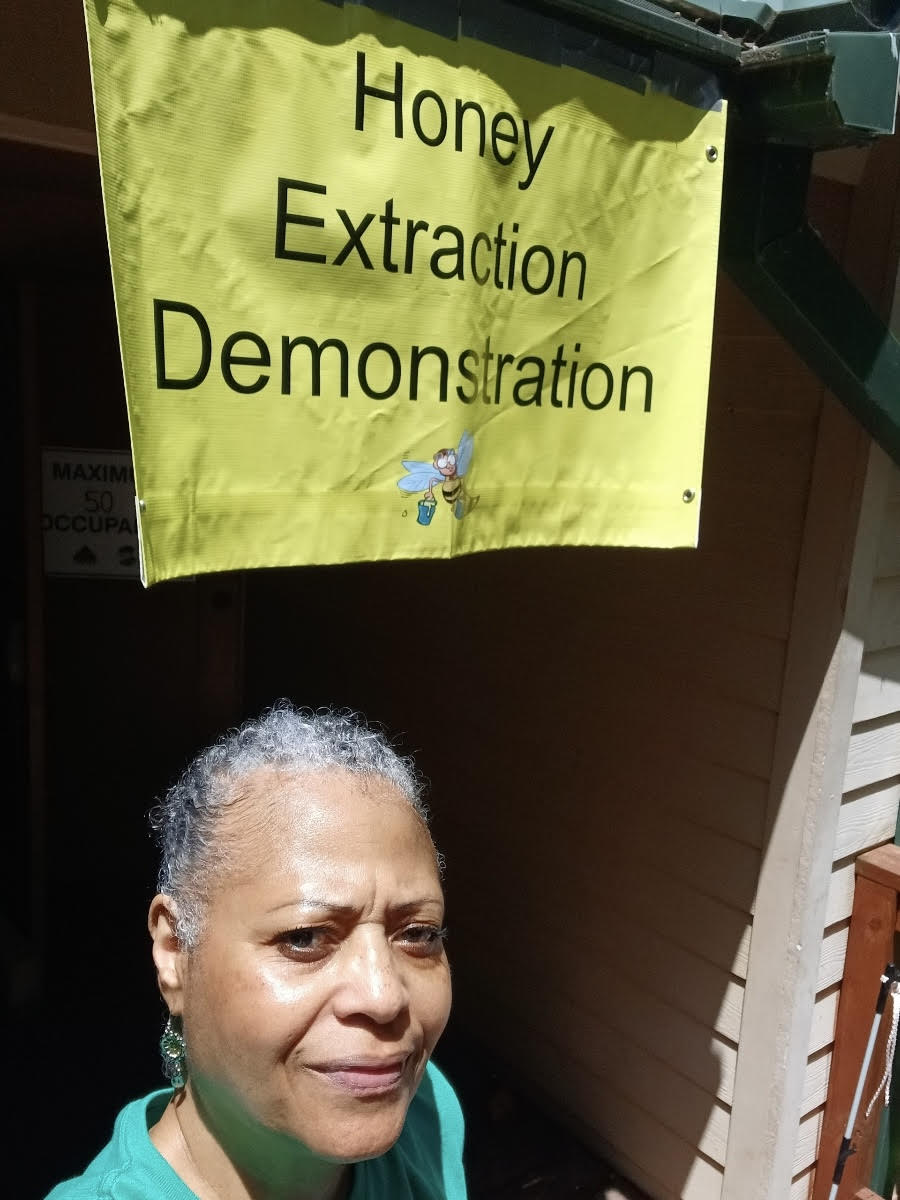

Q: How long have you been a beekeeper and how many hives do you manage?
A: I am expecting my 1st nuc any day now!
Q: What inspired you to become a beekeeper?
A: I had a family member who had beehives and gave us honey regularly. I was curious when I visited the hives. I was amazed how organized the bees worked. I thought it would be something my husband and I could do when we retired.
Q: What do you anticipate will be the best thing about beekeeping for you?
A: To help people to connect with our community, to make a difference in the environment and have fun! It is important that bees pollinate plants which provide food and shelter for other animals. A small beehive can make a difference to the gardens and farms in our area. “I heard the low humming of bees can have a calming effect, too. “

Q: What do you anticipate will be challenging about beekeeping for you?
A: Finding evidence of the Queen, how to prevent and recover a swarm, and pest maintenance.
Q: What fun, surprising story would you like to share about getting involved in beekeeping?
A: Ordering my first nuc of bees! I am getting excited in setting up my new hives! I also got my brother-in-law who lives in Tennessee to start his beehives this spring along with me. We are both so excited!


Bee Vocabulary – “Brood Nest”
Bees will use the available cells across frames for various purposes. They will use some cells to store pollen or honey. Other cells will be created for worker, drone or queen cells, which are collectively called the brood nest.
LIST: Common Beekeeping Terms You Should Know – Backyard Beekeeping
This Month in the Hive (April)
On colder days, the bees continue to form a cluster. The brood nest may be as much as 10 inches in diameter. The brood nest continues its slow migration upward into empty honeycomb. The bees will bring pollen and nectar into the hive. The queen is laying several hundred eggs per day at the beginning of the month and the population is growing fast. At the end of the month, the queen will lay 800-1000 eggs per day. The worker population will double this month. Drones will number above 200 by month end.
A congested hive in April will lead to swarms, typically in the last week of April and early May. Congestion exists where the combination of honey, pollen, brood and bees fills 80% or more of the available space. In a congested hive (for reasons about which there is no consensus) the worker bees begin to raise new queens in April. This is done by building “swarm cells” – peanut-like wax cells that often hang down between brood supers, or on the face of brood frames. From depositing the egg to the emergence of a new queen is 16 days. A hive that is storing honey by mid-late April is a hive to watch for swarming.
Henbit, wild mustard, dandelions, redbuds, pears, cherries, “Japanese” magnolias, plums, shadbush, chickweed, and many ornamental shrubs will provide substantial amounts of pollen and sufficient nectar for brood production on sunny days. Many hives that have consumed sugar syrup in March will cease taking it in early April. By mid-April, apples, peaches, crab apples, American holly and autumn olive may begin to supply ample amounts of nectar and some very strong hives will begin to make and cap honey. At the end of the month, nectar flows will be strong from many sources.
Generally, it should be understood that swarms are not good for honey production. Hive bodies should be reversed when the likelihood of 4 or more days of consistent cold (45 degrees or less) weather has passed, or around April 1 in most years. This will reduce congestion by encouraging the queen to expand egg-laying upward and outward into empty brood frames.
Remove any feeders where the syrup becomes moldy. Remove a feeder when 1 quart is not consumed in 1 week.
Place a bait hive for swarms nearby if you have decided to use such a hive. Be prepared to place a queen excluder and honey supers on top of the hive toward the end of April. On a warm day, do a complete inspection of the hive. Can you find any evidence of the queen? Are there plenty of eggs and brood? Is there a compact pattern to her egg laying? If not, locate a new queen and replace any weak or failing queen.
The final touches should be put on new hives and supers that will soon be full of bees and honey. Package bees should be installed as early as possible this month to take advantage of the heavy nectar flows at month end. Watch out for evidence of swarming (queen cells, live queen with no fresh eggs; queen that is reduced in size to fly with swarm). Remove frames with queen cells to a nucleus hive (with at least 2 frames of bees) or cut the queen cells from the frames and use them to requeen weak hives, or destroy them.
[From https://buzzwordhoney.com/wp-content/uploads/2012/12/Northern-Virginia-Honeybee-Annual-Cycle.pdf]
What’s in Bloom (according to Maymont)
1st Week: Maple, Birch, Oak, Cherry, Pear, Silver Bell, Crabapple, Dogwood, Redbud, Camellia, Pearlbush, Sweet-Breath-of-Spring, Forsythia, Boxwood, Flowering Quince, Barberry, Azalea, Periwinkle, Narcissus, Candy tuft, Violets, Tulip, Pansy, Wildflowers
2nd Week: Crabapple, Silver Bell, Cherry, Dogwood, Redbud, Boxwood, Flowering Quince, Wisteria, Barberry, Lilac, Azalea, Periwinkle, Narcissus, Candy tuft, Violet, Pansy, Tulip, Wildflowers
3rd Week: Azalea, Dogwood, Cherry, wisteria, Violet, Pansy, Tulip, Lilac, Barberry, Periwinkle, Candy tuft, Wildflowers
4th Week: Azalea, Dogwood, Wisteria, Violet, Pansy, Tulip, Lilac, Periwinkle, Candy tuft, Wildflowers
Happy Beekeeping!
-Hope to see you all at the meeting on April 8th at 7pm at Rockwood Park Nature Center.
Hollee Freeman
Communications
Check us out at rockwoodbeekeepers.com!
Like us on Facebook!
Join our Facebook RPBBA Practical Beekeeping Group!
Keep up with what RPBBA is doing, see Calendar of Events!
*****************************************************************************
This is the official Rockwood Park Backyard Beekeepers email. RPBBA will never share your email with anyone outside of the organization or for non-club-related business without your permission. If you wish to update your email or be removed from our email list please complete this form.
RPBBA March Newsletter 2024

It seems that we are all in the middle of an exciting & challenging time! Spring is coming in fast and furious. This means that your honey bee population is probably increasing and possibly preparing to swarm in the near future. Lots of beekeepers have installed swarm boxes or added a box on top of their colonies to increase the volume inside the hive. Soon it will soon be time to make splits-if you’re into that management technique.
📢March Club Meeting
During the March club meeting (7pm on the 11th), Keith White, co-owner of Honey and the Hive Beekeeping Supplies, will give a presentation on how to use bait hives to attract and collect honey bee swarms. Keith will demonstrate how he prepares and sets bait hives and share tips that he’s learned along the way for capturing swarms. Come learn or re-acquaint yourselves with this important information. Come at 6:30 for social time.
Monday, March 18th – join the study group at 7pm
Monday, March 24th – Honeybee Festival planning meeting at 7pm
The 2024 Honey Bee Festival will be held @ the Chesterfield County Fairgrounds
10300 Courthouse Rd, Chesterfield, VA 23832
June 22nd, 2024, 10AM – 4PM (Note: extended hours compared with past festivals)
Click the link to volunteer at one of our many stations and/or serving in a leadership role https://forms.gle/vvwUjwffUB8xhuLS9
📢 Calling All Swarm Chasers
We have a list of folks on our website (rockwoodbeekeepers.com) who are at the ready to remove swarms. Sometimes swarms can be easily removed; other times it requires an extensive cut-out. Emails are routed to active members in the club who have expressed interest in capturing swarms. These requests are immediate and you should have the flexibility to drop everything and help on short notice. If you are not already on the swarm list and would like to be, signup here. Even if you do not have the experience to go get the swarm yourself, you might want to tag along with an experienced beekeeper to see how it is done.
Keep the RPBBA Swarm Line handy to share with friends, neighbors, anyone who may need help with a swarm. Encourage people that you meet to call the swarm line instead of using pesticides or calling an exterminator.
RPBBA Swarm Line
(804) 404-BEE1 or (804) 404-2331

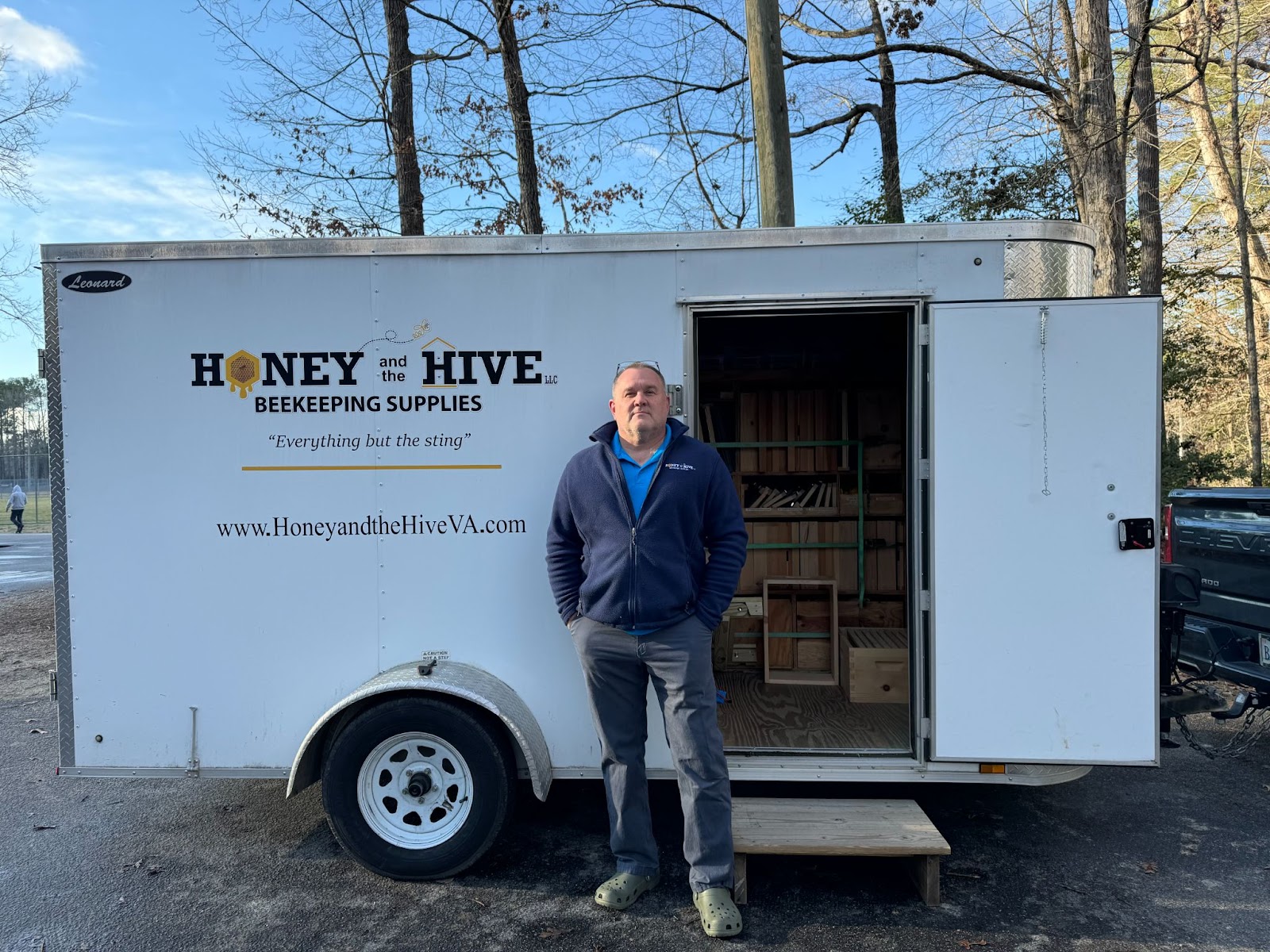
Q: How long have you been a beekeeper and how many hives do you manage?
A:I started keeping bees in 2016. I told the boss I was only going to have two colonies but I ended up buying three nucs and caught several swarms that first year. I also made a few splits and went into my first winter with nine colonies. The obsession has continued to grow since then and at last count, I have more than forty colonies.
Q: What inspired you to become a beekeeper?
A: A friend of mine keeps and he suggested that I start – he said I had a great place to have colonies. The suggestion took a couple years to take root but when it did, I went all in. Later, my mother told me that my grandfather also kept bees but he stopped before I was old enough to remember. So I guess you could say it runs in the family.
Q: What is the best thing about beekeeping for you?
A: It’s hard to pick just one thing. Catching swarms in the spring is a lot of fun and I like making splits and watching them grow into big, productive colonies. In a broader sense though, beekeeping is the perfect blend of several of my interests – the outdoors, gardening, and woodworking.
Q: What’s challenging about beekeeping for you?
A: It depends. (You really didn’t think I was going to pass on an opportunity to say that, did you?)
Queen rearing is a challenging aspect of being a sustainable beekeeper that I enjoy and continue to improve upon. With each grafting cycle I do, I get a little better and learn another nuance that makes my efforts more productive. I keep telling myself that next year might be the year that I’ll sell queens. Maybe 2024 will be the year.
Another challenge has been staying on the treatment-free path while continually hearing it can’t be done. I have been treatment-free since I started keeping. And aside from the three nucs I bought my first year and some queens I’ve purchased for genetic diversity, I don’t buy bees – I catch swarms and propagate from my survivors. After years of doing this, my overwinter losses are usually less than ten percent.
Q: What fun, surprising story would you like to share?
A: I already mentioned that my grandfather kept bees. He was also a woodworker and used lumber he harvested from the family farm in Madison County, VA. When he passed, I got quite a bit of this lumber. One of my first beekeeping-related woodworking projects was an observation hive for my garage made from this 60 to 70 year old walnut and cherry. I put a swarm in it in May of 2016 and with the exception of a four-day period in 2018, it has been continuously occupied. It’s Bee TV and a bee vending machine all in one.
Q: In what ways do you feel like you are making an impact on the environment?
A: On a very local scale, I’d like to think that I’ve had positive impacts on both the number of pollinators in the area as well as the forage that’s available for them. And as a result of our beekeeping supply business Honey and the Hive, I have had many opportunities for community outreach and education promoting beekeeping throughout the greater Richmond area.
📰Beekeepers in the News
Huge shout out to Mr. C, who provided snacks for the 1st session of the Beginning Beekeeper class. This thoughtful gesture was very much appreciated. Teamwork makes the dream work.
Hollee was recently featured on Channel 12 news talking about writing, teaching and beekeeping. https://www.12onyourside.com/video/2024/02/16/dr-hollee-freeman-discusses-writing-teaching-beekeeping/
If you do interesting stuff in the community related to bees, environmental stewardship or anything cool, shoot an email to the Rockwood Club for a feature in the newsletter. rockwood.beekeepers
This Month in the Hive (March)
In March, the days become longer and the queen steadily increases her rate of egg laying. The brood nest will expand and migrate upward into areas where honey has been consumed. The brood nest is now about 6-8 inches across, and may extend across several frames. Look for drone brood along the bottom edges of frames with brood. Remove some drone brood with a cappings scratcher and look for Varroa mites. If you find Varroa in 30% or more of the drone brood cells, perform a mite count, and decide whether to treat for mites.
The hive may consume as much as 7 lbs of nectar and pollen per week (net of inflow) when cold, rain, snow, or icy conditions prevail. Be sure to check for remaining honey and pollen stores. Food stores can run dangerously low until a heavy nectar flow starts. It may be necessary to continue feeding the hive and that the hive is slightly tilted forward to shield rain from the bottom board.
If using a screened bottom board, you should resist the urge to remove the insert. Leave it in until consistent warmer weather arrives in late April. In late March, you may consider reversing the deep brood supers, or the medium supers that some beekeepers use for brood. This will allow for a better distribution of the brood, and stimulate the growth of the colony. If the brood nest extends across the brood supers, do not reverse until there is a large enough population to keep both halves of the brood nest from death due to chilling.
On a sunny day early in the month, when there is little wind and the bees are flying, have a quick look inside the hive. A temperature above 54 degrees should do for this task. Remove frames for a quick inspection. Inspect for disease and see if the queen is laying eggs. Eggs laid in January and February will all be hatched into new workers by mid-late March and the population will be much higher than in January. You may want to add a pollen patty if you have not yet done so but be careful to add a small piece and watch carefully-you don’t want to entice mites.
[From https://buzzwordhoney.com/wp-content/uploads/2012/12/Northern-Virginia-Honeybee-Annual-Cycle.pdf]
Bee in the Know with your Bee Vocabulary – “split”
If you have a large, healthy hive, it is possible to create a new colony from it by making what is called a split. The basic concept of making a split is that you take a portion of an established colony and transfer it to a separate hive thereby creating two colonies. There are many reasons for making a split. Some beekeepers make splits to increase their apiary or to sell to other beekeepers. Others use splits as a form of swarm control, mite control or to reduce the size of a large colony.
Final Word
If you are not a member of RPBBA, we encourage you to join and bee active. You can join on our website. Please participate in meetings and volunteer to help with the Honey Bee Festival.
We are always looking for ways to improve communications in the club. If you have any ideas or suggestions, please let me know.
-Hollee (please excuse any typos-I’m trying to get this out for the weekend:)
Hollee Freeman
Communications
Check us out at rockwoodbeekeepers.com!
Like us on Facebook!
Join our Facebook RPBBA Practical Beekeeping Group!
Keep up with what RPBBA is doing, see Calendar of Events!
*****************************************************************************
This is the official Rockwood Park Backyard Beekeepers email. RPBBA will never share your email with anyone outside of the organization or for non-club-related business without your permission. If you wish to update your email or be removed from our email list please complete this form.
RPBBA Feb 2024 newsletter
Hello beekeepers and honeybee enthusiasts,
February is a busy month full of events for Rockwood Park Backyard Beekeepers. We have the Beginner Beekeeping Class, Honey Bee Festival planning, our monthly club meetings, and the study group all happening in February! Whew!

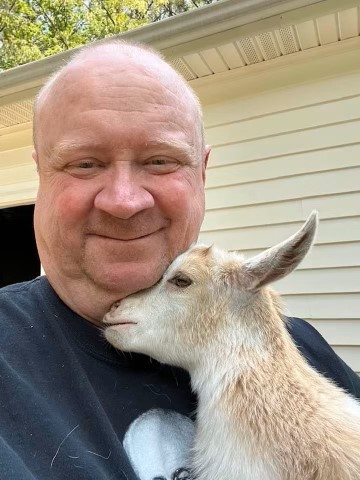
Meet Your Friendly 2024 Bee Club President: Don Osborne
Hello everyone,
I’ve been President of the RPBBA for about a week now and feel like I’m in a whirlwind!
The Honey Bee Festival Committee is meeting and planning, managing an amazing amount of details for our event. This is going to be a banner year for the festival with a new venue that is larger, more accommodating and has a lot more parking. Activating volunteers will be a substantial boost for our club. So, when you get the call, please say “yes, I’ll be glad to help”.
The new beekeeper’s classes are starting soon and one of the struggles is to find enough people to help teach and support the course. So, if you get the text asking you to help, please respond “of course, anywhere I’m needed”.
Our communications director, Hollee does a great job of keeping us informed and she is focused on helping us to get to know each other, so when she sends you an email asking you to be a feature in the newsletter, I hope you reply “absolutely, anything you need”.
When I was asked to be President, my first reaction was to think of a way to say no, surely there are better people for the job. However, I think back to how much this club has helped me keep my bees alive and strong through the seasons. I know that I owe our club more than I could repay with my service.
When I think of the friends I have made and conversations with members, I realize that the club is important. It is important for us as individuals who are trying to keep bugs in a box alive. It is important to our local community because our bees help the gardens and farms produce. It is important to the greater community by helping pollinators and mother nature. Sometimes we need to be reminded of how important the work of our club is.
Finally, I want to thank Stan for his outstanding work and dedication to RPBBA. He is tireless in his work in leadership and keeping our Master Beekeeper Study Group going. I plan on continuing his commitment to education and expanding opportunities for mentoring, teaching and learning for all our members. Thank you for the trust you’ve placed in me. If you have ideas or suggestions, please reach out to me.
Don
🐝 2024 Beginner Beekeeping Course
NOTE: location & time change – for the 1st class
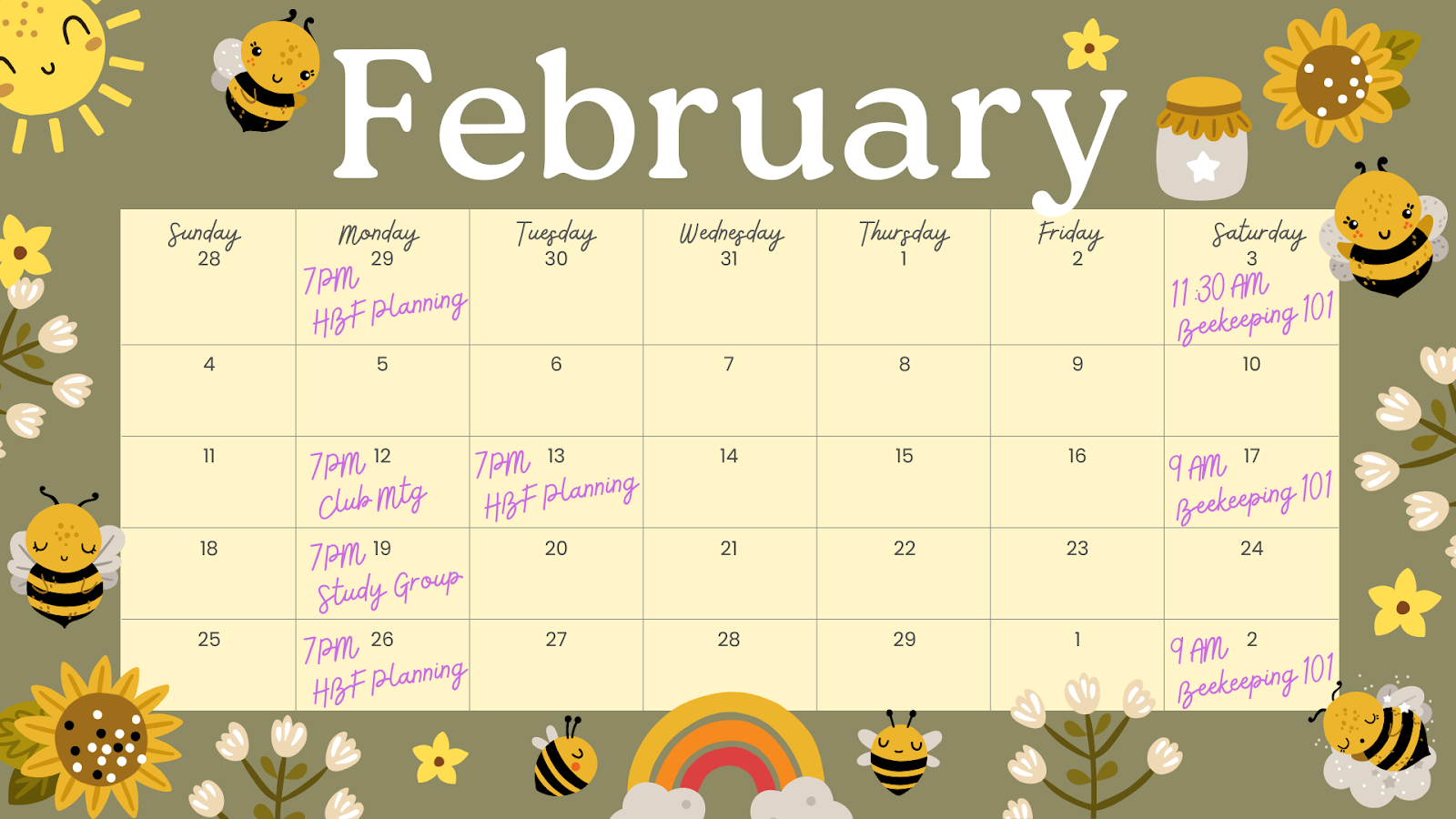
The first session of the 2024 RPBBA Beginner Beekeeping Course will be held on Saturday, Feb 3rd at the North Chesterfield Library (325 Courthouse Road). The class will begin at 11:30 am and end around 4 pm. Please arrive no later than 11:15 to orient yourself to the space and settle in before class.
As a reminder, RPBBA practices reciprocity with the Huguenot Beekeeping Association (HBA). Participants who are unable to make a class at RPBBA, may attend and receive the same instruction at HBA. Both clubs offer the same course on alternating Saturday’s.
2024 Honey Bee Festival Planning
Planning has begun and the date has been set for our 13th annual event (if you did not read the origin story of the RPBBA Honeybee Festival, please check it out in our January 2024 newsletter–it’s an interesting story).
The 2024 Honey Bee Festival will be held
@Chesterfield County Fairgrounds
10300 Courthouse Rd, Chesterfield, VA 23832
June 22nd, 2024, 10AM – 4PM (Note: extended hours compared with past festivals)
The festival continues to grow in popularity and attendance. To this end, we will need additional volunteers. There are many ways to help. Click the link below to see what suits your fancy. We need everything from baking items, volunteering at one of our many stations and/or serving in a leadership role https://forms.gle/vvwUjwffUB8xhuLS9
Thank you in advance for supporting this amazing, educational and fun event.
VSBA Master Beekeeping Study Group
For those who have never checked it out, the study group is a great way for RPBBA members to further their beekeeping knowledge. Several members are studying for the annual VSBA Apprentice and Journeyman exams. However, there is no requirement for attendees to pursue certification. The study group is open to all members who want to learn. During the study group sessions, questions from the VSBA Apprentice Study Guide are posed for the group to discuss and answer together. There is much to learn during open discussion with our peers!
Those interested to attend are encouraged to download the guide in advance and start working through the questions on their own.

Have You Reserved Your Bees For 2024?
Whether you’re a 1st time beekeeper, or looking to replace a colony that didn’t make it through Winter, there are resources for you to source live bees locally.
For those looking to purchase, check out our 2024 Resources for Live Bees & Equipment*. The time is now to start reserving your order(s).
*This is simply a list of local suppliers; RPBBA does not endorse or give preference. Buyers are encouraged to do their own research before making their decision to purchase from any supplier. The Virginia Bee Law requires that honey bees on combs, hives and equipment with combs must be accompanied by a certificate of health issued by the Office of Plant Industry Services prior to being sold in Virginia. For information on this, please visit the VDACS website.
ISO RPBBA Members Willing to Bee a Mentor
A Mentor’s purpose is to help other members with things like installing packages/nucs, in-hive help, capturing swarms or general questions.
With the 2024 Beginner Beekeeping course kicking off in January,we will soon have new-bee’s looking for assistance. If you are a RPBBA member and willing to bee a Mentor, please sign up here. You must be willing to have your contact information shared with other RPBBA members.
The goal is to create a current list of willing mentors, with their general location, to share with those ISO a Mentor near them.
This Month in the Hive (February)
The cluster is still tight on most days. The cluster will break and the bees will move on days where the temperature exceeds 50 degrees F or more. The queen remains in the cluster, and as the days lengthen, she will begin to lay a few more eggs each day. At this point, there are still no drones in the hive and workers will take cleansing flights on mild days.
As the cluster remains centered around the small brood nest, it will migrate upward as the lowest rows of capped brood hatch. The cluster will not quickly move up into new areas of honey after the brood nest forms, and mild days are important to the bees’ ability to move honey/pollen toward the cluster.
Around mid-February, maples begin to blossom and supply nectar and fresh pollen that are extraordinarily valuable to the growth of the hive. The maple blossom continues through mid-March. In areas of higher elevation, the maple blossoms start and end 7-14 days later. The bees will consume about 20 pounds of honey stores and nectar from maples. Alders may bloom in some locations and provide valuable variety in pollen proteins.
Tip: On a day that exceeds 55 degrees, open the hive and quickly check for sufficient food supplies, signs of disease, and to see if the queen is laying. Place a pollen patty near (but not directly on top of) the brood nest. More colonies are probably lost during this time of year than during all other winter months. A colony that is rearing brood will consume about 7 pounds of honey and nectar per week, and if the weather turns bad, a colony with small food reserves can quickly starve to death. Never allow the food stores to drop below 15 pounds. If they have less than 15 pounds of honey, start feeding stored honey or thick sugar syrup (two parts sugar to one part water.) Remember, once you start feeding, you need to continue feeding until the bees no longer consume the syrup, or until the end of April.
Consider whether to sign up for that “Advanced Beekeeper Course.” Attend bee club meetings and get equipment ready for spring. At this time of year, you may be advised to “reverse” the brood boxes on a hive with two brood boxes. It is too early in the year to perform this task with safety, so delay this task until you are confident that warmer weather has arrived. The first week of February may be a good time to add a pollen patty or candy board to a hive that is raising brood. If you enter the hive, you may consider moving a frame of honey from the outside of the hive to an area much closer to the brood nest. Do not place a frame of frozen honey immediately adjacent to the brood nest, however. Let it thaw out first.
Decide now how you are going to deal with the issue of swarms in April, May and June. Read and study the options, and seek advice. Prepare a bait hive now if you are going to use it later in the spring. If you are going to use more equipment to hold queen cells and deal with swarms, then take steps to obtain that equipment. https://buzzwordhoney.com/wp-content/uploads/2012/12/Northern-Virginia-Honeybee-Annual-Cycle.pdf]
Bee Vocabulary – “Pheromones”
Did you know that the Queen gives off pheromones to prevent workers from developing ovaries?!
The queen regulates the goings-on of the colony by emitting chemical blends (pheromones) from her mandibular glands (saclike glands located inside the head above the base of the mandible). The queen’s pheromones are often called the ‘queen signal’. The queen signal is a primer pheromone that keeps the colony in homeostasis (e.g. worker cohesion, inhibition of worker reproduction, and stimulation of worker activities).
When the queen is weak or dies, the low/no pheromonal signal drives workers to rear new queens. If there’s no young brood present in the colony, the workers become disorganized, stop doing their tasks and begin laying unfertilized eggs. The colony becomes unclean and more susceptible to diseases and prey. The hive population dwindles and in most cases, is doomed.
Beekeepers in the News
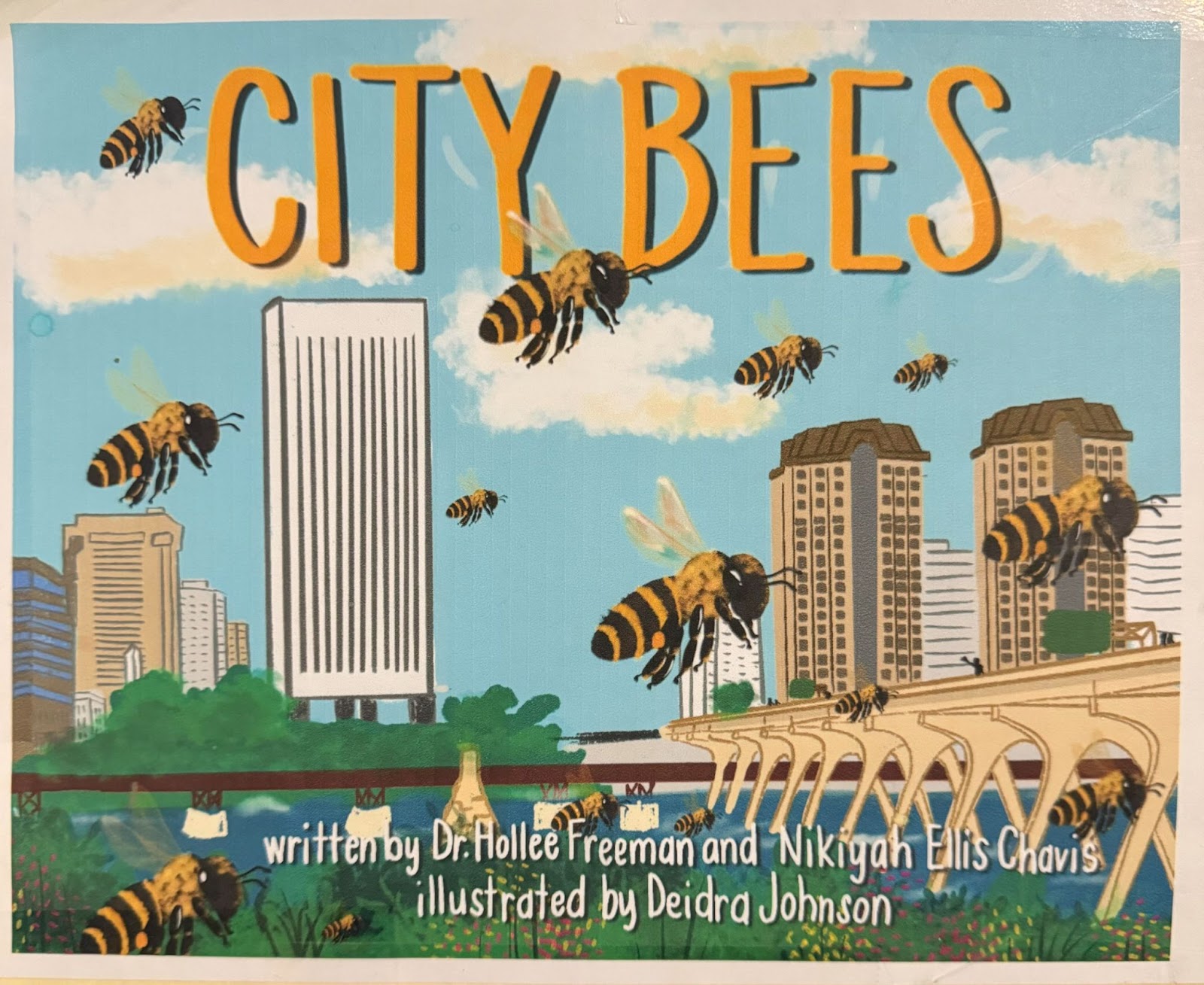
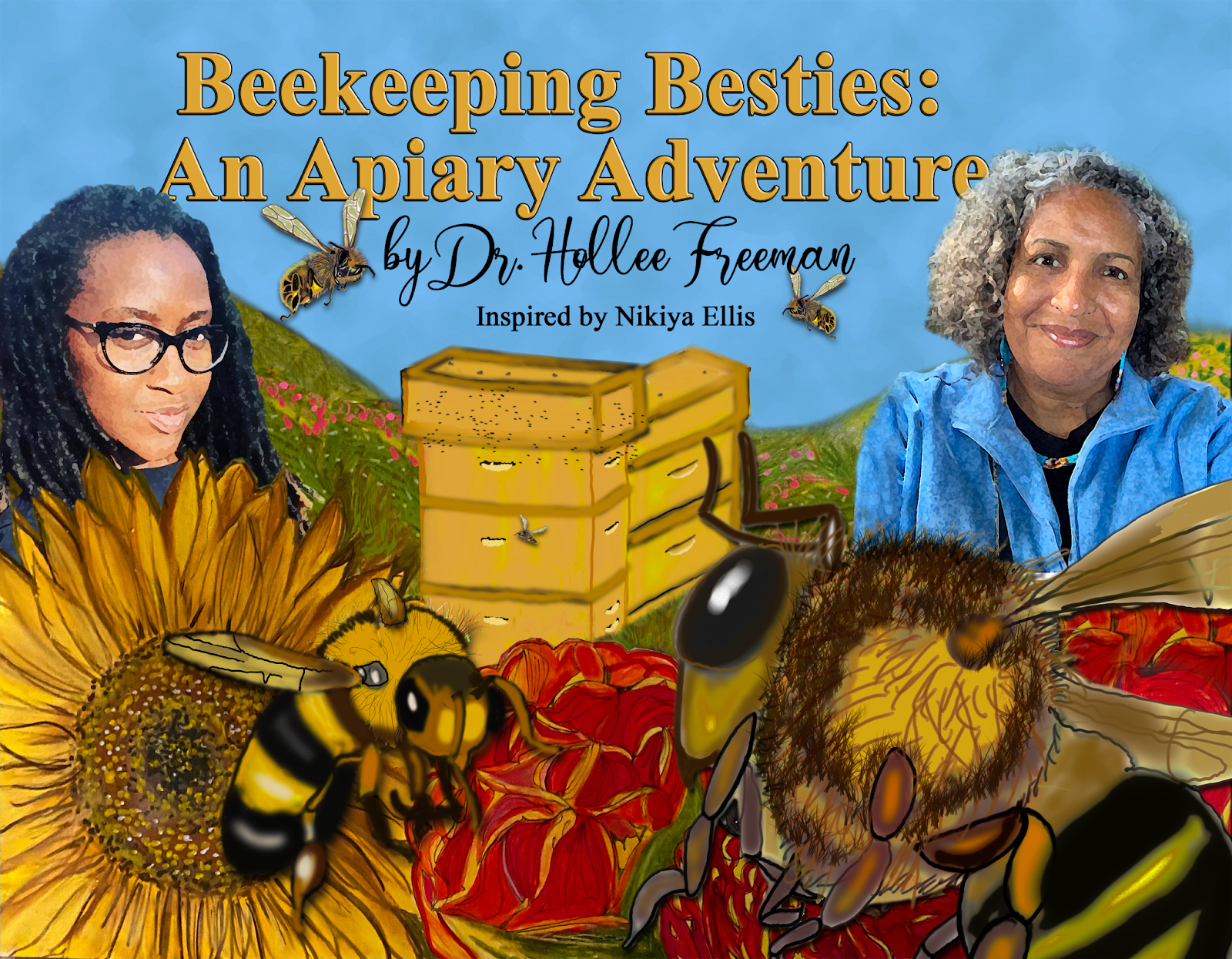
Hollee will be featured live on Channel 12 (12 About Town) on Friday, February 6th at…12 noon! She will talk about her children’s book, Beekeeping Besties: An Apiary Adventure, as well as her new book, City Bees.
Huge Thanks
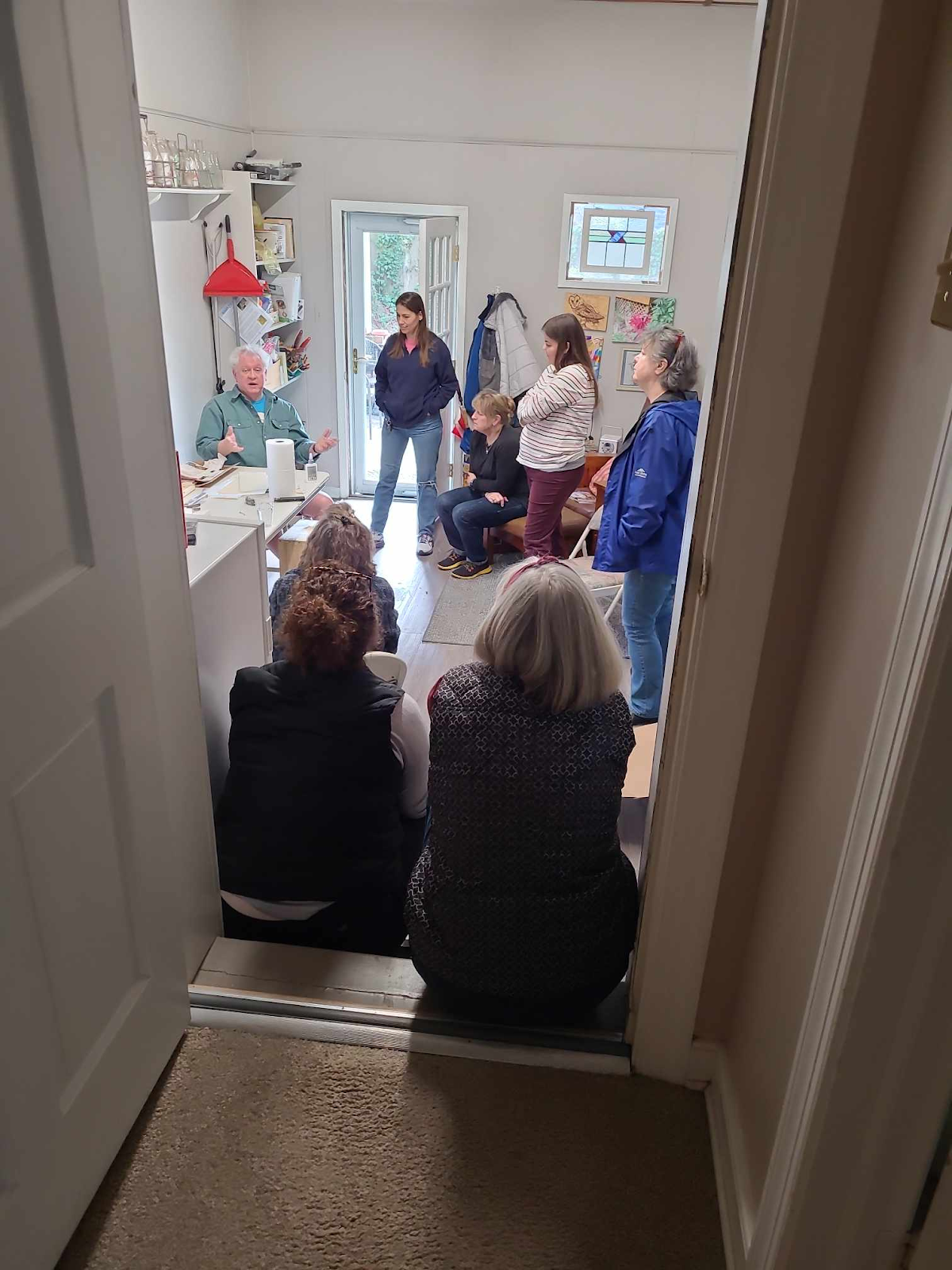
Rick McCormick would like to thank everyone who helped out with his hives while he was recuperating from knee surgery. We all know Rick and one thing is for sure…he is going to keep educating and sharing about honeybees. Recently, Rick had a group of bee students at his house for a potluck lunch & learning. 😀
Final Word
Thanks to everyone who talks with individuals, as well as, in small and large groups about beekeeping. Every little bit helps people understand the importance of honeybees in our ecosystem and just may encourage folks to become part of the beekeeping community or become bee-friendly in their gardens.
If you are not a member of RPBBA, we encourage you to join and bee active. You can join on our website. We are always looking for ways to improve communications in the club. If you have any ideas or suggestions, please let me know.
With February full of events,we will probably see a lot of each other!
Hollee Freeman
Communications
Check us out at rockwoodbeekeepers.com!
Like us on Facebook!
Join our Facebook RPBBA Practical Beekeeping Group!
Keep up with what RPBBA is doing, see Calendar of Events!
*****************************************************************************
This is the official Rockwood Park Backyard Beekeepers email. RPBBA will never share your email with anyone outside of the organization or for non-club-related business without your permission. If you wish to update your email or be removed from our email list please complete this form.
RPBBA Jan 2024 Newsletter
Hello everyone,Please enjoy the 1st newsletter of the year!
There’s a special feature on the origin of the club.
Happy Reading!
-Hollee
Happy New Year beekeepers!
We have had some ups and downs with the weather. Hopefully everyone’s bees are hanging in there! In the event that some hives didn’t make it, don’t fret, there will be plenty of opportunities to begin again. Several club members will be selling nucs and queens as the spring approaches. There are also quite a few conferences, classes and other events on tap to get us ready for spring. Bring it on!
Meeting Dates (all meetings are held at the Rockwood Park and Nature Center
📅 Monday, Jan 8th – Club Meeting @ 7pm (come early to socialize)
📅 Monday, Jan 15th – Study Group @ 7pm
2024 Beginner Beekeeping Course
The Rockwood Park Backyard Beekeepers Association (RPBBA) is holding their annual Beginning Beekeeping Course over 4 Saturdays (02/03, 02/17, 03/02 and 03/16).
Attendees will receive instruction on the
🐝History, Hive organization & location, 🐝Woodenware and equipment,
🐝Dynamics of the Colony, 🐝Diseases, Pests and Predators,
🐝Getting Started, 🐝The Beekeeping Year, 🐝Floral Sources, and 🐝Bee Field Day (hands-on apiary day)
Participants who are unable to make a class at RPBBA, may attend and receive the same instruction at Huguenot Beekeepers Association, which has classes on alternating Saturdays.
The cost is $105 through Jan12th and $120 thereafter. We are limited to 40 participants (we currently have 26 individuals registered). Registration includes 3 books and a 1-year membership to RPBBA. For more information, including a signup form, please see our website https://rockwoodbeekeepers.com/beginner-beekeeping
2024 BOD Announcement
RPBBA would like to extend a huge debt of gratitude for the outgoing BOD members:
Dennis Marshall, Steve Syrett, Kyree Tanner, and Rick McCormick.
The 2024 is comprised of:
Stan Houk (immediate past president), Sherry Kelley, Theo Hartmann, Don Osborne, and Jody Conway.
As per the recent election, Bill Crouch, Will Wagoner, and Hollee Freeman will join the Board as new members.
The BOD will meet this week to appoint club officers.

Have You Reserved Your Bees For 2024?
Whether you’re a 1st time beekeeper, or looking to replace a colony that didn’t make it through Winter, there are resources for you to source live bees locally.
For those looking to purchase, check out our 2024 Resources for Live Bees & Equipment*. The time is now to start reserving your order(s).
*This is simply a list of local suppliers; RPBBA does not endorse or give preference. Buyers are encouraged to do their own research before making their decision to purchase from any supplier. The Virginia Bee Law requires that honey bees on combs, hives and equipment with combs must be accompanied by a certificate of health issued by the Office of Plant Industry Services prior to being sold in Virginia. For information on this, please visit the VDACS website.
ISO RPBBA Members Willing to Bee a Mentor
A Mentor’s purpose is to help other members with things like installing packages/nucs, in-hive help, capturing swarms or general questions.
With the 2024 Beginner Beekeeping course kicking off in January,we will soon have new-bee’s looking for assistance. If you are a RPBBA member and willing to bee a Mentor, please sign up here. You must be willing to have your contact information shared with other RPBBA members.
The goal is to create a current list of willing mentors, with their general location, to share with those ISO a Mentor near them.
Heart of Virginia Beekeepers 2nd Annual Conference
The Heart of Virginia Beekeepers are hosting their second annual beekeeping conference on January 13th at Hampden-Sydney College in Farmville.
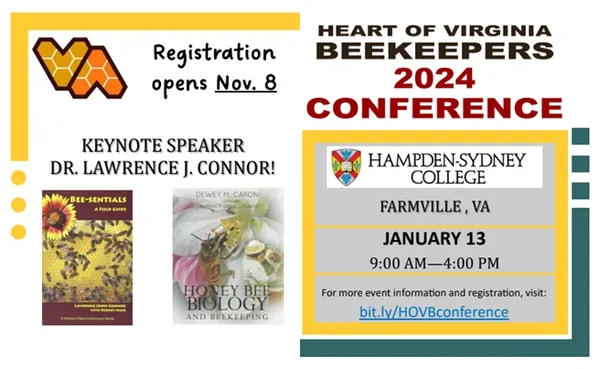
For more information, including registration, visit The Heart of Virginia Beekeepers

Meet Your Friendly Neighborhood Bee Club: Origin story RPBBA

In a season of new beginnings, let’s take a look at how the Rockwood Park Backyard Beekeepers Association began. (As you read, try to ignore any typos and remember that these memories may be a little dusty and may not be 100% accurate. Thank you Kristi, Gene and Jody for helping me piece together this important piece of our club’s history 🙂
Krisit Orcutt was the Interim Nature Center Manager at the Rockwood Park Nature Center circa 2007. At that time, the nature center had a plethora of snakes on exhibit and more than a few people walked out when they were face-to-face with snakes as soon as they entered. Kristi knew that although education and conservation about snakes was important, the nature center needed much more than snake exhibits to draw people in.
At the same time, a local beekeeper reached out to Kristi asking if she would consider teaching beekeeping classes. She said yes and the rest, they say… is history. In order to teach the classes effectively, Kristi became a beekeeper. Around this time there was a lot of interest in the importance of honeybees, agriculture, and pollination. Kristi and her colleagues connected these themes in their messaging about nature. They wanted lay people to enjoy interactions with nature in their own yards by helping the community know more about the role that honeybees have in the ecosystem and in plant reproduction.
Around 2008, the economic downturn impacted Chesterfield – so much so that the county eliminated nature and outdoor recreation programs. This made the need for a bee club which provided educational and community- focused programs even more important.
During this time, the Rockwood Park Backyard Beekeepers Association was born under the leadership of an experienced beekeeper, Ken Woodard and a few members: Chris Buck, Stacey Taffer, Mason, Kenny, Wilhelm G. and Kristi. Dave Peebles followed Ken as the 2nd president and the club began to hold classes in addition to the meetings. The first “tour de hives” was born and according to Kristi, it was “best thing we ever did” at the time. Also, the Honey Bee Festival began around this time.
Still the county was in an economic downtown and the nature center staff were told that the center was going to close. Kristi and her colleagues started a friend’s group completely (separate from the bee club). They made proposals to the Chesterfield Board of Supervisors to continue to run the nature center using their own funds with minimal support from the county. Thankfully, they were allowed to do so. This is when they put in an observation hive.
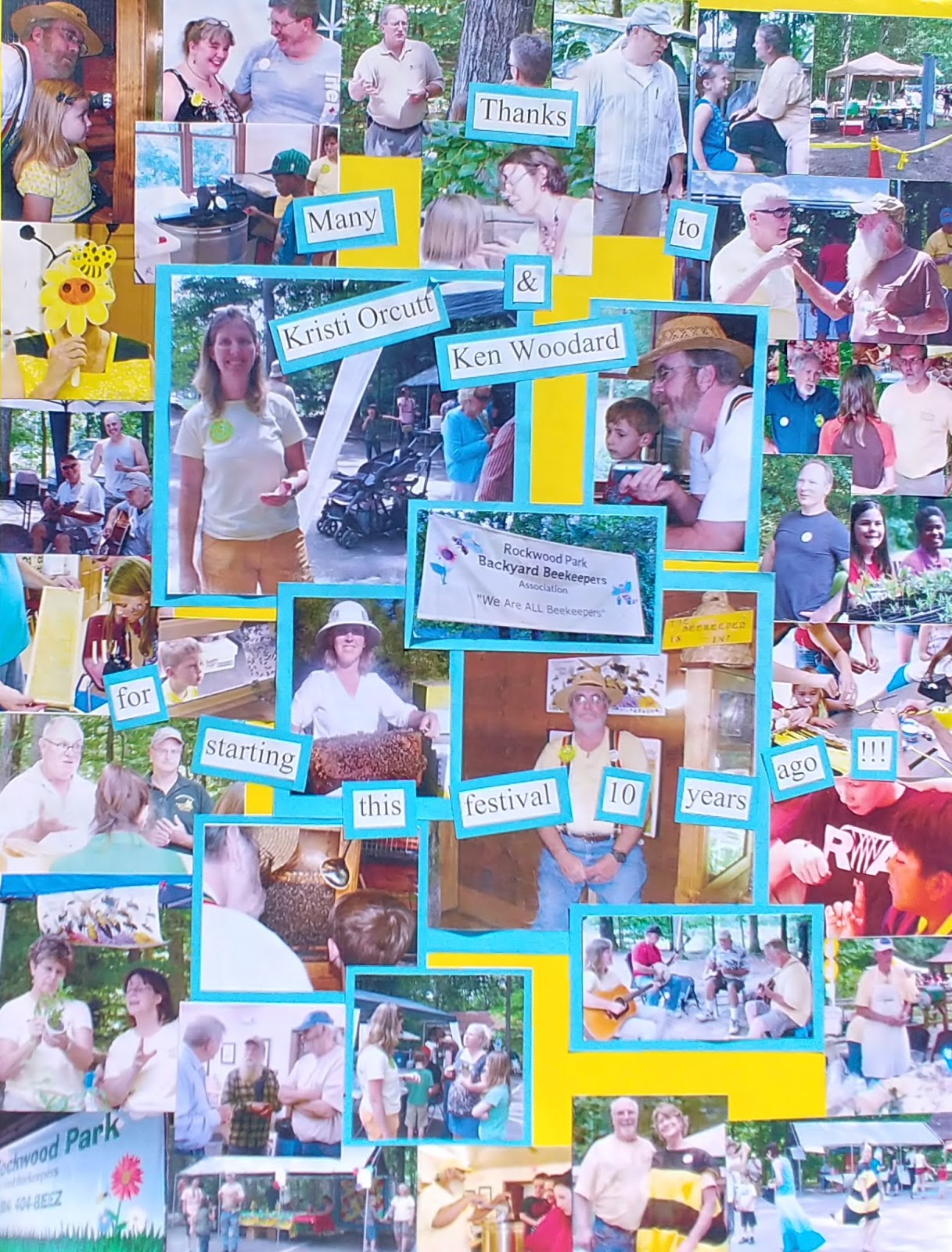
From that experience the club exploded. Gene DiSalvo, Sarah Buckley, Paul and Jan Edens joined. The club began to host more classes and John Davis became involved. Kristi met Stan and Carla while she sold honey at Boulevard Flowers in Colonial Heights. One day Carla whispered to Kristi that she wanted bees and a beehive for Stan for Christmas because his father kept bees. This is how Stan started with bees and the bee club and he hasn’t stopped yet! Jody came to the second class and Kristi recalls thinking that the club was in good hands with this group of folks.
As Kristi recounts, the RPBBA started out to make a connection with people in Chesterfield. It was a diverse group of people – from preppers to right wing fundamentalists to left-wing liberals and everything in between! Somehow all these folks were able to be friends despite all the other things that would normally divide them. The pretext of the club was and continues to be a place where everyone is welcome, where any newbie can ask a question without being embarrassed or shamed or talked down by the more experienced beekeepers.
Another tenet of the club was mentoring. It was expected that members mentor one another and as Stan often says, act like a honey bee hive. Additionally, the founders dreamt that RPBBA would collaborate with other clubs and create a uniformity of messaging for classes and that newbies were invited to teach subsections of the beekeeping classes to learn more under the tutelage of an experienced beekeeper. As Kristi recalls, Jody was one of our first victims, ahem…student teachers.
RPBBA continues to strive to be a place that embraces beekeepers of all levels. Currently, the club currently has 152 members. Let’s keep the dream alive as we connect and educate the community all while getting to know each other in the process.
This Month in the Hive (January)
This month the queen is surrounded by thousands of workers. She is in the midst of the winter cluster, where the temperature at the center is about 88 degrees F. At the periphery of the cluster, the temperature will drop to 42 degrees on the coldest nights. The worker bees continuously move in and out of the center of the cluster. The bees in the cluster flex their wing and thorax muscles to generate heat, and they consume honey that was stored in the previous year.
The cluster will continuously move upward into new honey if it is available. On a day that reaches 45 degrees or more in the hive, the bees may be able to move the cluster upward or horizontally into new honey, or they may be able to move honey toward the cluster from other parts of the hive. On a warm day (50 degrees or more) the worker bees will leave the hive to take a cleansing flight, during which they defecate away from the hive. The workers will wait weeks for a warm day if necessary before flying.
The queen will usually begin laying a small number of worker eggs in the 3rd full week of January (about 28 days after the winter solstice), and some worker brood will begin to appear at the center of the cluster at that time.
Food Consumption & Storage
A strong hive may consume 15-20 lbs of honey in January if the weather is consistently cold or wet. Stored pollen will be in demand in the hive after brood rearing commences in the third full week. On a warm day, a few bees may fly out and collect small amounts of pollen from witch hazel and winter aconite. Bees may visit a gardenia in bloom in a garden. These pollen sources are miniscule compared to the bounty waiting later in the year.
Events to Watch For in the Hive
If there is heavy snow, make certain the entrance to the hive is cleared to allow for proper ventilation. Check the weight of the hive by placing one hand under the back of the bottom board and lifting it up. If it feels as if most of the honey is gone, you may need to start feeding the hive this month. Once you start feeding, you must continue feeding until the bees are gathering pollen and nectar on their own. Unless you are confident that a hive is starving, do not open a hive at less than 55 degrees Fahrenheit (without wind chill.)
Tasks to Be Performed
This is a great time to catch up on reading those bee books you received as holiday gifts, or that you requested on inter-library loan. Don’t forget to attend your next club meeting and start ordering, assembling, and repairing the equipment you might need for this coming season. If you have not done so, go ahead and order that package of bees or a nucleus hive, if needed, from a reputable supplier.
[From https://buzzwordhoney.com/wp-content/uploads/2012/12/Northern-Virginia-Honeybee-Annual-Cycle.pdf]
Bee Vocabulary – “torpor” as in: I’m not dead (yet), I’m just in torpor.
Friends, please resist the temptation to knock on the outside of your hives to see if they are alive. Torpor is a natural state of decreased physiological activity. By knocking on your hives, you will disrupt their torpor state and you may just kill them off without even knowing it. Here are some interesting nuggets to keep in mind:
-
Honeybees keep the hive temp in the cluster btw 54-57 degrees F.
-
When you knock on the hive, the temp rises to about 80 degrees for about 5+ hours.
-
Approx ½ cup of food stores are needed to maintain this temp.
We want our ladies to waste their valuable energy during these cold months. So…buy an inexpensive stethoscope if you feel the overwhelming urge to listen for activity OR just be patient. Spring is coming.
Final Word
If you are a member of RPBBA, don’t forget to pay your dues. The amount is miniscule compared to the vast array of knowledge from mentors, study groups and meetings. If you are not a member of RPBBA, we encourage you to join and bee active. You can join on our website. If you are a honeybee enthusiast looking to get started, check out the Beginner Beekeeping course. It’s worth its weight in gold.
We are always looking for ways to improve communications in the club. If you have any ideas or suggestions, please let me know.
Hollee Freeman
Communications
Check us out at rockwoodbeekeepers.com!
Like us on Facebook!
Join our Facebook RPBBA Practical Beekeeping Group!
Keep up with what RPBBA is doing, see Calendar of Events!
*****************************************************************************
This is the official Rockwood Park Backyard Beekeepers email. RPBBA will never share your email with anyone outside of the organization or for non-club-related business without your permission. If you wish to update your email or be removed from our email list please complete this form.
 Rockwood Park Backyard Beekeepers